No-Confidence Against the Speaker Latest News
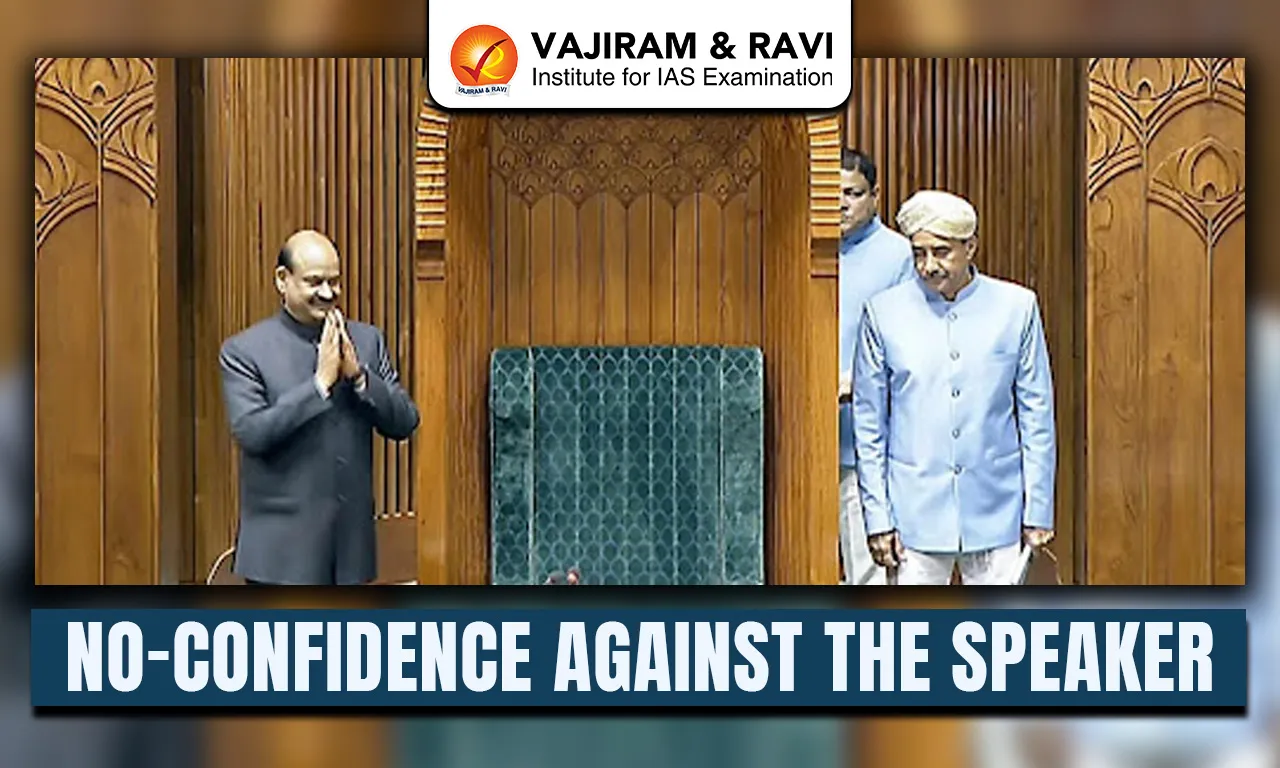
- The Opposition has moved a no-confidence motion against Om Birla, the Lok Sabha Speaker. Parliamentary sources said the motion will now be examined and processed as per established rules.
- The move follows criticism from the Congress and other parties, who accused the Speaker of not permitting the Leader of Opposition to quote from or discuss former Army Chief M M Naravane’s unpublished memoir.
- The Opposition also objected to the Speaker’s claim that PM Modi could have been attacked inside the House, calling it unwarranted and contentious.
Removal of the Lok Sabha Speaker: What the Constitution Allows
- The Lok Sabha Speaker (or Deputy Speaker) can be removed from office, but only through a strict constitutional process.
- Under Article 94(c) of the Constitution, removal is possible by a resolution passed by a majority of all the then members of the Lok Sabha.
- The provision applies only to the Lok Sabha, not the Rajya Sabha, and the procedural requirements are stringent, reflecting the high threshold set for removing the presiding officer of the House.


When Does the Lok Sabha Speaker or Deputy Speaker Vacate Office
- Article 94 of the Constitution lays down the conditions under which the Speaker or Deputy Speaker of the Lok Sabha vacates office:
- Cessation of membership (Article 94(a)): They automatically vacate office if they cease to be a member of the Lok Sabha.
- Resignation (Article 94(b)): They may resign at any time by submitting a written resignation.
- Removal by resolution (Article 94(c)): They can be removed through a Lok Sabha resolution passed by a majority of all the then members of the House.
- These provisions ensure both stability and accountability of the presiding officers.
Procedure to Remove the Lok Sabha Speaker or Deputy Speaker
- A member seeking removal must submit a written notice to the Secretary-General of the Lok Sabha.
- The notice may be jointly signed by two or more members, but the resolution cannot be moved unless at least 14 days’ notice is given.
- After receipt, a motion for leave to move the resolution is listed in the List of Business in the members’ names.
- The date fixed must be any day after the 14-day notice period, following which the House may consider the motion as per rules.
Past Precedents of No-Confidence Motions Against Lok Sabha Speakers
- No-confidence motions have been moved against the Lok Sabha Speaker on three occasions—in 1954, 1966, and 1987.
- For such a motion to proceed, it must be supported by at least two Members of Parliament, and 50 members must stand in support, fulfilling the House’s quorum.
- The procedure is governed by Rules 200–203 of the Rules of Procedure and Conduct of Business in Lok Sabha.
- Historically:
- 1954: G V Mavalankar, the first Speaker, faced a motion
- 1966: Motion against Hukam Singh
- 1987: Motion against Balram Jakhar
- In all three cases, the motions failed, and none of the Speakers were removed from office.
Guidelines Governing a No-Confidence Motion Against the Speaker
- Under Rule 200A of the Rules of Procedure and Conduct of Business in Lok Sabha, a no-confidence motion against the Speaker must meet strict content and conduct requirements.
- The resolution must be specific in its charges, clearly and precisely worded, and free of arguments, inferences, ironic expressions, imputations, or defamatory statements.
- Additionally, once the motion is admitted for discussion, the Member(s) who submitted it are not permitted to make a speech, underscoring the procedural rigor governing such motions.
What Follows If a No-Confidence Motion Is Admitted
- If a no-confidence motion is admitted, members supporting it must rise in their places.
- If at least 50 members stand, the presiding officer declares that leave is granted and schedules the motion for a day within 10 days.
- If fewer than 50 members rise in support, the presiding officer declares that the member “has not the leave of the House”, and the motion does not proceed further.
- Additionally, any resolution for the removal of the Speaker or Deputy Speaker submitted without the required notice is not taken up, ending the process at the preliminary stage.
- On the appointed day, the resolution is listed in the business of the House and taken up for discussion.
- The mover(s) may be allowed to speak for up to 15 minutes, subject to the presiding officer’s permission. The debate must be strictly confined to the charges stated in the resolution.
Speaker’s Role During Consideration of Removal Motion
- While a removal motion is under discussion, the Speaker continues in office and, as a Member of the Lok Sabha, retains the right to participate and speak in the proceedings.
- The Speaker is entitled to vote in the first instance on the resolution or related matters, but cannot exercise a casting vote in the event of a tie.

 Last updated on Oct, 2026
→ UPSC 2027 Notification will be released on 13 January 2027 at upsconline.nic.in.
→ Check Nobel Prize 2026 Winners List here.
→ Download PIB PRiSM Monthly Magazine 2026 here.
→ Check UPSC Monthly Current Affairs Magazine The Recitals here.
→ Check out the latest UPSC Syllabus here.
→ Download UPSC Model Answers for Mains 2026
→ UPSC Mains Question Paper 2026 is out now for Essay & GS Paper 1, 2, 3 & 4.
→ UPSC Calendar 2027 has been released.
→ Enroll in Vajiram & Ravi’s UPSC Mains Test Series 2027 for structured answer writing practice, expert evaluation, and exam-oriented feedback.
→ Join Vajiram & Ravi’s UPSC Mentorship Program 2027 for personalized guidance, strategy planning, and one-to-one support from experienced mentors.
→ Go through the UPSC Mains Previous Year Papers to enhance your preparation.
→ UPSC has released UPSC Toppers List 2025 with the Civil Services final result on its official website.
→ Also check Best UPSC Coaching in India
No-Confidence Against the Speaker FAQs
Q1. What triggered the No-Confidence Against the Speaker?+
Q2. What constitutional provision governs No-Confidence Against the Speaker?+
Q3. What procedural requirements apply to No-Confidence Against the Speaker?+
Q4. Has No-Confidence Against the Speaker occurred earlier?+
Q5. What happens if No-Confidence Against the Speaker is admitted?+
Tags: mains articles No-Confidence Against the Speaker upsc current affairs upsc mains current affairs