Strait of Hormuz Latest News
- International oil prices have climbed to a six-month high amid rising US-Iran tensions and fears of potential American military strikes on Tehran. Although recent nuclear talks in Geneva showed limited progress, no concrete breakthrough has emerged to ease concerns.
- The US has increased its military presence in the region, and President Donald Trump’s statement giving Iran 10–15 days to agree to a “meaningful deal” has been widely viewed as an ultimatum, intensifying market anxiety over possible supply disruptions.
Strait of Hormuz: A Critical Chokepoint
- Oil markets are nervous that any US military action against Iran could disrupt supplies from the Gulf, which dominates global exports.
- Brent crude has already risen above $71 per barrel, up over 12% in a month, reflecting market anxiety.
- Future price movements hinge on whether the US undertakes military action and how Iran responds.
- Prices could ease if diplomacy prevails, or spike sharply—possibly into triple digits—if conflict escalates regionally.
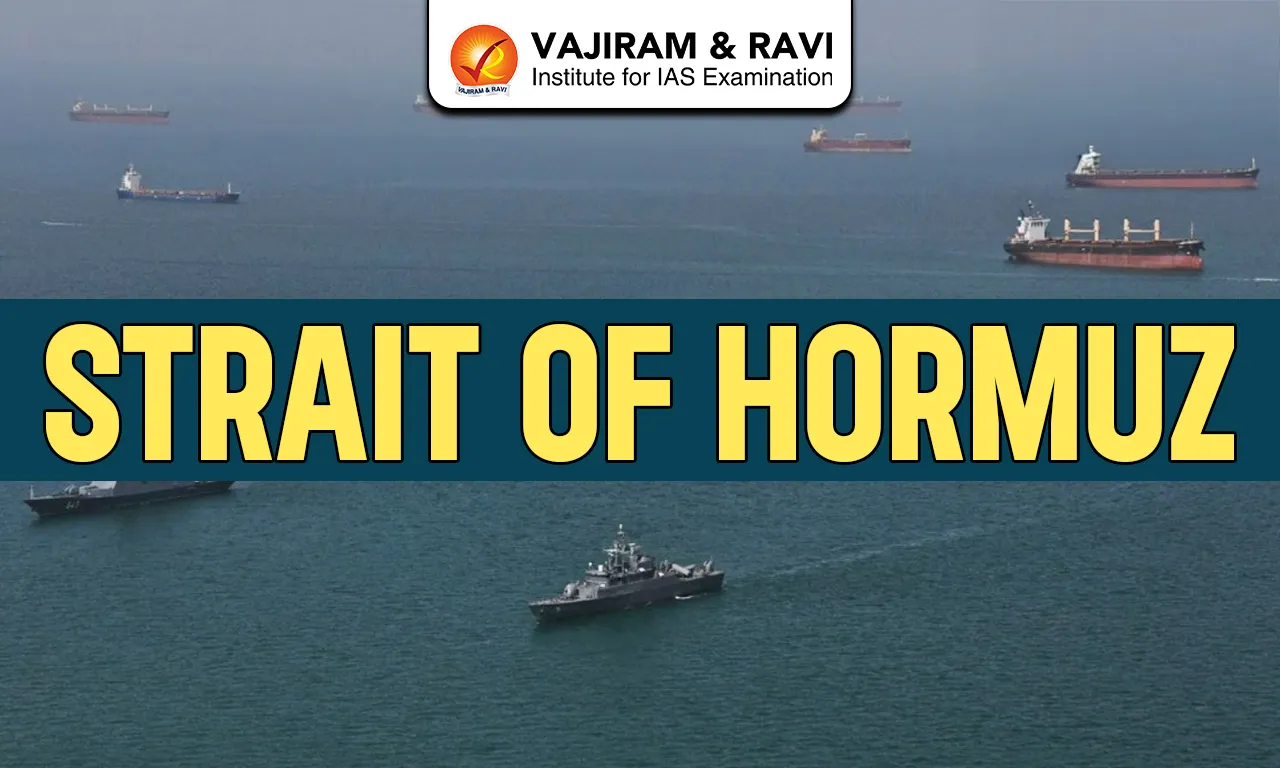
- The key concern is the Strait of Hormuz, a vital transit route for global oil and gas. If Iran blocks or disrupts the strait, energy flows could be severely affected.
- Major producers such as Saudi Arabia, Iraq, the UAE, and Kuwait depend heavily on Hormuz for exports.
- Despite strained ties with Tehran, Gulf nations are engaging diplomatically to prevent escalation.


Implications for India
- Rising Import Bill – India imports around 2 billion barrels of oil annually. Every $1 rise in crude prices adds roughly $2 billion to its annual import bill.
- Strategic Vulnerability – Over 40% of India’s crude imports pass through the Strait of Hormuz. As the world’s third-largest oil consumer, meeting more than 88% of its needs through imports, India faces significant energy security risks if supplies are disrupted.
Strait of Hormuz: The World’s Key Energy Chokepoint
- Described by the US Energy Information Administration as the most important oil transit chokepoint, the Strait of Hormuz handles nearly one-fifth of global petroleum consumption and LNG trade.
- Around 15 million barrels of crude and 20% of global LNG volumes pass through it daily, linking the Persian Gulf to global markets.
Escalation Risks and Limited Alternatives
- With US-Iran tensions rising, oil markets fear disruptions not just to Iranian supplies but to wider Gulf exports.
- Though some bypass pipelines exist, their capacity is limited. Even at full use, about 9 million barrels per day—around 9% of global demand—would remain vulnerable during a major conflict.
- Iran has repeatedly threatened to block the strait or target tankers.
- Additionally, proxy attacks from Yemen on vessels in the Bab el-Mandeb—another critical chokepoint connecting the Red Sea to the Arabian Sea—pose further risks to global energy flows.
Strait of Hormuz: Blockade Risks and Strategic Calculations
- Although Iran often threatens to close the Strait of Hormuz, analysts say a complete blockade would be self-defeating.
- It could alienate China—its key oil buyer—strain ties with Oman, and invite international military retaliation.
- Despite these deterrents, risks persist. If Tehran feels existentially threatened, it may escalate.
- Any disruption in this globally critical energy corridor would sharply raise oil prices and damage the fragile global economy.
Oil Price Scenarios if Conflict Escalates
- Limited Disruption: Iranian Shipments Targeted – If the US or Israel disrupts Iranian oil exports alone, analysts project oil prices might rise by around $10–$12 per barrel as buyers like China seek alternative supply sources.
- Strait of Hormuz Disruption – If Iran moves to throttle oil flows through the Strait of Hormuz—a chokepoint for roughly 20% of global oil and LNG trade—prices could exceed $90 per barrel.
- Attacks on Iranian Oil Facilities – Should military action target Iranian refineries, platforms, or terminals and keep Iranian supply off the market for longer, oil prices could top $100 per barrel amid broader escalation risk.
- Broad Regional Conflict – In the worst case, if Iran directly attacks major Arab Gulf oil infrastructure or the conflict spreads, prices could surge past $130 per barrel, rivaling spikes seen after major geopolitical shocks.
- Strategic Dilemma for Policymakers – Leaders face a challenge: confronting Iran may risk supply disruptions and sharp price spikes, while restrained action could embolden adversaries—making oil market volatility a key strategic variable.
Source: IE

 Last updated on August, 2026
→ UPSC Mains Question Paper 2026 is out now for Essay & GS Paper 1, 2, 3 & 4.
→ UPSC Mains GS Paper 1 2026 is out now.
→ UPSC Mains GS Paper 2 2026 is out now.
→ UPSC Mains GS Paper 3 2026 is out now.
→ UPSC Mains GS Paper 4 2026 is out now.
→ UPSC Mains Indian Language Paper & English Compulsory Paper are out now.
→ Check out the latest UPSC Syllabus 2026 here.
→ UPSC Mains Admit Card 2026 is now out.
→ Enroll in Vajiram & Ravi’s UPSC Mains Test Series 2027 for structured answer writing practice, expert evaluation, and exam-oriented feedback.
→ Join Vajiram & Ravi’s UPSC Mentorship Program 2027 for personalized guidance, strategy planning, and one-to-one support from experienced mentors.
→ Go through the UPSC Mains Previous Year Papers to enhance your preparation.
→ Download UPSC Mains Essay Paper 2025, UPSC Mains GS Paper-I 2025, UPSC Mains GS Paper-II 2025, UPSC Mains GS Paper-III 2025, UPSC Mains GS Paper-IV 2025, UPSC Mains English (Compulsory) Paper 2025, UPSC Mains Hindi (Qualifying) Paper 2025 here.
→ UPSC has released UPSC Toppers List 2025 with the Civil Services final result on its official website.
→ UPSC Calendar 2027 has been released.
→ Also check Best UPSC Coaching in India
Strait of Hormuz FAQs
Q1. Why is the Strait of Hormuz important to global oil markets?+
Q2. How could US-Iran conflict affect oil prices?+
Q3. Why would Iran avoid fully blocking the Strait of Hormuz?+
Q4. What are the risks for India?+
Q5. What are the possible oil disruption scenarios?+
Tags: mains articles strait of hormuz upsc current affairs upsc mains current affairs