Election Commission Latest News
- The Independence of the Election Commission has come under debate following allegations of irregularities in electoral roll revisions and a proposed motion to remove the Chief Election Commissioner (CEC).
Importance of Free and Fair Elections
- Free and fair elections form part of the Basic Structure of the Constitution, as recognised by the Supreme Court in Indira Gandhi vs. Raj Narain (1975).
- Adult franchise under Article 326 guarantees the right to vote to every citizen above 18 years of age, subject to reasonable restrictions.
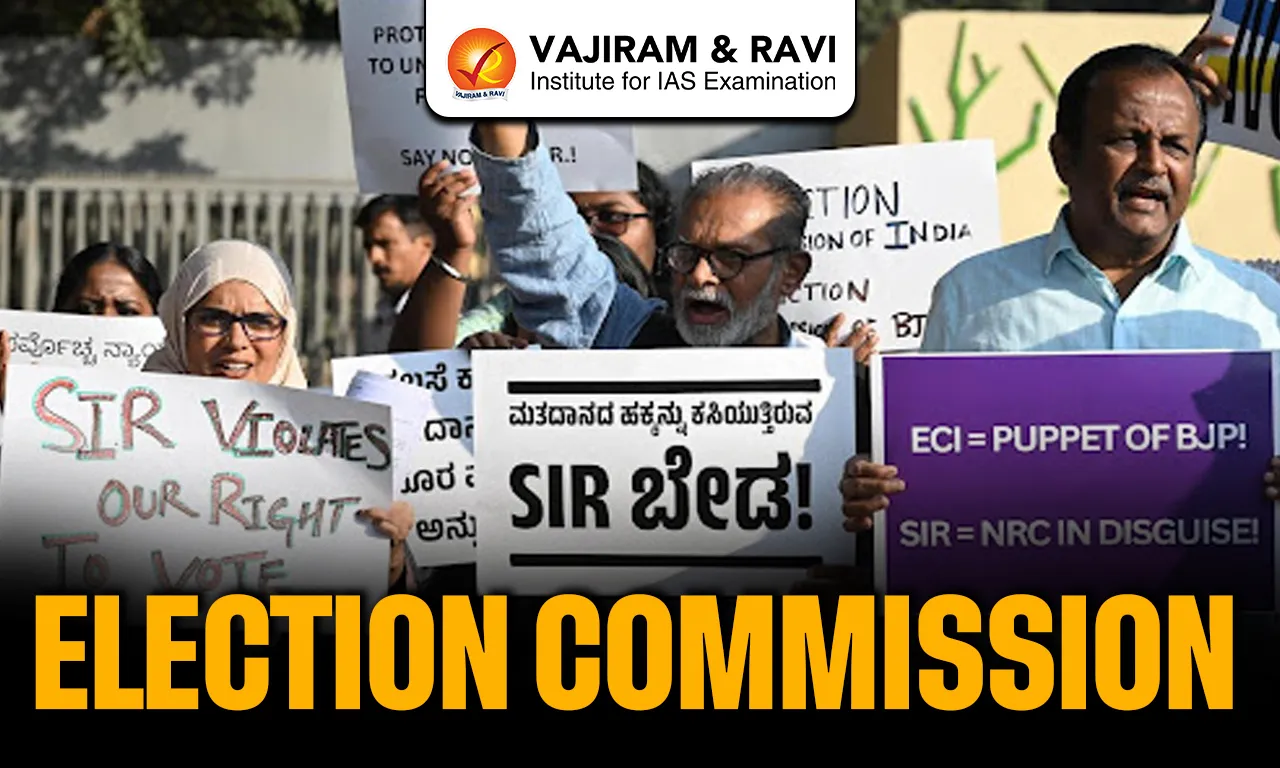
- Recent controversies have revolved around alleged “vote theft” and manipulation of electoral rolls during the Special Intensive Revision (SIR) exercise.
- It has been claimed that lakhs of names were deleted from voter lists in certain States, raising concerns about procedural fairness and the sanctity of electoral democracy.
- Any perceived dilution in the electoral process directly impacts public trust in democratic institutions.


Constitutional Status of the Election Commission
- Article 324 of the Constitution provides for a permanent Election Commission of India (ECI) with powers of superintendence, direction, and control over elections to Parliament, State Legislatures, and the offices of President and Vice-President.
- This constitutional status ensures:
- Institutional permanence
- Autonomy from routine executive interference
- Wide discretionary powers in conducting elections
- The Election Commission may consist of a Chief Election Commissioner and other Election Commissioners. Since 1993, it has functioned as a multi-member body, a structure upheld by the Supreme Court in T.N. Seshan vs. Union of India (1995).
- The CEC acts as the Chairperson of the Commission, and decisions are generally taken collectively.
Appointment of the Election Commissioners
- The appointment process became controversial after the enactment of the Chief Election Commissioner and Other Election Commissioners (Appointment, Conditions of Office and Terms of Office) Act, 2023.
- Under the 2023 Act:
- The CEC and Election Commissioners are appointed by the President.
- A Selection Committee comprising the Prime Minister, a Union Minister, and the Leader of the Opposition recommends names.
- Critics argue that the exclusion of the Chief Justice of India from the Selection Committee weakens institutional independence.
- This change followed the Supreme Court’s 2023 judgment in Anoop Baranwal vs. Union of India, which had temporarily mandated the inclusion of the CJI in the selection panel until Parliament enacted a law.
- The validity of the 2023 Act is currently under judicial scrutiny.
Safeguards for Independence
- The Constitution incorporates strong safeguards to protect the Election Commission from executive pressure.
- Removal of the CEC
- Article 324(5) provides that the CEC can be removed only in the same manner and on the same grounds as a Supreme Court judge under Article 124(4). The grounds are:
- Proved misbehaviour, Incapacity
- The removal process is rigorous and quasi-judicial:
- A motion must be signed by at least 100 Lok Sabha members or 50 Rajya Sabha members.
- The Speaker or Chairman may admit the motion.
- A three-member inquiry committee is constituted, comprising:
- A Supreme Court judge
- A Chief Justice of a High Court
- A distinguished jurist
- The CEC is given the opportunity to defend themselves, ensuring adherence to principles of natural justice.
- Both Houses of Parliament must pass the motion by a special majority.
- Article 324(5) provides that the CEC can be removed only in the same manner and on the same grounds as a Supreme Court judge under Article 124(4). The grounds are:
- Removal of Other Election Commissioners
- Other Election Commissioners can be removed by the President on the recommendation of the CEC. However, the Supreme Court in Vineet Narain vs. Union of India (1997) clarified that such advice should not be arbitrary.
- These mechanisms create a balance between executive oversight and institutional independence.
Special Intensive Revision and Electoral Concerns
- The recent controversy relates to the Special Intensive Revision (SIR) of electoral rolls. Allegations include:
- Large-scale deletion of names from voter lists
- Targeting of specific demographic groups
- Rushed revision processes
- Since electoral rolls form the foundation of democratic participation, any irregularity in revision exercises can undermine public confidence.
- Challenges to such revisions have reached the Supreme Court.
- The issue highlights the delicate balance between administrative efficiency and constitutional guarantees of universal adult suffrage.
Source: TH

 Last updated on Oct, 2026
→ UPSC 2027 Notification will be released on 13 January 2027 at upsconline.nic.in.
→ Check Nobel Prize 2026 Winners List here.
→ Download PIB PRiSM Monthly Magazine 2026 here.
→ Check UPSC Monthly Current Affairs Magazine The Recitals here.
→ Check out the latest UPSC Syllabus here.
→ Download UPSC Model Answers for Mains 2026
→ UPSC Mains Question Paper 2026 is out now for Essay & GS Paper 1, 2, 3 & 4.
→ UPSC Calendar 2027 has been released.
→ Enroll in Vajiram & Ravi’s UPSC Mains Test Series 2027 for structured answer writing practice, expert evaluation, and exam-oriented feedback.
→ Join Vajiram & Ravi’s UPSC Mentorship Program 2027 for personalized guidance, strategy planning, and one-to-one support from experienced mentors.
→ Go through the UPSC Mains Previous Year Papers to enhance your preparation.
→ UPSC has released UPSC Toppers List 2025 with the Civil Services final result on its official website.
→ Also check Best UPSC Coaching in India
Election Commission FAQs
Q1. Under which Article is the Election Commission established?+
Q2. How can the Chief Election Commissioner be removed?+
Q3. What is the Special Intensive Revision (SIR)?+
Q4. What was the controversy regarding the 2023 Appointment Act?+
Q5. Why is the Election Commission’s independence important?+
Tags: election commission mains articles upsc current affairs upsc mains current affairs