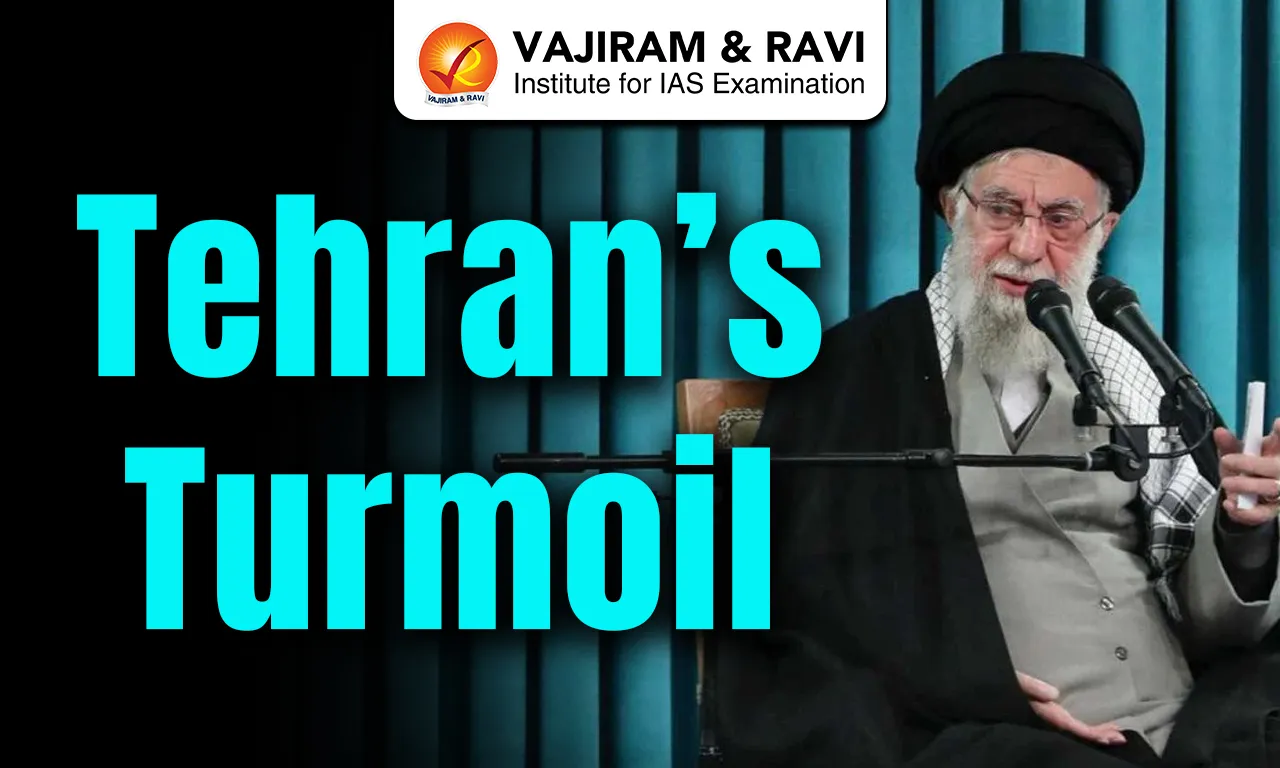
Tehran’s Turmoil Latest News
- The United States and Israel have launched a joint attack on Iran with the stated goal of bringing about regime change in Tehran. The move is seen as an attempt to reverse the 1979 Islamic Revolution.
- The 1979 Revolution reshaped Iran’s political system by establishing religious rule. It also changed the balance of power in West Asia.
- The revolution affected global energy markets and influenced relations among major world powers.


Why the 1979 Revolution Matters
- The Islamic Revolution created a system in which a Supreme Leader holds ultimate religious and political authority.
- Ayatollah Ali Khamenei consolidated this system and suppressed internal dissent.
- The revolution also had an external agenda. Iran sought to export its revolutionary ideology across the Middle East.
- It strongly supported the Palestinian cause and positioned itself as a challenger to the US and Israel. This alarmed both Western powers and conservative Arab monarchies.
The Question of Regime Survival
- The reported killing of Khamenei raises questions about the resilience of the Islamic Republic. The future depends on whether the regime can maintain cohesion after him.
- Iran has witnessed repeated protest movements since 2000. These protests were crushed by the security apparatus.
- However, regime change will not be easy because coercive power remains with the existing state structure.
- The next phase may see mobilisation by both regime supporters and opponents. The extent of US–Israeli intervention will influence the political outcome in Tehran.
Regional Implications
- Iran’s revolutionary posture shaped Middle Eastern politics for decades. It deepened sectarian divides and alarmed Gulf Arab states.
- Today, many Arab governments are not openly supporting Iran. Gulf states that initially stayed neutral have closed ranks after Iranian missiles targeted US bases and civilian infrastructure.
- The key political battleground is not the “Arab street” but the Iranian public, especially urban groups seeking reform.
Energy and Economic Impact
- The 1979 revolution contributed to the 1980 oil shock. The present crisis again affects global energy markets.
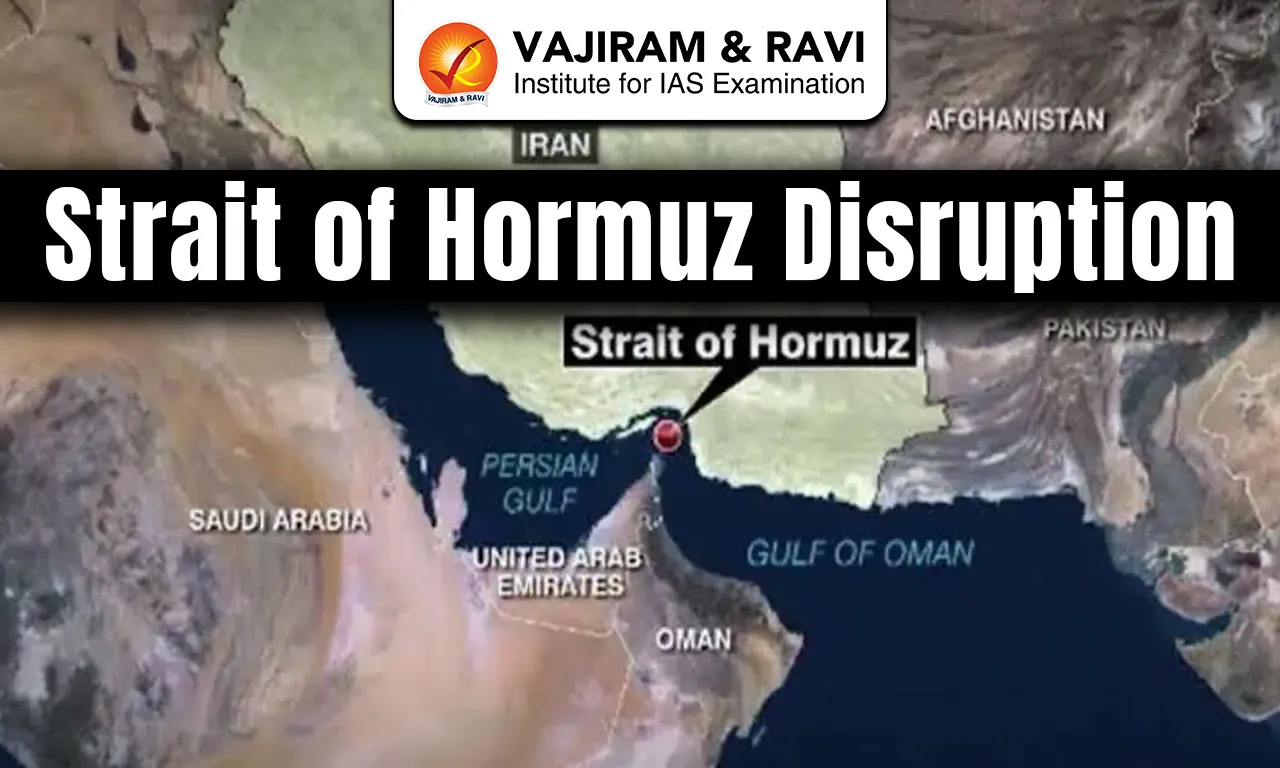
- Iran holds major hydrocarbon reserves. Rising tensions in the Strait of Hormuz are pushing up oil prices.
- If sanctions are lifted under a new regime, Iranian oil could return to global markets. This would ease global energy prices and benefit major importers like India.
Great Power Competition
- After 1979, Iran moved closer to Russia and China. It joined platforms like BRICS Plus and the Shanghai Cooperation Organisation.
- If regime change leads to a pro-US government, Russia and China would face a setback in West Asia. The geopolitical balance would shift significantly.
Implications for India
- For India, the 1979 revolution and the Soviet intervention in Afghanistan reshaped its regional environment.
- India has energy, security, and diaspora interests in West Asia.
Scale of the Indian Presence in the Gulf
- The Indian diaspora in West Asia is one of the largest overseas Indian communities.
- More than nine million Indians live in the Gulf Cooperation Council (GCC) countries. The largest numbers are in the United Arab Emirates and Saudi Arabia.
- There are over 100,000 Indians in Israel and more than 10,000 in Iran. Thousands of Indian students are also present in the region.
- In the UAE alone, Indians form about 35 per cent of the population.
- Around 43 lakh Indians live there. Many are from Kerala, Tamil Nadu, Andhra Pradesh, Telangana, Uttar Pradesh, Bihar, and Punjab.
Economic Significance: Remittances and Travel
- The Gulf is vital for India’s economy. According to the RBI’s Remittances Survey 2025, India received $118.7 billion in remittances in 2023–24.
- The UAE contributed 19.2 per cent of this total, followed by Saudi Arabia at 6.7 per cent. Qatar, Kuwait, and Oman also rank among the top sources.
- Gulf countries are also major travel destinations for Indians. In 2025, about 86 lakh Indians travelled to the UAE, 34 lakh to Saudi Arabia, and 11 lakh to Qatar.
India’s Ability to Influence the Conflict
- India has limited ability to influence the conflict. However, it must prepare for possible consequences.
- These include energy supply disruptions, shifts in regional alliances, and changes in Iran’s foreign policy.
- An Iran that is less confrontational could become a stronger economic and strategic partner for India. But instability could also create security and economic risks.
Conclusion
- The effort to undo the 1979 Islamic Revolution is a major geopolitical development. The outcome will affect regional politics, global energy markets, and great-power competition.
- For India, the challenge is to adapt to these tectonic shifts. Whatever happens in Tehran will cast a long shadow over West Asia and the wider international system.

 Last updated on Oct, 2026
→ UPSC 2027 Notification will be released on 13 January 2027 at upsconline.nic.in.
→ Check Nobel Prize 2026 Winners List here.
→ Download PIB PRiSM Monthly Magazine 2026 here.
→ Check UPSC Monthly Current Affairs Magazine The Recitals here.
→ Check out the latest UPSC Syllabus here.
→ Download UPSC Model Answers for Mains 2026
→ UPSC Mains Question Paper 2026 is out now for Essay & GS Paper 1, 2, 3 & 4.
→ UPSC Calendar 2027 has been released.
→ Enroll in Vajiram & Ravi’s UPSC Mains Test Series 2027 for structured answer writing practice, expert evaluation, and exam-oriented feedback.
→ Join Vajiram & Ravi’s UPSC Mentorship Program 2027 for personalized guidance, strategy planning, and one-to-one support from experienced mentors.
→ Go through the UPSC Mains Previous Year Papers to enhance your preparation.
→ UPSC has released UPSC Toppers List 2025 with the Civil Services final result on its official website.
→ Also check Best UPSC Coaching in India
Tehran’s Turmoil FAQs
Q1. Why is Tehran’s turmoil globally significant?+
Q2. How did the 1979 Islamic Revolution affect global politics?+
Q3. What does regime change in Tehran mean for energy markets?+
Q4. How is India affected by Tehran’s turmoil?+
Q5. How does Tehran’s turmoil affect Russia and China?+
Tags: mains articles Tehran’s Turmoil upsc current affairs upsc mains current affairs