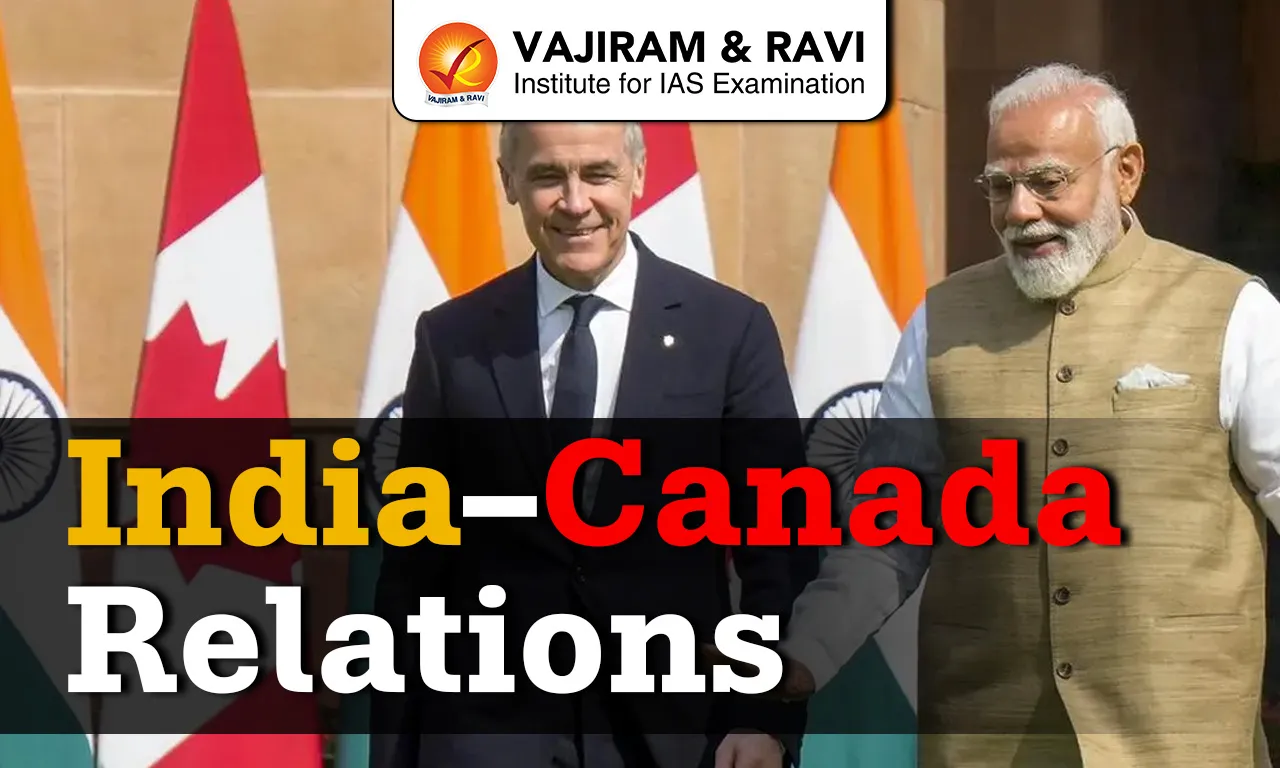
India-Canada Relations Latest News
- India and Canada have taken significant steps to reset strained bilateral relations during the recent visit of Canadian Prime Minister Mark Carney to India.
- Talks with the Indian PM focused on rebuilding strategic trust, enhancing economic ties, and strengthening cooperation in energy and security.
- The visit marks the first full bilateral Canadian Prime Ministerial visit since Justin Trudeau’s 2018 trip and comes after relations deteriorated following the 2023 diplomatic dispute over the killing of Hardeep Singh Nijjar.
- Leaders also discussed escalating conflict in West Asia. India emphasised peace and stability, diplomacy and dialogue, however, no joint position was announced.
Major Outcomes of the Visit
- Long-term uranium supply:
- Agreement:
- India and Canada signed a $1.9 billion uranium supply agreement for 10,000 tonnes (2027–2035).
- Canadian company Cameco will supply uranium for Indian nuclear power plants.
- This will support India’s civil nuclear energy programme and clean energy transition, and is intended to ensure reliable baseload power through nuclear energy.
- Significance:
- Enhances India’s energy security.
- Strengthens civil nuclear cooperation.
- Helps achieve climate goals and net-zero targets.
- Builds on earlier uranium supply agreement (2015–2020).
- Agreement:
- Comprehensive Economic Partnership Agreement (CEPA):
- Trade expansion goals: Terms of Reference for CEPA negotiations finalised, targeting to boost bilateral trade by 2030 [from $8.66 billion (2024–25) to $50 billion].
- Key areas of cooperation: Clean energy, critical minerals, agricultural value chains, advanced manufacturing, and technology cooperation.
- Significance:
- Reduces trade dependence on the U.S.
- Diversifies global economic partnerships.
- Revives suspended trade negotiations.
- Strategic energy partnership:
- India and Canada agreed to cooperate in uranium supplies, renewable energy, LPG sector, nuclear technology, Small Modular Reactors (SMRs), and advanced reactors.
- This reflects a shift towards clean energy cooperation and energy transition.
- Multilateral cooperation:
- Canada agreed to join the International Solar Alliance, and Global Biofuel Alliance.
- Significance: This will strengthen India’s climate diplomacy, and expands India’s role in global renewable governance.
- Security and strategic cooperation:
- Both sides agreed to strengthen cooperation in counterterrorism, violent extremism, organised crime, and intelligence sharing.
- They agreed to convene the Joint Working Group on Counterterrorism. Key focus – Addressing concerns over Khalistani extremism, and combating transnational repression and foreign interference.


Strategic Significance for India
- Economic importance: Access to critical minerals, energy resources, and advanced technologies.
- Energy security: Reliable uranium supply for nuclear energy expansion.
- Climate goals: Nuclear and renewable cooperation supports low-carbon growth.
- Indo-Pacific strategy: Strengthens ties with a key G7 partner.
India-Canada Relations
- Canada and India share over 75 years of diplomatic relations, which were formally designated as a “Strategic Partnership” in 2018.
- India is Canada’s largest source country for most immigration categories, with over 1.8 million (including over 425,000 Indian students) people of Indian origin—nearly 4% of its population—significantly influencing the nation’s culture, economy, and politics.
- Key exports from India to Canada ($4.22 billion) include drugs & pharmaceuticals, iron & steel, seafood, cotton garments, electronic goods and chemicals among others.
- Key imports of India from Canada ($4.44 billion) include pulses, pearls & semiprecious stones, coal, fertilizer, paper and petroleum crude.
Challenges in India-Canada Relations
- Trust deficit:
-
- Nijjar killing controversy, and diplomatic tensions since 2023.
- Canadian agencies reportedly claim involvement of Indian consular officials in the killing of Hardeep Singh Nijjar, which India strongly denies.
- This had earlier led to diplomatic expulsions, suspension of trade negotiations, strategic mistrust, and remains a major obstacle to trust-building.
- Khalistan issue: India’s concerns over safe havens for separatist groups in Canada. Canada’s concerns about transnational repression.
- Trade barriers: Long-pending CEPA negotiations due to regulatory differences.
- Implementation risks: Earlier uranium agreements did not fully deliver. Need for reliable supply commitments.
Way Forward
- Institutional dialogue: Regular political and diplomatic engagement, strengthening counterterrorism mechanisms.
- Early conclusion of CEPA: Fast-track negotiations by addressing regulatory barriers.
- Confidence-Building Measures: Transparent investigation mechanisms, intelligence cooperation.
- Expanding energy cooperation: Uranium supply stability, SMR development, renewable partnerships.
- Diaspora engagement: Address concerns related to extremism while protecting democratic freedoms.
Conclusion
- The 2026 India–Canada agreements mark a cautious but significant attempt to rebuild strategic trust after years of diplomatic friction.
- It signals a pragmatic shift toward economic and energy cooperation. However, the unresolved Nijjar controversy and mutual security concerns continue to pose risks.
- Sustained dialogue and institutional cooperation will be crucial to transforming the relationship into a stable strategic partnership.

 Last updated on Oct, 2026
→ UPSC 2027 Notification will be released on 13 January 2027 at upsconline.nic.in.
→ Check Nobel Prize 2026 Winners List here.
→ Download PIB PRiSM Monthly Magazine 2026 here.
→ Check UPSC Monthly Current Affairs Magazine The Recitals here.
→ Check out the latest UPSC Syllabus here.
→ Download UPSC Model Answers for Mains 2026
→ UPSC Mains Question Paper 2026 is out now for Essay & GS Paper 1, 2, 3 & 4.
→ UPSC Calendar 2027 has been released.
→ Enroll in Vajiram & Ravi’s UPSC Mains Test Series 2027 for structured answer writing practice, expert evaluation, and exam-oriented feedback.
→ Join Vajiram & Ravi’s UPSC Mentorship Program 2027 for personalized guidance, strategy planning, and one-to-one support from experienced mentors.
→ Go through the UPSC Mains Previous Year Papers to enhance your preparation.
→ UPSC has released UPSC Toppers List 2025 with the Civil Services final result on its official website.
→ Also check Best UPSC Coaching in India
India–Canada Relations FAQs
Q1. What is the significance of the uranium supply agreement between India and Canada?+
Q2. What is the strategic importance of the proposed India–Canada CEPA?+
Q3. How civil nuclear cooperation contributes to India’s clean energy transition?+
Q4. How persistent political differences continue to shape India–Canada relations despite economic cooperation?+
Q5. What is the role of minilateral climate initiatives in strengthening India’s global leadership?+
Tags: india-canada relations mains articles upsc current affairs upsc mains current affairs