Andhra Pradesh Population Policy Latest News
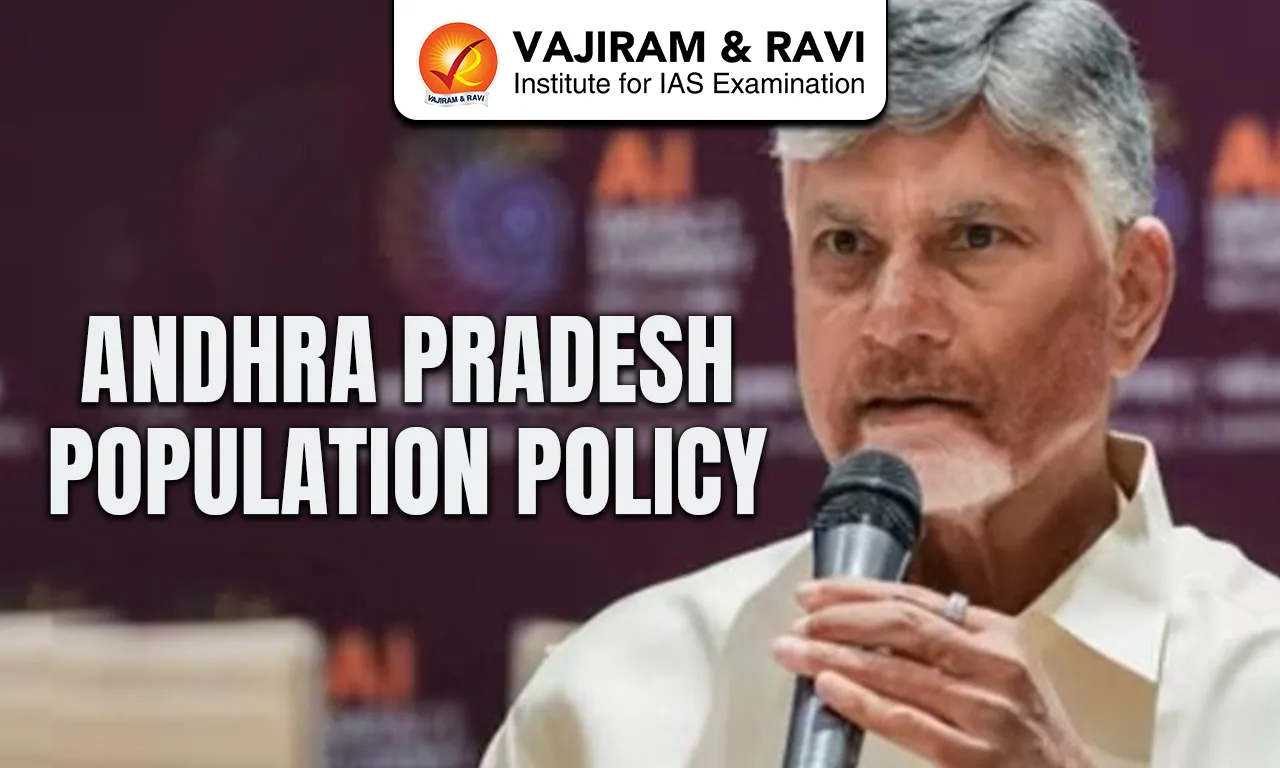
- The Andhra Pradesh government has introduced a draft Population Management Policy aimed at encouraging families to have two or three children.
- The policy proposes better healthcare facilities, particularly for women. It also seeks to strengthen elderly care systems, as the proportion of older people in the population is expected to rise in the coming years.
- The initiative responds to the sharp decline in fertility rates in Andhra Pradesh. The state’s Total Fertility Rate (TFR) has fallen to 1.5, which is significantly below the replacement level of 2.1.
- The AP govt has expressed concern that declining birth rates could reduce the working-age population while increasing the elderly population.
- This may slow economic growth and increase pressure on government welfare systems, turning a demographic dividend into a demographic burden.
Demographic Trends in Andhra Pradesh and India
- The Total Fertility Rate (TFR) in Andhra Pradesh has declined steadily from 2.2 in 2003 (when Andhra Pradesh and Telangana were a combined state) to 1.5 in 2023.
- Telangana has also recorded the same fertility rate of 1.5.
- The decline in fertility is a national trend. India’s overall TFR has fallen from 3 in 2003 to about 1.9 today.
- Falling fertility rates are often linked with development indicators such as better education, healthcare, urbanisation, higher incomes, and the rise of nuclear families.
Regional Differences in Fertility
- Southern states generally have lower fertility rates than the national average due to stronger social development indicators.
- Tamil Nadu: 1.3
- Andhra Pradesh, Telangana, Karnataka, Kerala: around 1.5
- In contrast, several northern and eastern states still have higher fertility rates:
- Bihar: 2.8
- Uttar Pradesh: 2.6
- Madhya Pradesh, Chhattisgarh, Rajasthan, Jharkhand, Assam: above the national average.
Political Implications of Population Changes
- Falling fertility in southern states could affect their representation in Parliament.
- Since parliamentary constituencies are allocated based on population, states with slower population growth may see their relative representation decline compared to populous states like Uttar Pradesh and Bihar.
Delimitation Debate
- This concern is linked to the delimitation exercise, which redraws parliamentary constituencies after each Census.
- The process has been suspended for about 50 years, but with the suspension set to end soon, the issue of representation based on population is expected to re-emerge in national politics.


Objectives of Andhra Pradesh’s Population Management Policy
- Andhra Pradesh has introduced a targeted population management policy to address declining fertility rates and demographic challenges.
- The government believes this initiative could significantly shape the state’s future demographic and economic structure.
Five Key Pillars of the Policy
- The policy is built around five major components:
- Matrutva: Focus on maternal health and well-being.
- Shakti: Increase women’s participation in the workforce.
- Kshema: Strengthen care and welfare for senior citizens.
- Naipunyam: Improve workforce skills, especially for healthcare services for children and the elderly.
- Sanjeevani: Expand and strengthen the digital public health system.
Incentives to Encourage Childbirth
- The government proposes several incentives to encourage families to have more children:
- ₹25,000 cash incentive for the birth of a second or third child.
- ₹1,000 monthly support for five years for the third child to ensure nutrition.
- Free education in government institutions for the second and third child until age 18.
- Subsidised IVF treatments through public-private partnerships to support infertile couples.
Health and Workforce Measures
- The policy also includes measures to improve health outcomes and workforce preparedness:
- ₹50,000 and 15 days leave for retiring government employees for preventive health check-ups.
- Training of 10,000 healthcare assistants annually to support adolescent and elderly healthcare needs.
Public Health and Social Targets
- The state government aims to achieve several health-related goals:
- Reduce C-section birth rates from 67.5% to below 40%.
- Lower teenage pregnancies.
- Reduce male sterilisation procedures.
Addressing Ageing Population and Workforce Participation
- Andhra Pradesh is experiencing faster population ageing than the national average.
- Median age: 32.5 years (India: 28.4 years).
- Population above 60 years: about 10%, expected to reach 23% by 2047.
- Female workforce participation: about 31%, lower than the national average of 37%.
Urgency of Policy Intervention
- The government believes there is a limited window to address declining fertility and ageing population trends.
- Without timely intervention, these demographic shifts could weaken the state’s economic structure and future growth prospects.

 Last updated on Oct, 2026
→ UPSC 2027 Notification will be released on 13 January 2027 at upsconline.nic.in.
→ Check Nobel Prize 2026 Winners List here.
→ Download PIB PRiSM Monthly Magazine 2026 here.
→ Check UPSC Monthly Current Affairs Magazine The Recitals here.
→ Check out the latest UPSC Syllabus here.
→ Download UPSC Model Answers for Mains 2026
→ UPSC Mains Question Paper 2026 is out now for Essay & GS Paper 1, 2, 3 & 4.
→ UPSC Calendar 2027 has been released.
→ Enroll in Vajiram & Ravi’s UPSC Mains Test Series 2027 for structured answer writing practice, expert evaluation, and exam-oriented feedback.
→ Join Vajiram & Ravi’s UPSC Mentorship Program 2027 for personalized guidance, strategy planning, and one-to-one support from experienced mentors.
→ Go through the UPSC Mains Previous Year Papers to enhance your preparation.
→ UPSC has released UPSC Toppers List 2025 with the Civil Services final result on its official website.
→ Also check Best UPSC Coaching in India
Andhra Pradesh Population Policy FAQs
Q1. Why did Andhra Pradesh introduce a new population policy?+
Q2. What demographic trends prompted Andhra Pradesh’s population policy?+
Q3. What are the key pillars of the Andhra Pradesh population policy?+
Q4. What incentives does the policy provide to encourage childbirth?+
Q5. How could population decline affect political representation in India?+
Tags: Andhra Pradesh Population Policy mains articles upsc current affairs upsc mains current affairs