Satellites play a crucial role in modern technology, including communication, weather forecasting, navigation, and scientific research. Many satellites are placed in special orbits around Earth so they can operate efficiently. A geostationary orbit is actually a special type of geosynchronous orbit with specific conditions. Understanding the difference between Geosynchronous and Geostationary Orbit is important to get an overview of both of these orbits.
What is Geosynchronous Orbit?
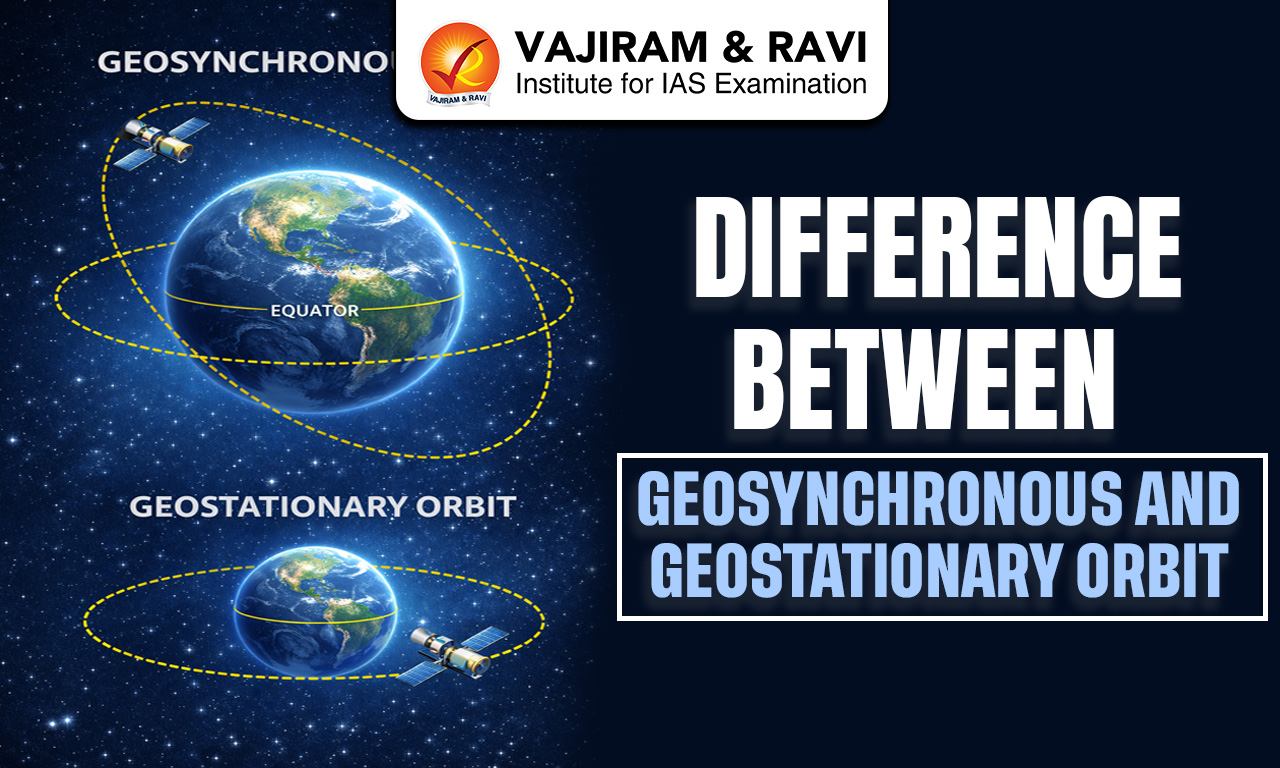
A Geosynchronous Orbit is a type of Earth orbit in which a satellite takes 24 hours to complete one revolution around the Earth, matching the rotation period of our planet. Because of this synchronization, the satellite returns to the same position in the sky at the same time each day. However, it may still appear to move slightly north or south relative to a fixed point on Earth. These orbits are commonly used for communication, weather, and observation satellites.
What is Geostationary Orbit?
A Geostationary Orbit is a special type of Geosynchronous Orbit in which a satellite moves around the Earth with the same rotational speed as the planet. The satellite orbits directly above the Earth’s equator at an altitude of about 35,786 km and completes one revolution in 24 hours. Because of these conditions, the satellite appears completely stationary over one fixed point on Earth. This orbit is widely used for communication, television broadcasting, and weather satellites.
Also Read: Types of Satellites


Difference between Geosynchronous and Geostationary Orbit
Both Geosynchronous Orbit and Geostationary Orbit are important satellite orbits used for communication, weather monitoring, and scientific observation. The Difference between Geosynchronous and Geostationary Orbit has been highlighted below.
| Difference between Geosynchronous and Geostationary Orbit | ||
|
Basis of Difference |
Geosynchronous Orbit |
Geostationary Orbit |
|
Definition |
An orbit in which a satellite takes the same time as Earth (24 hours) to complete one revolution |
A special type of geosynchronous orbit where the satellite remains fixed over one point on Earth |
|
Relation Between Them |
General category of orbit |
Subset of geosynchronous orbit |
|
Orbital Period |
24 hours (same as Earth’s rotation) |
24 hours |
|
Satellite Motion from Earth |
Appears to move in the sky |
Appears completely stationary |
|
Orbit Shape |
Can be circular or elliptical |
Always circular |
|
Orbital Inclination |
Can have any inclination relative to the equator |
Must have zero inclination (0°) |
|
Location of Orbit |
May orbit above different latitudes |
Must orbit directly above the equator |
|
Ground Track |
Forms a figure-eight pattern (analemma) when viewed from Earth |
Appears as a single fixed point |
|
Satellite Position |
Changes position over Earth during the day |
Remains above the same longitude |
|
Altitude |
Usually around 35,786 km but may vary slightly |
About 35,786 km above the equator |
|
Coverage Area |
Covers different regions during orbit |
Continuous coverage of the same region |
|
Ground Antenna Requirement |
Ground stations must track satellite movement |
Ground antennas remain fixed |
|
Communication Stability |
Slight signal variation due to satellite movement |
Stable communication because satellite is fixed |
|
Applications |
Scientific observation, communication satellites |
Television broadcasting, weather satellites, telecommunications |
|
Examples |
Some research and communication satellites |
Weather and communication satellites like INSAT satellites |
|
Visibility from Earth |
Appears to move north–south during the day |
Always visible at the same position in the sky |
|
Polar Coverage |
Can observe wider latitudes depending on inclination |
Poor coverage of polar regions |
|
Complexity of Operation |
Requires tracking systems for antennas |
Easier operation due to fixed satellite position |

 Last updated on Oct, 2026
→ UPSC 2027 Notification will be released on 13 January 2027 at upsconline.nic.in.
→ Check Nobel Prize 2026 Winners List here.
→ Download PIB PRiSM Monthly Magazine 2026 here.
→ Check UPSC Monthly Current Affairs Magazine The Recitals here.
→ Check out the latest UPSC Syllabus here.
→ Download UPSC Model Answers for Mains 2026
→ UPSC Mains Question Paper 2026 is out now for Essay & GS Paper 1, 2, 3 & 4.
→ UPSC Calendar 2027 has been released.
→ Enroll in Vajiram & Ravi’s UPSC Mains Test Series 2027 for structured answer writing practice, expert evaluation, and exam-oriented feedback.
→ Join Vajiram & Ravi’s UPSC Mentorship Program 2027 for personalized guidance, strategy planning, and one-to-one support from experienced mentors.
→ Go through the UPSC Mains Previous Year Papers to enhance your preparation.
→ UPSC has released UPSC Toppers List 2025 with the Civil Services final result on its official website.
→ Also check Best UPSC Coaching in India
Difference between Geosynchronous and Geostationary Orbit FAQs
Q1. What is the difference between Geosynchronous Orbit and Geostationary Orbit?+
Q2. Is a Geostationary Orbit a type of Geosynchronous Orbit?+
Q3. What is the altitude of a Geostationary Orbit?+
Q4. Why are Geostationary satellites important?+
Q5. Do Geosynchronous satellites remain stationary in the sky?+
Tags: difference between geosynchronous and geostationary orbit