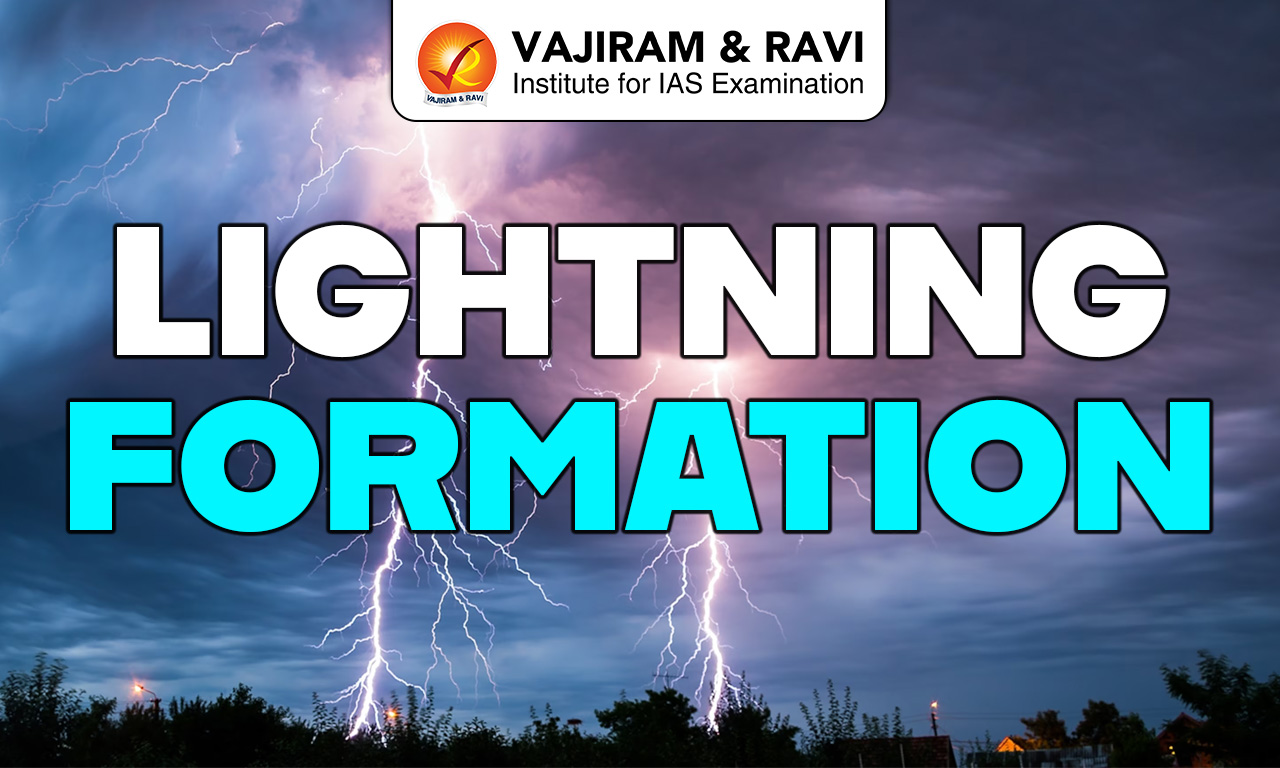
Lightning is a powerful atmospheric electrical discharge occurring between charged regions in clouds or between cloud and ground. It releases massive energy ranging from 200 megajoules to 7 gigajoules, heating surrounding air and producing visible flashes and thunder. It plays a key role in atmospheric chemistry and the global electrical circuit.
Lightning Types
Lightning occurs in three main forms based on discharge location within atmosphere and between cloud systems and Earth’s surface.
- Intra cloud: Occurs within a single thundercloud between oppositely charged regions. It is the most frequent type and often appears as sheet lightning, visible at long distances without audible thunder.
- Cloud to cloud: Happens between two separate clouds due to potential difference. It often creates branching patterns called “anvil crawlers,” moving across upper cloud layers, especially during mature or decaying thunderstorms.
- Cloud to ground: Discharge between cloud and Earth, posing maximum risk to life and property. It involves stepped leaders and upward streamers forming a conductive path before a high current return stroke.
Lightning Formation Causes
Lightning Formation occurs due to atmospheric instability, charge buildup in clouds and interactions between temperature, moisture and air movements.
- Atmospheric Instability: Mixing of warm moist air with colder air creates strong updrafts, leading to thunderstorm formation and necessary conditions for charge separation inside clouds.
- Moisture and Temperature: High moisture content and temperature differences help form supercooled droplets and ice particles, which collide and generate electrical charges within clouds.
- Air Movements: Updrafts and downdrafts inside storms move charged particles in different directions, helping in the development of distinct positive and negative regions.
- Aerosols and Dust: Presence of dust, smoke and pollutants influences cloud electrification by affecting particle collisions, increasing the chances of lightning occurrence.
- Weather Systems: Lightning also occurs in volcanic eruptions, forest fires, hurricanes and dust storms due to strong energy release and turbulent atmospheric conditions.
- Electric Field Strength: When the electric field becomes strong enough to overcome air resistance, it results in sudden discharge in the form of lightning.


Lightning Formation Process
The process of Lightning Formation has been highlighted below:
- Inside a thundercloud, tiny ice particles collide and create electrical charges. Positive charges move to the top, while negative charges gather in the middle and lower parts.
- This separation of positive and negative charges creates a strong difference in electrical energy within the cloud and between cloud and ground.
- The difference in charges builds a powerful electric field in the air, which acts like stored electrical energy waiting to be released.
- When the electric field becomes too strong, the air (which normally acts as an insulator) breaks down and allows electricity to pass through.
- A path called a leader forms between the charged regions, creating a channel for electricity to flow.
- Electricity rapidly flows through this channel, producing a bright flash of lightning and heating the air, which later causes thunder.
Also Read: Hailstorm Formation
Lightning Formation in India
- As per National Crime Records Bureau 2021, lightning caused 2,880 deaths, contributing about 40% of total accidental deaths from natural forces, showing its major impact across India.
- Lightning frequency is highest in northeastern states along with West Bengal, Sikkim, Jharkhand, Odisha and Bihar, while central states like Madhya Pradesh, Maharashtra and Chhattisgarh report higher death counts.
- Bihar remains one of the most vulnerable states, with 107 deaths recorded till July 2023, mainly due to frequent cloud to ground lightning and dense rural exposure.
- A sharp 184% increase in lightning deaths during March-April 2025 across 12 states highlights growing intensity and frequency of lightning events in recent years.
- Interaction of moist easterly winds from Bay of Bengal with western disturbances and jet streams creates unstable atmospheric conditions, increasing thunderstorm formation and lightning probability.
- Urban heat island effect, land use changes and pollution aerosols influence cloud formation and electrification, leading to higher lightning frequency in rapidly urbanizing regions.
- India is among five countries with lightning early warning systems, providing forecasts from 5 days to 3 hours, with IMD systems and Damini app offering location based real time alerts.
- Lightning is not classified under SDRF disaster list and the Union government focuses on awareness campaigns, lightning resistant infrastructure and safety education rather than disaster declaration.
Lightning Formation Effects
Lightning produces several impacts affecting the environment and humans following manners.
- Extreme Heating: Lightning heats air up to about 30,000°C, causing rapid expansion and generating shock waves that are heard as thunder.
- Electromagnetic Radiation: It emits radiation across multiple wavelengths, including visible light, making lightning appear as a bright flash.
- Fire Ignition: Lightning acts as a natural source of ignition, often causing forest fires, especially in dry conditions known as dry lightning events.
- Atmospheric Chemistry: It influences atmospheric composition by altering gases and contributing to chemical reactions in the atmosphere.
- Damage to Infrastructure: High voltage and current can damage buildings, power lines and electronic devices through direct strikes or induced surges.
- Human and Animal Risk: Cloud to ground lightning can cause fatalities through direct strikes or step voltage effects near the strike location.

 Last updated on Oct, 2026
→ UPSC 2027 Notification will be released on 13 January 2027 at upsconline.nic.in.
→ Check Nobel Prize 2026 Winners List here.
→ Download PIB PRiSM Monthly Magazine 2026 here.
→ Check UPSC Monthly Current Affairs Magazine The Recitals here.
→ Check out the latest UPSC Syllabus here.
→ Download UPSC Model Answers for Mains 2026
→ UPSC Mains Question Paper 2026 is out now for Essay & GS Paper 1, 2, 3 & 4.
→ UPSC Calendar 2027 has been released.
→ Enroll in Vajiram & Ravi’s UPSC Mains Test Series 2027 for structured answer writing practice, expert evaluation, and exam-oriented feedback.
→ Join Vajiram & Ravi’s UPSC Mentorship Program 2027 for personalized guidance, strategy planning, and one-to-one support from experienced mentors.
→ Go through the UPSC Mains Previous Year Papers to enhance your preparation.
→ UPSC has released UPSC Toppers List 2025 with the Civil Services final result on its official website.
→ Also check Best UPSC Coaching in India
Lightning Formation FAQs
Q1. What is the main cause of Lightning Formation in India? +
Q2. Which state is most affected by Lightning in India? +
Q3. What is Lightning Formation? +
Q4. At what temperature does Lightning heat the air? +
Q5. Which type of Lightning is most dangerous? +
Tags: geography lightning formation physics