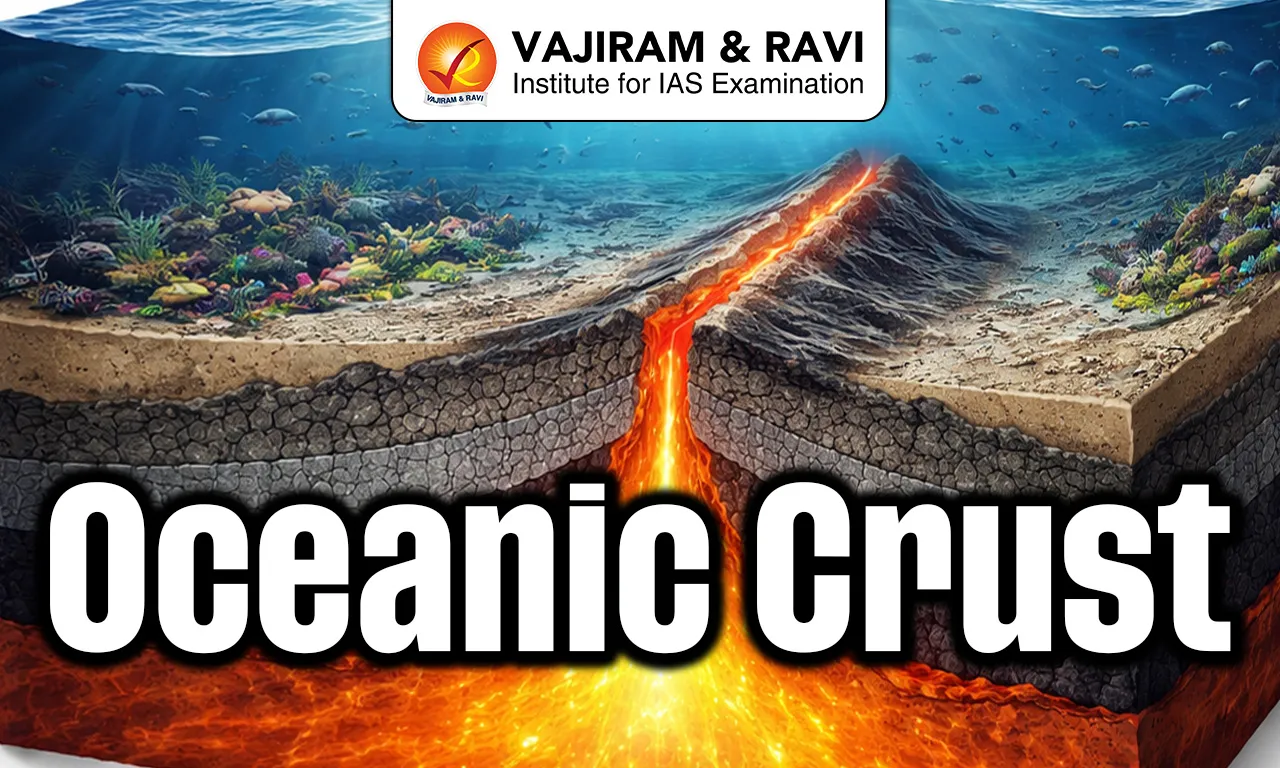
Oceanic crust is the outermost layer of the Earth that lies beneath the oceans. It is thinner (5-10Km), denser, and younger compared to continental crust. This type of crust plays a vital role in shaping the Earth’s surface through continuous geological processes like seafloor spreading and subduction. The study of oceanic crust is important in understanding plate tectonics, ocean basins, earthquakes, and volcanic activity.
Oceanic Crust Formation
Oceanic Crust forms at mid-ocean ridges where magma from the mantle rises, cools, and solidifies. This continuous process of seafloor spreading creates new crust while older crust moves away and eventually gets recycled.
- Mantle Convection Initiates the Process: Heat from the Earth’s interior creates convection currents in the mantle, causing hot, less dense material to rise upward beneath oceanic ridges.
- Divergent Plate Movement: At mid-ocean ridges, tectonic plates move away from each other, creating a gap or weak zone where magma can rise easily.
- Magma Upwelling: Molten magma from the asthenosphere rises through cracks and fractures due to reduced pressure (decompression melting).
- Cooling and Solidification: When magma reaches the ocean floor, it comes in contact with cold seawater and cools rapidly, forming fine-grained basaltic rocks.
- Formation of Pillow Basalts: Rapid cooling underwater leads to the formation of rounded, pillow-shaped lava structures known as pillow basalts.
- Development of Layered Structure: Continuous magma supply forms different layers, basalt at the top, sheeted dikes in the middle, and gabbro deeper below.
- Seafloor Spreading Mechanism: Newly formed crust pushes older crust away from the ridge on both sides, gradually expanding the ocean basin.
- Magnetic Striping Evidence: As lava cools, iron minerals align with Earth’s magnetic field, recording polarity reversals and creating symmetrical magnetic stripes.
- Aging and Cooling of Crust: As oceanic crust moves away from the ridge, it cools, becomes denser, and subsides deeper into the ocean basin.
Also Read: Hailstorm Formation
Major Minerals found in Oceanic Crust
Oceanic crust is mainly composed of mafic igneous rocks such as basalt and gabbro, which are rich in silica and magnesium, commonly referred to as SiMa. These rocks contain high amounts of iron and magnesium, making oceanic crust denser than continental crust.
- Pyroxene: An important silicate mineral commonly found in basaltic rocks
- Plagioclase Feldspar: A dominant mineral in the upper layers of oceanic crust
- Olivine: Present in deeper layers like gabbro and mantle-derived rocks
- Silica and Magnesium: Basic chemical components forming mafic rocks
- Rich in iron, contributing to higher density
- Hydrothermal Sulfides: Found near mid-ocean ridges, containing valuable metals like copper, zinc, and gold
- Polymetallic Nodules: Located on the ocean floor, rich in manganese, cobalt, and nickel


Oceanic Crust Importance
Oceanic crust plays a crucial role in Earth’s geological processes by driving plate tectonics and shaping ocean basins. It also supports the largest carbon sink and sustains vast plant and animal ecosystems of the world.
- Drives plate tectonics through seafloor spreading and subduction
- Helps in formation and evolution of ocean basins
- Supports the largest plant and animal ecosystem (marine ecosystem) on Earth
- Controls occurrence of earthquakes and volcanic activity
- Provides habitat for diverse marine biodiversity
- Source of valuable minerals like manganese nodules
- Helps regulate global climate systems
- Provides insights into Earth’s internal structure and processes

 Last updated on Sep, 2026
→ UPSC 2027 Notification will be released on 13 January 2027 at upsconline.nic.in.
→ Asian Games 2026 are being held in Aichi-Nagoya, Japan, from 19 September to 4 October.
→ Check out the latest UPSC Syllabus here.
→ Download UPSC Model Answers for Mains 2026
→ UPSC Mains Question Paper 2026 is out now for Essay & GS Paper 1, 2, 3 & 4.
→ UPSC Calendar 2027 has been released.
→ Enroll in Vajiram & Ravi’s UPSC Mains Test Series 2027 for structured answer writing practice, expert evaluation, and exam-oriented feedback.
→ Join Vajiram & Ravi’s UPSC Mentorship Program 2027 for personalized guidance, strategy planning, and one-to-one support from experienced mentors.
→ Go through the UPSC Mains Previous Year Papers to enhance your preparation.
→ UPSC has released UPSC Toppers List 2025 with the Civil Services final result on its official website.
→ Also check Best UPSC Coaching in India
Oceanic Crust FAQs
Q1. What is oceanic crust?+
Q2. How is oceanic crust formed?+
Q3. What is the average thickness of oceanic crust?+
Q4. Why is oceanic crust younger than continental crust?+
Q5. What is oceanic crust mainly made of?+
Tags: geography oceanic crust