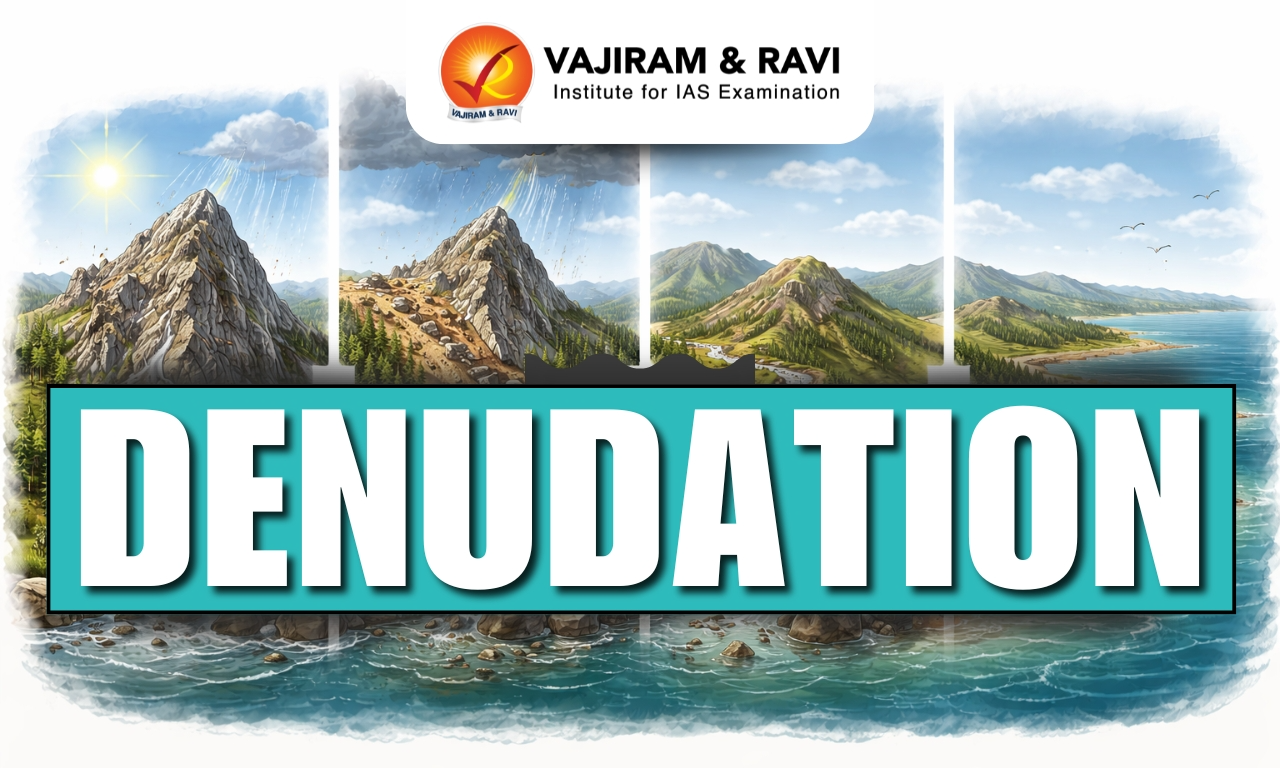
Denudation is the overall process that lowers the Earth’s surface by removing rock, soil and dissolved materials through agents like water, wind, ice and waves. It combines weathering, erosion and mass wasting, reducing relief over time. While erosion involves transport, Denudation represents the total effect of all surface lowering processes acting together.
Denudation Process Classification
Denudation operates through interconnected external processes that progressively break, move and deposit Earth materials across landscapes over time. The types of process under Denudation are:
- Weathering: Weathering breaks rocks in place without movement, through mechanical, chemical and biological actions. Processes like frost wedging, carbonation, oxidation, hydration and root activity weaken rocks, preparing material for further removal and reducing structural strength of surface layers.
- Mass Movement: Mass movement shifts weathered material downslope under gravity without external agents. Slow forms like soil creep and solifluction act gradually, while rapid events such as landslides, mudflows, debris avalanches and slumps quickly transport large volumes of material.
- Erosion (Transportation): Erosion removes and carries weathered material by agents like rivers, glaciers, wind and waves. Fluvial erosion dominates globally, while glacial erosion shapes valleys and wind erosion transports fine particles forming dunes and desert landforms.
- Deposition: Deposition occurs when transporting agents lose energy and drop sediments, forming features like floodplains, deltas, beaches and moraines. It redistributes eroded material and contributes to new landform development, balancing erosion in geomorphic systems.
Factors Affecting Denudation
Denudation rates vary widely due to natural conditions and human influence, controlling how fast landscapes are worn down globally.
- Climate: Climate controls Denudation through rainfall, temperature and weathering intensity. High rainfall increases chemical weathering, while freeze thaw cycles dominate cold regions, accelerating rock breakdown and enhancing erosion rates significantly.
- Lithology: Rock type determines resistance to Denudation. Hard rocks resist erosion, while soft or soluble rocks like limestone weather quickly through carbonation, leading to rapid landscape changes and formation of features like caves.
- Topography: Steep slopes increase gravitational force, accelerating mass movement and erosion. Flat surfaces experience slower Denudation, while mountainous regions like active plate margins show rapid landscape lowering due to intense geomorphic activity.
- Tectonic Activity: Uplift exposes fresh rocks to surface processes, increasing Denudation. In active regions, uplift and Denudation may occur simultaneously, with orogeny rates often exceeding Denudation rates by several times except in highly active zones.
- Biosphere: Plants, animals and microorganisms influence Denudation by breaking rocks physically and chemically. Root growth widens cracks, while microbial activity produces acids that enhance chemical weathering and mineral breakdown.
- Human Activity: Activities like deforestation, mining, agriculture and dam construction accelerate Denudation by disturbing soil and vegetation. Human induced soil loss up to 0.5 meters can increase Denudation rates by nearly 30 percent in affected regions.


Denudation Chronology
Denudation chronology reconstructs landscape evolution by analyzing past and present geomorphic processes and their sequential development over geological time.
- Definition: Denudation chronology is the study of landscape evolution over time by analyzing erosion, weathering, transportation and deposition to understand how Earth’s surface has been gradually modified.
- Process: It reconstructs past landscapes by examining sediments, drainage patterns, erosion surfaces and tectonic events, using the idea that present processes help explain past geomorphic changes.
- Significance: It helps explain how mountains, valleys and plains developed over long geological periods, giving insight into the continuous shaping and lowering of Earth’s surface.
- Impact: It shows how Denudation reduces elevation and relief, influencing landform development, river systems and long term surface stability across different regions.
- Uses: It is used to identify past erosion cycles, study drainage evolution, understand tectonic activity and estimate long term changes in landscapes based on available geological evidence.
- Limitations: It is partly uncertain because old landforms are often modified or destroyed and lack of precise geological data makes dating erosion surfaces and reconstructing original landscapes difficult.
Denudation Measurement
Denudation is measured as surface lowering, usually in centimeters per 1000 years. It is analysed using field observations and advanced techniques like stream load analysis and cosmogenic isotopes. These methods estimate how quickly landscapes wear down, though assumptions like uniform erosion and environmental variability can influence accuracy across regions.

 Last updated on Sep, 2026
→ UPSC 2027 Notification will be released on 13 January 2027 at upsconline.nic.in.
→ Asian Games 2026 are being held in Aichi-Nagoya, Japan, from 19 September to 4 October.
→ Check out the latest UPSC Syllabus here.
→ Download UPSC Model Answers for Mains 2026
→ UPSC Mains Question Paper 2026 is out now for Essay & GS Paper 1, 2, 3 & 4.
→ UPSC Calendar 2027 has been released.
→ Enroll in Vajiram & Ravi’s UPSC Mains Test Series 2027 for structured answer writing practice, expert evaluation, and exam-oriented feedback.
→ Join Vajiram & Ravi’s UPSC Mentorship Program 2027 for personalized guidance, strategy planning, and one-to-one support from experienced mentors.
→ Go through the UPSC Mains Previous Year Papers to enhance your preparation.
→ UPSC has released UPSC Toppers List 2025 with the Civil Services final result on its official website.
→ Also check Best UPSC Coaching in India
Denudation FAQs
Q1. What is Denudation? +
Q2. How is Denudation measured? +
Q3. What are the main processes of Denudation? +
Q4. Which factor most strongly controls Denudation rates? +
Q5. What is Denudation Chronology? +
Tags: denudation physical geography