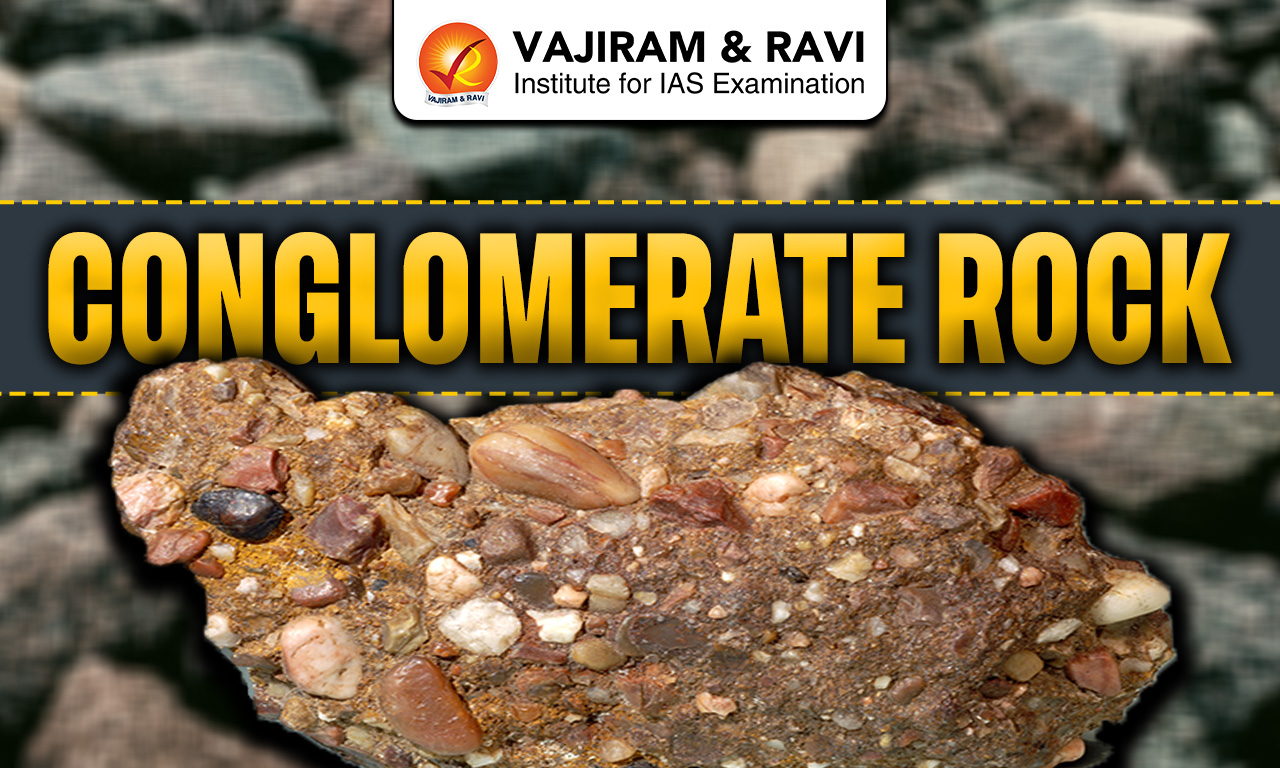
Conglomerate rock is a type of sedimentary rock made up of large, rounded pieces of stones or pebbles that are stuck together by natural minerals. These rounded fragments show that they were carried by water, such as rivers or waves, over a long distance before settling down. Over time, layers of these materials got compacted and cemented to form a solid rock. Conglomerate rock is commonly found in riverbeds, beaches, and areas where strong water currents once existed.
Geology Conglomerate
- Conglomerate is a type of sedimentary rock made up of rounded pebbles, stones, and sand that are naturally cemented together by materials like silica, calcite, or iron oxide. It looks a bit like sandstone, but instead of fine sand grains, it contains larger, rounded rock pieces.
- This rock usually forms in places like riverbeds, where strong flowing water carries and smoothens the stones before depositing them. The materials in conglomerate can come from different minerals, but many are rich in quartz.
- The hardness of conglomerate can vary, and it often looks similar to concrete. It is usually found in thick, rough layers. Because of its appearance, it is sometimes used as a decorative stone in construction.
Also Read: Rock Systems of India
Conglomerate Composition
- Conglomerate rock can have many different compositions because it is made from a mix of materials. It is a clastic sedimentary rock, which means it forms from broken pieces (called clasts) of other rocks that are carried by water and then deposited.
- These rounded clasts can be small mineral grains like quartz, or larger pieces of different types of rocks such as igneous, sedimentary, or metamorphic rocks. Over time, these pieces get pressed together.
- The spaces between these larger fragments are filled with finer materials like sand or mud, known as the matrix. This matrix, along with natural cements like silica, calcite, or iron compounds, helps bind everything together and turn it into solid rock.
- Because of this mix of different materials, conglomerate can vary a lot in appearance, color, and strength depending on what it is made of and where it was formed.


Conglomerate Rock Classification
Conglomerate rock is classified based on a few important features. These help scientists understand how the rock was formed and what materials it contains.
- Matrix (material between the stones): Classification depends on how much fine material (like sand, clay, or silt) is present and what type it is. Some conglomerates have a lot of matrix holding the pebbles together, while others have very little.
- Composition of clasts (pebbles): The type of rock fragments (called clasts) inside the conglomerate also matters. These clasts can be made of different materials like quartz, limestone, or other rocks. If most clasts are of the same type, it tells us about their source.
- Size of clasts: The size range of the gravel or pebbles is another factor. Conglomerates can contain small pebbles or larger stones, and this helps in identifying the environment where the rock was formed (like rivers or beaches).
- Purpose of classification: The way conglomerate rocks are classified can change depending on the level of detail needed. For basic study, simple features are used, but for detailed research, scientists may use more specific methods and measurements.
Also Read: Types of Rocks
Conglomerate Characteristics and Properties
- Conglomerate is a type of sedimentary rock that has some very easy-to-recognize features.
- Main characteristic:The most important feature of a conglomerate is the presence of clearly visible, rounded pebbles or stones called clasts. These clasts are cemented together by a finer material known as the matrix.
- Appearance and composition: Conglomerate often looks similar to concrete because it is made up of large, rounded pebbles held together by substances like calcite, silica, or iron oxide. The rounding of the pebbles usually shows that they were carried by water (like rivers or waves) before becoming part of the rock.
- Properties: The properties of a conglomerate depend on what materials it is made of.
- It can be hard or soft, depending on the strength of the cementing material.
- It can be found in different colours, based on the minerals present in the clasts and matrix.
Conglomerate Uses
- Use in Construction
- Low-performance material: Conglomerate rocks do not break cleanly, and their fine particles are not very strong. Because of this, they are mostly used where high-strength material is not required.
- Crushed aggregate: Conglomerates can be crushed into smaller pieces to produce aggregate, which is used for building roads, foundations, and other construction projects.
- Cement manufacturing: Certain types of conglomerate are suitable as raw material in cement production, contributing to the binding and structural properties of cement.
- Decorative and Ornamental Uses
- Attractive appearance: Many conglomerates are naturally colorful and visually appealing due to the variety of pebbles and minerals they contain.
- Limited interior use: Despite their beauty, they are rarely used for interior decoration because their uneven breakage makes them difficult to cut and polish cleanly.
- Art, Sculpture, and Monuments
- Sculpture material: Well-cemented conglomerate is excellent for making statues, monuments, and sculptures due to its unique texture and hardness.
- Artifacts and figurines: Its patterns and natural colors make it suitable for crafting small figurines, decorative artifacts, and artistic creations.
- Dimension Stone Applications
- Cutting potential: Conglomerates with smaller clasts can be easily shaped and cut into required sizes.
- When the cementing material is strong and durable, conglomerate can be used for: Flooring tiles, Wall veneers, Roof tiles
- Durability: Properly cemented conglomerate dimension stones can last long and withstand moderate wear, making them suitable for both functional and decorative construction.

 Last updated on Sep, 2026
→ UPSC 2027 Notification will be released on 13 January 2027 at upsconline.nic.in.
→ Asian Games 2026 are being held in Aichi-Nagoya, Japan, from 19 September to 4 October.
→ Check out the latest UPSC Syllabus here.
→ Download UPSC Model Answers for Mains 2026
→ UPSC Mains Question Paper 2026 is out now for Essay & GS Paper 1, 2, 3 & 4.
→ UPSC Calendar 2027 has been released.
→ Enroll in Vajiram & Ravi’s UPSC Mains Test Series 2027 for structured answer writing practice, expert evaluation, and exam-oriented feedback.
→ Join Vajiram & Ravi’s UPSC Mentorship Program 2027 for personalized guidance, strategy planning, and one-to-one support from experienced mentors.
→ Go through the UPSC Mains Previous Year Papers to enhance your preparation.
→ UPSC has released UPSC Toppers List 2025 with the Civil Services final result on its official website.
→ Also check Best UPSC Coaching in India
Q1. What is conglomerate rock?+
Q2. How does conglomerate form?+
Q3. What is the composition of the conglomerate?+
Q4. How is conglomerate rock classified?+
Q5. What are the main characteristics of a conglomerate?+
Tags: Conglomerate Rock geography geography notes