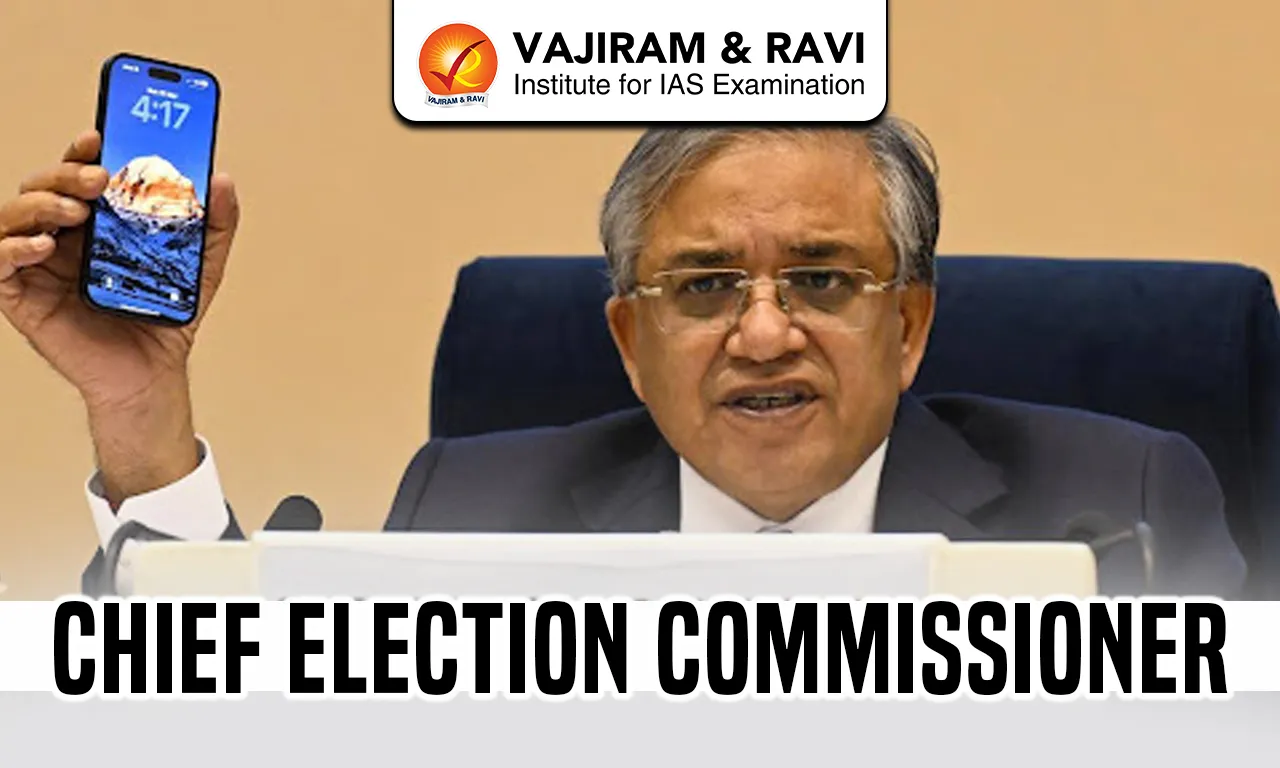
Chief Election Commission Latest News
Office of the Chief Election Commissioner
- The Chief Election Commissioner (CEC) is the head of the Election Commission of India, a constitutional body established under Article 324 of the Constitution.
- The Commission is responsible for conducting free and fair elections to Parliament, State Legislatures, and the offices of the President and Vice-President.


Appointment of CEC
- The CEC is appointed by the President of India.
- As per the Chief Election Commissioner and Other Election Commissioners Act, 2023, the appointment is made on the recommendation of a selection committee comprising:
- Prime Minister,
- Leader of the Opposition in the Lok Sabha, and
- One Union Cabinet Minister.
- This aims to bring transparency and balance in the selection process.
Tenure
- The CEC holds office for a term of six years or until the age of 65 years, whichever is earlier.
- The conditions of service cannot be varied to their disadvantage after appointment, ensuring independence.
Powers and Functions
- The Election Commission, headed by the CEC, enjoys wide-ranging powers under Article 324.
- These include:
- Superintendence, direction, and control of elections.
- Preparation and revision of electoral rolls.
- Conduct of free and fair elections.
- Monitoring election expenditure and enforcing the Model Code of Conduct.
- The Commission also has plenary powers to act in areas where laws are silent, ensuring the integrity of the electoral process.
Removal Process
- The removal of the CEC is similar to that of a Supreme Court judge.
- Under Article 324(5), the CEC can be removed only on grounds of proved misbehaviour or incapacity. The process requires:
- A motion passed in both Houses of Parliament.
- Special majority (majority of total membership and two-thirds of members present and voting).
- This high threshold ensures institutional independence and protects the office from arbitrary removal.
News Summary
- Rajya Sabha Chairman C.P. Radhakrishnan and Lok Sabha Speaker Om Birla rejected notices submitted by Opposition MPs seeking the removal of Chief Election Commissioner Gyanesh Kumar.
- The presiding officers held that the Opposition failed to provide sufficient proof and that the allegations did not establish a prima facie case of “misbehaviour,” which is a constitutional requirement for removal.
- The notices were signed by 63 Rajya Sabha members and 130 Lok Sabha members and included seven charges against the CEC. These charges were examined in detail and subsequently rejected.
- The presiding officers stated that the allegations either lacked evidence, related to matters already adjudicated, or were currently under judicial consideration.
- They emphasised that such issues did not meet the “high constitutional bar” required to initiate removal proceedings under Articles 324(5) and 124(4).
Allegations Made Against the CEC
- Several specific allegations were addressed. Claims regarding the CEC’s appointment being “tainted” were dismissed, as the pendency of a legal challenge does not constitute misbehaviour.
- Similarly, allegations of bias or differential treatment between the government and the opposition lacked demonstrable evidence.
- The refusal to share electoral data or provide machine-readable electoral rolls was found to be consistent with legal provisions and Supreme Court directions, including considerations of privacy under the Puttaswamy judgment.
- Issues related to the Special Intensive Revision (SIR) of electoral rolls were also examined.
Basis of Rejection of the Allegations
- The presiding officers reiterated that the Election Commission has plenary powers under Article 324 and that the Supreme Court has affirmed its competence in such matters.
- Allegations of contempt of court and lack of institutional independence were rejected as either falling under judicial jurisdiction or being vague and unsupported by evidence.
- Overall, the decision reinforced the constitutional safeguards surrounding the office of the CEC and highlighted the stringent standards required for initiating removal proceedings.
Source: TH

 Last updated on Oct, 2026
→ UPSC 2027 Notification will be released on 13 January 2027 at upsconline.nic.in.
→ Check Nobel Prize 2026 Winners List here.
→ Download PIB PRiSM Monthly Magazine 2026 here.
→ Check UPSC Monthly Current Affairs Magazine The Recitals here.
→ Check out the latest UPSC Syllabus here.
→ Download UPSC Model Answers for Mains 2026
→ UPSC Mains Question Paper 2026 is out now for Essay & GS Paper 1, 2, 3 & 4.
→ UPSC Calendar 2027 has been released.
→ Enroll in Vajiram & Ravi’s UPSC Mains Test Series 2027 for structured answer writing practice, expert evaluation, and exam-oriented feedback.
→ Join Vajiram & Ravi’s UPSC Mentorship Program 2027 for personalized guidance, strategy planning, and one-to-one support from experienced mentors.
→ Go through the UPSC Mains Previous Year Papers to enhance your preparation.
→ UPSC has released UPSC Toppers List 2025 with the Civil Services final result on its official website.
→ Also check Best UPSC Coaching in India
Chief Election Commissioner FAQs
Q1. Who appoints the Chief Election Commissioner?+
Q2. What is the tenure of the CEC?+
Q3. Under which Article is the Election Commission established?+
Q4. How can the CEC be removed?+
Q5. Why was the recent removal plea rejected?+
Tags: chief election commissioner mains articles upsc current affairs upsc mains current affairs