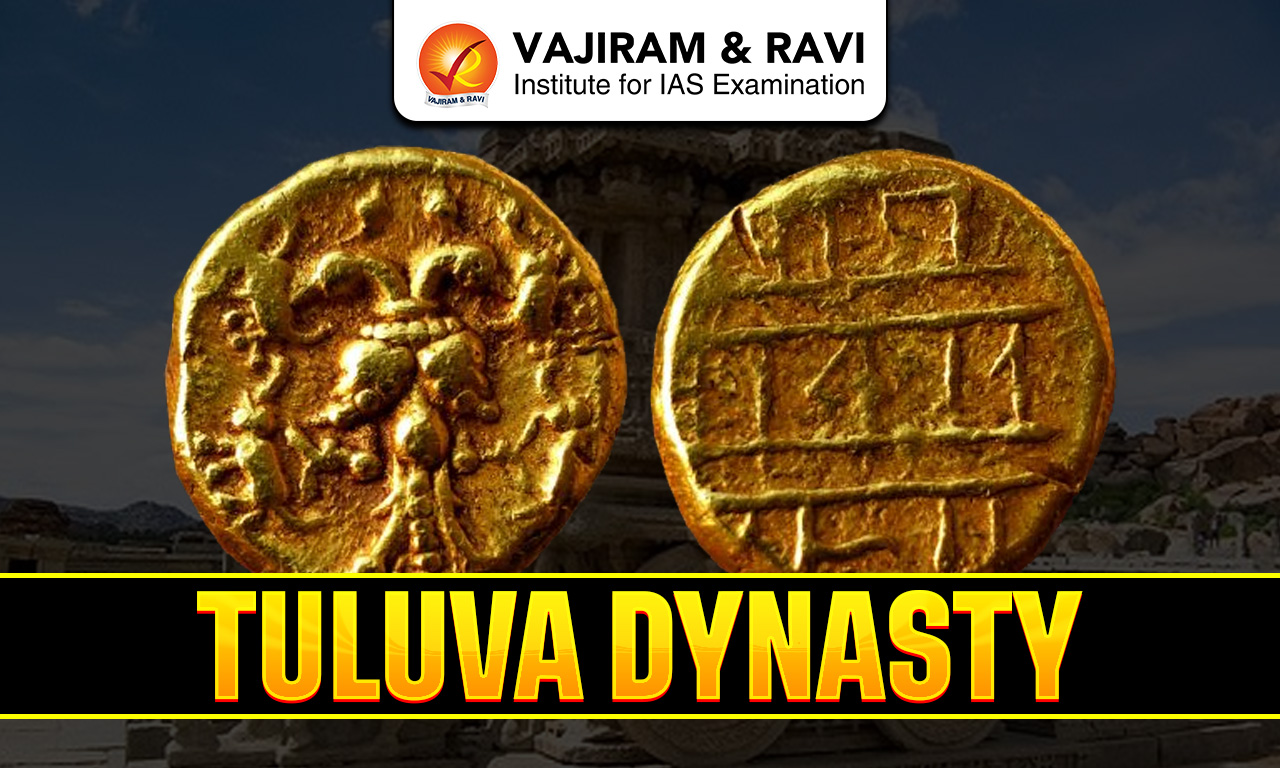
The Tuluva Dynasty was a ruling family in South India that played an important role in the history of the Vijayanagara Empire. It came to power during a time of change and helped strengthen the empire. The rulers of this dynasty contributed to the growth of administration, culture, and overall stability. In general, the Tuluva Dynasty is remembered for its role in maintaining the power and importance of the Vijayanagara Empire.
Tuluva Dynasty History
- The Tuluva Dynasty was an important ruling family of the Vijayanagara Empire. It originally came from the Tulu-speaking region on the western coast of South India. Information about their early ancestors is found in inscriptions, such as those at the Tirumala Temple.
- The earliest known ancestors of this dynasty were Timmabhupati and his wife Devaki. They were followed by their son Ishvara and then Narasa Bhupala, who is better known as Tuluva Narasa Nayaka. He was a powerful military leader who helped strengthen the empire by defeating enemies like the Gajapatis and some Muslim rulers.
- After him, his son Krishnadevaraya became the most famous ruler of the dynasty. His rule is often considered the golden period of the Vijayanagara Empire. He was a capable king who maintained peace and prosperity and supported art, culture, and literature. Even though he spoke Tulu, he respected many languages and encouraged literature in Sanskrit, Tamil, Kannada, and Telugu. He especially promoted Telugu and even wrote a famous work called Amuktamalyada in that language.
- The rulers of the Tuluva Dynasty were followers of Vaishnavism and supported its growth. Krishnadevaraya was guided by the saint Vyasatirtha.
- After the decline of the Tuluva rulers, the Vijayanagara Empire also started to weaken. This marked the beginning of the empire’s gradual fall.
Tuluva Dynasty Key Rulers
The Tuluva Dynasty was an important ruling family of the Vijayanagara Empire. It came to power in the early 16th century after a period of political instability. Below are its main rulers and their contributions:
- Vira Narasimha Raya (1505-1509)
- Vira Narasimha founded the Tuluva Dynasty after taking control following the decline of the Saluva rulers. He worked to stabilize the empire and maintain control during a difficult time. Though his rule was short, he laid the foundation for future success.
- Krishnadevaraya (1509-1529)
- Krishnadevaraya was the greatest ruler of the Vijayanagara Empire. He was the younger brother of Vira Narasimha and made the empire very powerful. He is also known as Andhra Bhoj because of his support for literature and learning.
- Military Achievements: He fought wars against the Bahmani Sultanates and the Gajapati rulers of Odisha. He captured important regions like Raichur Doab (1512), defeated Odisha rulers (1514), and won against the Sultan of Bijapur (1520). He also captured strong forts like Udayagiri.
- Expansion and Foreign Relations: He expanded his control to coastal areas like Malabar and Konkan with the help of the Portuguese. He allowed them to build a fort at Bhatkal, which helped in trade and military support.
- Administration and Tax System: He had a strong administration. Land tax was fixed based on the quality of land, and industries had to pay taxes. This helped improve the economy.
- Architecture and Temples: He supported temple building and gave donations to places like Tirupati, Srisailam, and Kanchipuram. He added tall gopurams (temple towers) and built a victory pillar at Simhachalam. He also founded a town called Nagalapuram.
- Culture and Literature: He was a great scholar of Telugu and Sanskrit. He wrote the famous Telugu work Amuktamalyada. He supported a group of eight famous Telugu poets called Ashtadiggajas, including Allasani Peddana and Tenali Ramakrishna. He also supported scholars from Kannada and Tamil traditions.
- Foreign Accounts: Travellers like Domingo Paes and Fernao Nuniz praised his rule and described the richness of his empire.
- Religious and Political Policy: Although he followed Vaishnavism, he was tolerant towards other religions. He even helped some Muslim rulers and took pride in the title “establisher of the Yavana kingdom.”
- Achyuta Deva Raya (1529-1542)
- After Krishnadevaraya’s death, his brother Achyuta Deva Raya became king. His rule was more difficult because the empire started facing internal problems and external threats.
- He was supported by powerful nobles like Saluva Nayak, which helped him stay in power. Though some foreign writers described him negatively, he tried to maintain stability and protect the empire.
- Sadasiva Raya (1543-1567)
- Sadasiva Raya was the last ruler of the Tuluva Dynasty, but he did not have real power. The actual control was in the hands of his minister Aliya Rama Raya.
- Role of Rama Raya: Rama Raya was a strong leader and strategist. He placed his relatives in important positions and controlled the administration.
- Relations with Other Kingdoms: He tried to manage the Deccan Sultanates by playing them against each other. He also made a treaty with the Portuguese and controlled horse trade, which was very important for armies.
- Conflicts and Decline: Rama Raya fought and sometimes allied with different Sultanates like Bijapur. These shifting alliances finally led to the Battle of Talikota (1565), where Vijayanagara was badly defeated.


Tuluva Dynasty Significance
- The Tuluva Dynasty played a key role in making the Vijayanagara Empire strong and prosperous. Under rulers like Krishnadevaraya, the empire reached its peak in power, stability, and economic growth.
- The dynasty helped in expanding the empire by defeating powerful enemies and securing important regions. It also promoted culture, literature, and art, leading to great developments in languages like Telugu, Sanskrit, Kannada, and Tamil.
- The rulers supported temple building and architecture and maintained good relations with foreign powers like the Portuguese, which helped trade and military strength.

 Last updated on Oct, 2026
→ UPSC 2027 Notification will be released on 13 January 2027 at upsconline.nic.in.
→ Check Nobel Prize 2026 Winners List here.
→ Download PIB PRiSM Monthly Magazine 2026 here.
→ Check UPSC Monthly Current Affairs Magazine The Recitals here.
→ Check out the latest UPSC Syllabus here.
→ Download UPSC Model Answers for Mains 2026
→ UPSC Mains Question Paper 2026 is out now for Essay & GS Paper 1, 2, 3 & 4.
→ UPSC Calendar 2027 has been released.
→ Enroll in Vajiram & Ravi’s UPSC Mains Test Series 2027 for structured answer writing practice, expert evaluation, and exam-oriented feedback.
→ Join Vajiram & Ravi’s UPSC Mentorship Program 2027 for personalized guidance, strategy planning, and one-to-one support from experienced mentors.
→ Go through the UPSC Mains Previous Year Papers to enhance your preparation.
→ UPSC has released UPSC Toppers List 2025 with the Civil Services final result on its official website.
→ Also check Best UPSC Coaching in India
Tuluva Dynasty FAQs
Q1. What was the Tuluva Dynasty?+
Q2. Where did the Tuluva Dynasty originate?+
Q3. Who was the founder of the Tuluva Dynasty?+
Q4. Why is Krishnadevaraya considered the greatest ruler?+
Q5. What were the major achievements of Krishnadevaraya?+
Tags: history history notes tuluva dynasty