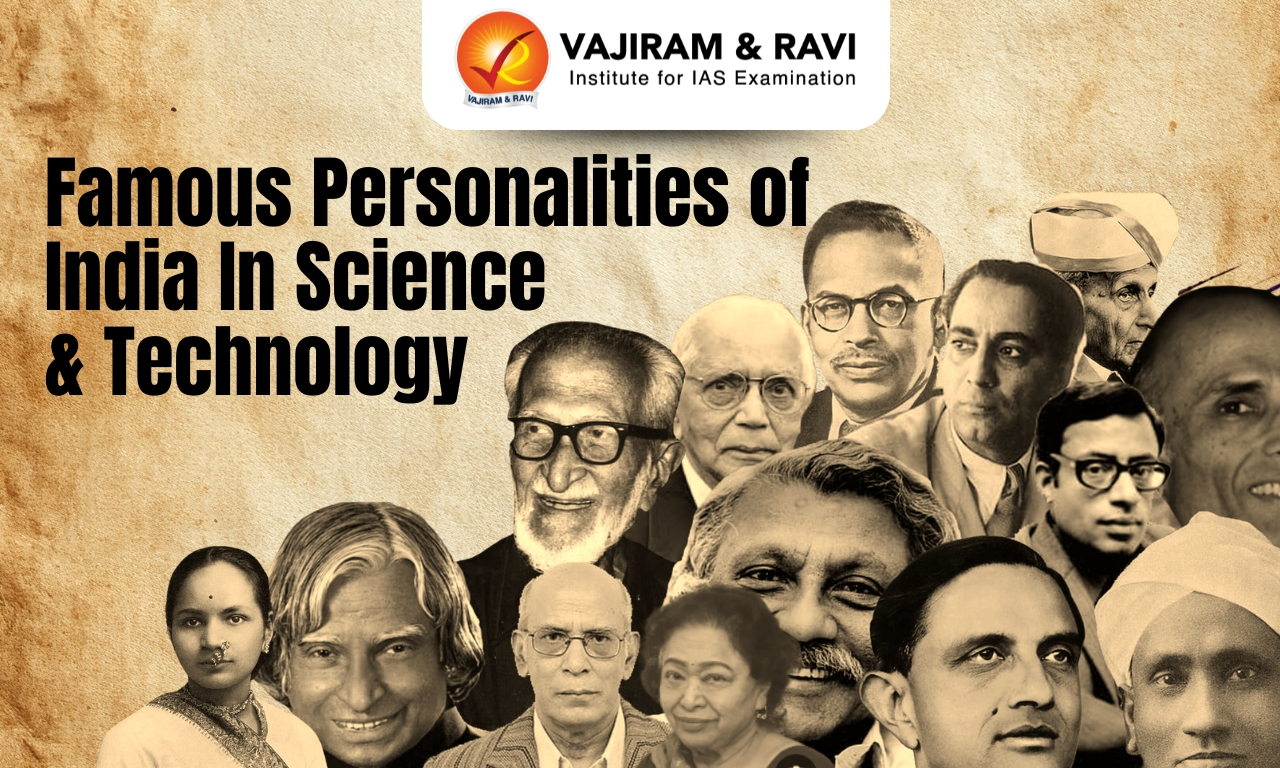
One of the oldest civilizations in the world, the Indian civilization has a strong tradition of science and technology. In the early period, Indians made important discoveries in mathematics, astronomy, and medicine, which laid a strong foundation for future knowledge. In modern times, Indian scientists have made significant progress in fields like space technology, nuclear science, agriculture, and information technology. Together, these contributions have played an important role in the growth of science both in India and across the world.
Famous Personalities of India in Science & Technology in Ancient and Early Medieval India
India has a rich scientific heritage, with important contributions from ancient and medieval times:
Baudhayana
- Baudhayana was one of the earliest Indian mathematicians associated with the Sulba Sutras, which were texts dealing with geometric rules for constructing Vedic altars.
- He made an important contribution by stating a principle equivalent to the Pythagorean Theorem, showing that the square of the diagonal is equal to the sum of the squares of the sides.
Pingala
- Pingala was a Vedic scholar who wrote the Chandahsastra, a treatise on Sanskrit prosody.
- He introduced the concept of binary numbers (0 and 1), which later became the foundation of modern computer systems.
- He also described patterns similar to the Fibonacci sequence in poetic meter analysis.
Kanad
- Kanad was an ancient philosopher who developed the Vaisheshika school of thought.
- He proposed an early atomic theory, suggesting that matter is made up of indivisible particles called “anu.”
- His ideas anticipated modern atomic theory long before John Dalton.
Sushruta
- Sushruta was a pioneering surgeon of ancient India and is often called the father of surgery.
- In his work Sushruta Samhita, he described detailed surgical procedures, including plastic surgery, cataract operations, and wound treatment.
- The text also lists over a hundred surgical instruments, demonstrating the systematic development of surgical science in ancient India.
- His systematic approach to surgery, use of instruments, and emphasis on training and hygiene demonstrate the advanced state of medical science in ancient India.
Charaka
- Charaka was a leading physician and a major contributor to Ayurveda, the traditional system of Indian medicine.
- His text Charaka Samhita explains diagnosis, treatment, and prevention of diseases in a detailed and systematic way.
- He emphasized preventive healthcare, balanced diet, and lifestyle, showing a holistic understanding of health and medicine.
Aryabhata
- Aryabhata stands as one of the greatest mathematicians and astronomers of ancient India
- In his work Aryabhatiya, he proposed that the Earth rotates on its axis, challenging prevailing geocentric beliefs.
- He calculated the value of pi with remarkable accuracy and made significant contributions to trigonometry, including the introduction of sine functions.
- His explanation of eclipses as natural astronomical phenomena rather than supernatural events marked a shift toward scientific reasoning.
Brahmagupta
- Brahmagupta made major contributions to mathematics and astronomy through his work Brahmasphutasiddhanta.
- He defined zero as a number and gave rules for arithmetic operations involving zero and negative numbers.
- His work influenced the Islamic world and later European mathematics.
Bhaskara II
- Bhaskara II, also known as Bhaskaracharya, was a leading mathematician of medieval India.
- His works Lilavati and Bijaganita deal with arithmetic, algebra, and geometry in a clear and systematic manner.
- He introduced early ideas related to calculus, such as concepts of change and motion, showing advanced mathematical thinking.
Madhava of Sangamagrama
- Madhava was the founder of the Kerala School of Mathematics, one of the most advanced mathematical traditions in medieval India.
- He developed infinite series for trigonometric functions like sine and cosine.
- His work anticipated ideas of calculus much before they appeared in Europe.
Famous Personalities of India in Science & Technology in Modern India
Famous Personalities of India in Science & Technology in Modern India have played a crucial role in advancing scientific knowledge and driving technological progress, contributing significantly to both national development and global innovation.
Srinivasa Ramanujan
- Ramanujan was a self-taught mathematical genius who made remarkable contributions to number theory and infinite series.
- His collaboration with G.H. Hardy brought international recognition to his work.
- Many of his discoveries continue to influence modern mathematics even today.
C. V. Raman
- C.V. Raman was a distinguished physicist who discovered the Raman Effect, explaining how light changes when it passes through a medium.
- This discovery earned him the Nobel Prize in Physics in 1930.
- It led to the development of Raman Spectroscopy, widely used in science and industry.
Satyendra Nath Bose
- S.N. Bose made a major contribution to quantum mechanics through Bose-Einstein statistics.
- His work led to the classification of particles called bosons.
- This concept is fundamental to understanding the behavior of matter at the quantum level.
Meghnad Saha
- Meghnad Saha developed the Saha Ionization Equation, which explains how elements behave at high temperatures.
- This helped scientists understand the composition of stars.
- His work remains essential in astrophysics.
Homi J. Bhabha
- Homi J. Bhabha is regarded as the architect of India’s nuclear programme.
- He established major scientific institutions such as the Tata Institute of Fundamental Research and played a key role in the Atomic Energy Commission.
- His vision focused on the peaceful use of nuclear energy for development, laying the institutional and technological foundation for India’s nuclear capabilities.
Jagadish Chandra Bose
- Jagadish Chandra Bose was a pioneering Indian scientist who made significant contributions to both physics and plant physiology.
- In the field of radio science, he conducted early experiments on microwave transmission and developed devices for wireless communication.
- In plant physiology, he proved through experiments that plants respond to external stimuli such as light, heat, and electricity, similar to living organisms.
- He invented the crescograph, an instrument capable of measuring very small movements in plant growth, which provided scientific evidence of plant sensitivity.
Vikram Sarabhai
- Vikram Sarabhai is known as the father of the Indian space programme.
- He founded the Indian Space Research Organisation and promoted the use of space technology for communication, weather forecasting, and rural development.
- His vision ensured that India’s space programme focused on practical applications for national development rather than prestige alone.
A. P. J. Abdul Kalam
- A.P.J. Abdul Kalam played a central role in India’s missile and space programmes, earning the title “Missile Man of India.”
- He contributed to the development of satellite launch vehicles and led the Integrated Guided Missile Development Programme (IGMDP).
- He also played a key role in India’s nuclear tests and later became the President of India, inspiring youth toward science and innovation.
M. S. Swaminathan
- M.S. Swaminathan is known as the father of the Green Revolution in India.
- He introduced high-yielding varieties of wheat and rice, significantly increasing agricultural productivity.
- His work transformed India from a food-deficit nation into a food-surplus country and ensured long-term food security.
C. N. R. Rao
- C.N.R. Rao is one of the world’s leading materials scientists, with contributions to solid-state chemistry and nanotechnology.
- His research has advanced the understanding of materials used in electronics, energy storage, and superconductors.
- He has also played an important role in shaping India’s science policy and promoting research and innovation.
Har Gobind Khorana
- He decoded the genetic code and won the Nobel Prize in Medicine (1968).
- He contributed to understanding DNA and protein synthesis.
- His work laid the foundation for biotechnology.


 Last updated on Oct, 2026
→ UPSC 2027 Notification will be released on 13 January 2027 at upsconline.nic.in.
→ Check Nobel Prize 2026 Winners List here.
→ Download PIB PRiSM Monthly Magazine 2026 here.
→ Check UPSC Monthly Current Affairs Magazine The Recitals here.
→ Check out the latest UPSC Syllabus here.
→ Download UPSC Model Answers for Mains 2026
→ UPSC Mains Question Paper 2026 is out now for Essay & GS Paper 1, 2, 3 & 4.
→ UPSC Calendar 2027 has been released.
→ Enroll in Vajiram & Ravi’s UPSC Mains Test Series 2027 for structured answer writing practice, expert evaluation, and exam-oriented feedback.
→ Join Vajiram & Ravi’s UPSC Mentorship Program 2027 for personalized guidance, strategy planning, and one-to-one support from experienced mentors.
→ Go through the UPSC Mains Previous Year Papers to enhance your preparation.
→ UPSC has released UPSC Toppers List 2025 with the Civil Services final result on its official website.
→ Also check Best UPSC Coaching in India
Famous Personalities of India in Science & Technology FAQs
Q1. Who among Indian scientists first proposed that the Earth rotates on its axis?+
Q2. Which ancient Indian text is associated with surgery and medical practices?+
Q3. Who defined zero as a number and gave rules for its operations?+
Q4. Which Indian scientist is associated with the Raman Effect?+
Q5. Who is known as the father of the Indian space programme?+
Tags: famous personalities of india in science & technology