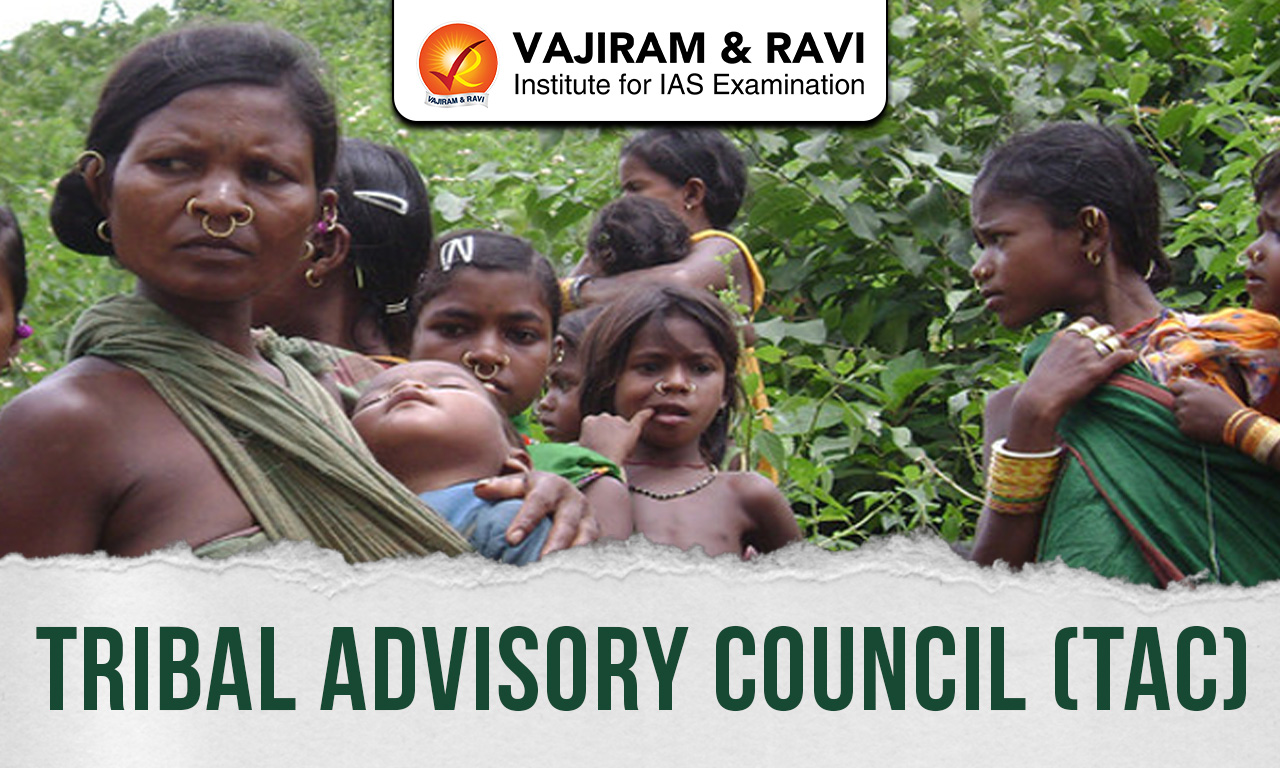
The Tribal Advisory Council (TAC) is an important constitutional body established to ensure the welfare and advancement of Scheduled Tribes in India. It acts as a bridge between tribal communities and the state government by providing advice on key issues. The council plays a significant role in protecting tribal interests, especially in Scheduled Areas and helps in shaping policies related to social, economic and cultural development of tribal populations.
Tribal Advisory Council (TAC) Background
The Tribal Advisory Council (TAC) originates from constitutional provisions aimed at safeguarding tribal interests in Scheduled Areas.
- Origin: The concept of TAC is derived from the Fifth Schedule of the Constitution, which mandates its establishment in states having Scheduled Areas.
- Historical Context: The Fifth Schedule was adopted in September 1949 to address administration and control of tribal areas, ensuring autonomy and protection of tribal rights over land and resources.
- Applicability: TAC is compulsory in states with Scheduled Areas and can also be established in states having Scheduled Tribes even without Scheduled Areas, if directed by the President.
- Coverage of States: TACs have been constituted in 10 states with Scheduled Areas: Andhra Pradesh, Telangana, Chhattisgarh, Gujarat, Himachal Pradesh, Jharkhand, Madhya Pradesh, Maharashtra, Odisha and Rajasthan.
- Extension to Other States: States like West Bengal, Tamil Nadu and Uttarakhand, though lacking Scheduled Areas, have also formed TACs, ensuring no mandated state remains without such a council.
Tribal Advisory Council (TAC) Features
The Tribal Advisory Council (TAC) has defined structural and constitutional features that ensure representation and functioning focused on tribal welfare.
- Establishment Criteria: TAC must be established in every state having Scheduled Areas and may also be formed in states with Scheduled Tribes if the President directs its formation.
- Constitutional Basis: It is established under Paragraph 4 of the Fifth Schedule under the Article 244(1), making it a constitutionally mandated advisory body for tribal welfare.
- Composition: TAC consists of not more than 20 members, ensuring a compact and focused advisory structure to address tribal issues effectively at the state level.
- Representation Rule: As nearly as possible, three-fourths of the members must be representatives of Scheduled Tribes in the State Legislative Assembly, ensuring strong tribal representation.
- Filling Vacancies: If sufficient ST representatives are not available in the Legislative Assembly, remaining seats are filled by other members belonging to Scheduled Tribes.
- Appointment and Structure: The Governor has the authority to determine the number of members, mode of appointment and appoint the Chairman and supporting staff of the council.
- Regulatory Powers of Governor: The Governor can frame rules regarding the conduct of meetings, procedures and other incidental matters necessary for smooth functioning of the council.


Tribal Advisory Council (TAC) Functions
The Tribal Advisory Council (TAC) primarily acts as an advisory body focusing on tribal welfare and development in states.
- Advisory Role: The core function of TAC is to advise on matters related to the welfare and advancement of Scheduled Tribes when such issues are referred by the Governor.
- Welfare Oriented Mandate: TAC addresses issues such as socio-economic development, land rights, cultural preservation and access to resources for tribal communities.
- Governor Centric Functioning: The council functions under the direction of the Governor, who decides which matters should be placed before it for advice and consultation.
- Policy Input Mechanism: TAC provides inputs on policy decisions impacting Scheduled Tribes, ensuring that tribal perspectives are included in governance processes.
- Link with PESA Act 1996: TAC plays an indirect role in supporting implementation of provisions like self governance in Scheduled Areas through Gram Sabhas under the Panchayat Extension to Scheduled Areas (PESA) Act.
- Cultural Protection: The council advises on preserving tribal traditions, customs and social practices, preventing external interference in their cultural identity.
- Land and Resource Safeguards: TAC helps in advising on protection of tribal land rights, including issues related to land acquisition, transfer and use of natural resources.
Tribal Advisory Council (TAC) Significance
The Tribal Advisory Council (TAC) holds crucial importance in ensuring inclusive governance and protection of tribal communities.
- TAC acts as a constitutional mechanism to ensure that tribal interests are formally integrated into state governance and policy making processes.
- By including majority ST representatives, TAC ensures that tribal communities directly participate in decisions affecting their lives and development.
- The council serves as a link between the government and tribal populations, improving communication and addressing grievances effectively.
- TAC contributes to balanced development by focusing on the socio-economic upliftment of historically marginalized tribal communities.
- Through its advisory role, TAC supports decentralized governance and complements institutions like Gram Sabhas in Scheduled Areas.
- It plays a key role in safeguarding land rights, cultural heritage and traditional practices of tribal communities against exploitation.
- TAC ensures that state policies are sensitive to tribal needs, particularly in areas like education, health, livelihood and natural resource management.
- TAC strengthens the broader constitutional framework for tribal administration under the Fifth Schedule, ensuring continuous oversight and advisory support.
- By advising on welfare measures, TAC indirectly promotes accountability in governance related to Scheduled Tribes and Scheduled Areas.

 Last updated on Oct, 2026
→ UPSC 2027 Notification will be released on 13 January 2027 at upsconline.nic.in.
→ Check Nobel Prize 2026 Winners List here.
→ Download PIB PRiSM Monthly Magazine 2026 here.
→ Check UPSC Monthly Current Affairs Magazine The Recitals here.
→ Check out the latest UPSC Syllabus here.
→ Download UPSC Model Answers for Mains 2026
→ UPSC Mains Question Paper 2026 is out now for Essay & GS Paper 1, 2, 3 & 4.
→ UPSC Calendar 2027 has been released.
→ Enroll in Vajiram & Ravi’s UPSC Mains Test Series 2027 for structured answer writing practice, expert evaluation, and exam-oriented feedback.
→ Join Vajiram & Ravi’s UPSC Mentorship Program 2027 for personalized guidance, strategy planning, and one-to-one support from experienced mentors.
→ Go through the UPSC Mains Previous Year Papers to enhance your preparation.
→ UPSC has released UPSC Toppers List 2025 with the Civil Services final result on its official website.
→ Also check Best UPSC Coaching in India
Tribal Advisory Council (TAC) FAQs
Q1. What is the Tribal Advisory Council (TAC)?+
Q2. Under which constitutional provision is the Tribal Advisory Council (TAC) established?+
Q3. What is the maximum strength of a Tribal Advisory Council (TAC)?+
Q4. Which states have Tribal Advisory Council (TAC)?+
Q5. What is the main function of the Tribal Advisory Council (TAC)?+
Tags: governance indian constitution tribal advisory council (tac)