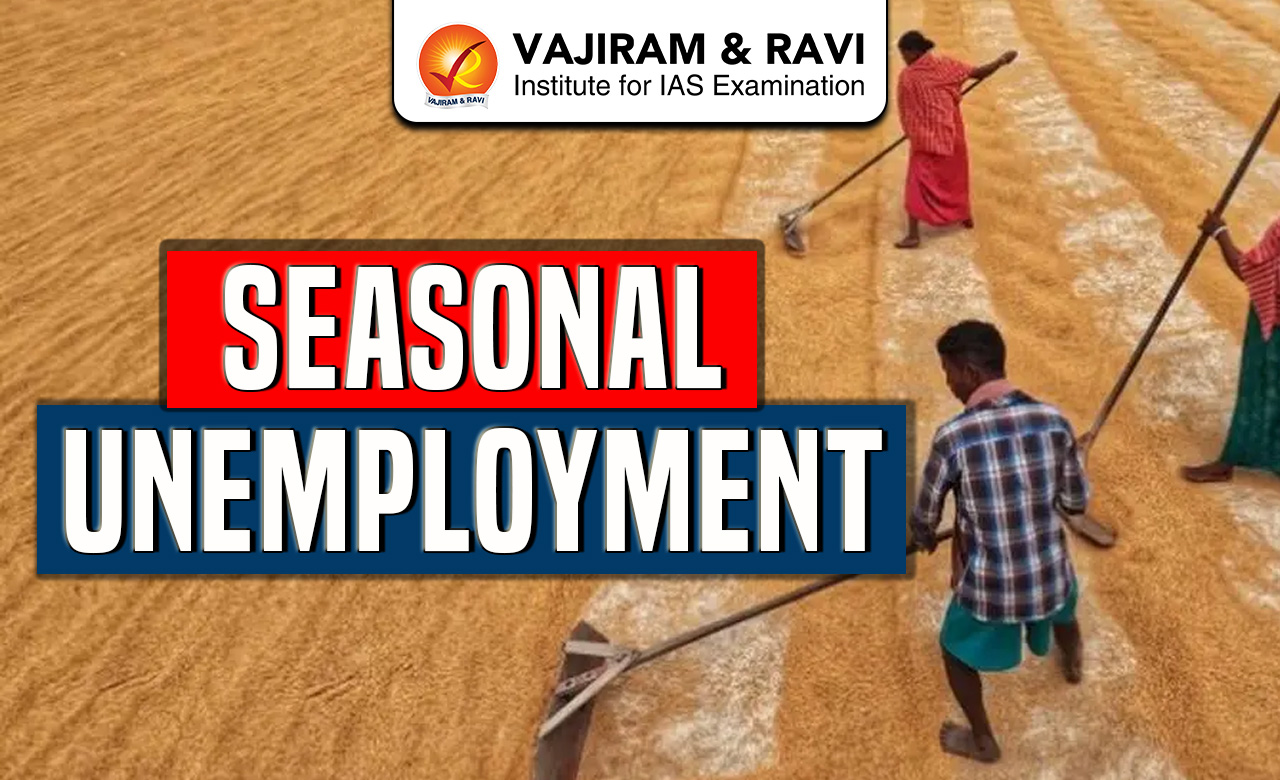
Seasonal unemployment is a type of unemployment that occurs when people are unable to find work during certain times of the year. It usually happens in jobs that depend on seasons, such as agriculture, tourism, or construction. During off-seasons, workers may not have regular employment, but they can find work again when the season returns. This type of unemployment is temporary and repeats in a regular pattern.
For example, in India, agricultural workers are mostly employed during sowing and harvesting seasons, but may not have work in between. Similarly, during festivals and wedding seasons, demand for services like catering, decoration, transport, and retail increases, creating temporary jobs. Once the season ends, many workers again become unemployed.
Seasonal Unemployment Key Features
- Temporary in nature: Seasonal unemployment does not last throughout the year. It occurs only for a specific period when there is no work available and ends when the working season begins again.
- Repeats every year: It follows a regular and predictable pattern. Workers know in advance that they will be employed during certain months and unemployed during others.
- Linked to seasons and climate: Employment depends heavily on natural factors like weather, rainfall, or specific seasons, especially in agriculture and tourism.
- Limited to certain sectors: It is mostly seen in industries like farming, tourism, construction, and seasonal manufacturing, where work is not continuous throughout the year.
- Common in rural areas: Seasonal unemployment is more common in rural and less developed regions where people depend mainly on agriculture and have fewer alternative job options.
- Causes irregular income: Since workers earn only during certain periods, their income is not stable, making it difficult to manage expenses throughout the year.
Also Read: Frictional Unemployment
Reasons for Seasonal Unemployment
- Dependence on natural conditions: A large part of employment, especially in agriculture, depends on factors like rainfall and climate. In India, since agriculture relies heavily on the monsoon, there is less work during non-monsoon periods.
- Nature of certain industries: Some industries operate only at particular times, such as tourism (peak seasons in hill stations or beaches) or sugar mills that function during specific months.
- Limited job opportunities in rural areas: In many regions, especially rural areas, there are few alternative sources of employment during the off-season.
- Low level of industrialization: Lack of industries and infrastructure limits year-round job opportunities.
- Lack of skills and awareness: Workers may not have the necessary skills or information to shift to other types of jobs during the off-season.
Also Read: Types of Unemployment


Seasonal Unemployment Impact
- Irregular and unstable income: Workers earn only for part of the year, making it difficult to maintain a steady income.
- Financial difficulties: People struggle to meet basic needs like food, rent, healthcare, and education during the off-season.
- Low savings and poverty: Due to already low wages, saving money becomes difficult, which can push families into poverty.
- Migration for work: Many workers move to cities or other regions in search of temporary jobs, which can disrupt family life and social stability.
- Underutilization of labour: Workers remain idle for a part of the year, leading to wastage of human resources.
- Opportunity for skill diversification: Some workers take up different jobs during the off-season, which can help them learn new skills and improve future employment chances.
Measures to Reduce Seasonal Unemployment
- Providing alternative employment: Governments can create jobs through public works like road construction, irrigation projects, and rural development schemes during the off-season.
- Skill development and training: Training programs can help workers learn new skills and find work in other sectors such as small industries or services.
- Diversification of economic activities: Encouraging multiple industries in a region can ensure year-round employment opportunities.
- Improving agricultural practices: Better irrigation, use of technology, and multiple cropping can increase agricultural activities throughout the year.
- Promotion of small-scale and cottage industries: These industries can provide additional employment, especially in rural areas.
- Social security measures: Providing financial assistance, wage support, or employment guarantee schemes can help workers manage during the off-season.

 Last updated on Oct, 2026
→ UPSC 2027 Notification will be released on 13 January 2027 at upsconline.nic.in.
→ Check Nobel Prize 2026 Winners List here.
→ Download PIB PRiSM Monthly Magazine 2026 here.
→ Check UPSC Monthly Current Affairs Magazine The Recitals here.
→ Check out the latest UPSC Syllabus here.
→ Download UPSC Model Answers for Mains 2026
→ UPSC Mains Question Paper 2026 is out now for Essay & GS Paper 1, 2, 3 & 4.
→ UPSC Calendar 2027 has been released.
→ Enroll in Vajiram & Ravi’s UPSC Mains Test Series 2027 for structured answer writing practice, expert evaluation, and exam-oriented feedback.
→ Join Vajiram & Ravi’s UPSC Mentorship Program 2027 for personalized guidance, strategy planning, and one-to-one support from experienced mentors.
→ Go through the UPSC Mains Previous Year Papers to enhance your preparation.
→ UPSC has released UPSC Toppers List 2025 with the Civil Services final result on its official website.
→ Also check Best UPSC Coaching in India
Seasonal Unemployment FAQs
Q1. What is seasonal unemployment?+
Q2. In which sectors is seasonal unemployment common?+
Q3. Why does seasonal unemployment occur?+
Q4. What are the main features of seasonal unemployment?+
Q5. What are the effects of seasonal unemployment?+
Tags: economy economy notes seasonal unemployment