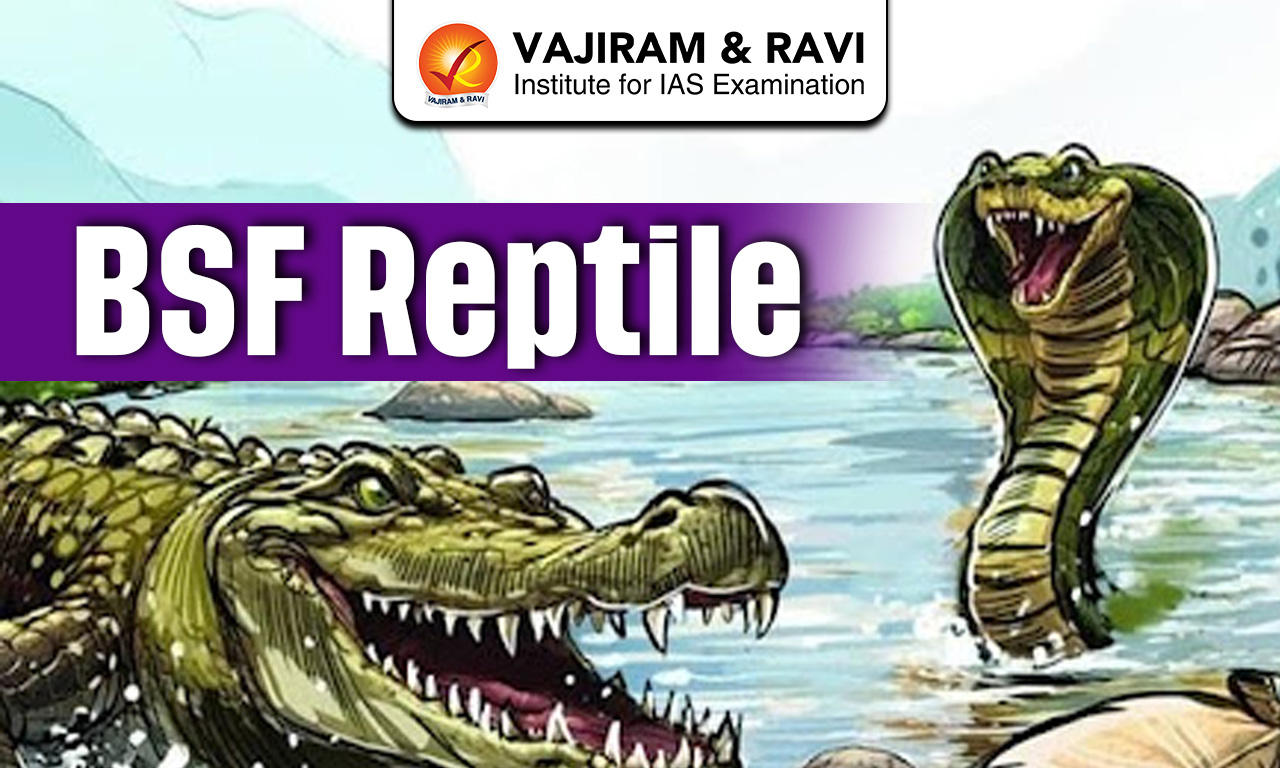
BSF Reptile Latest News
- The Border Security Force has directed field units to explore the feasibility of deploying reptiles like snakes and crocodiles in riverine border areas to curb infiltration and criminal activities.
- The directive, issued after a meeting in Delhi, aligns with inputs linked to Union Minister of Home Affairs. Field units have been asked to examine operational feasibility, not implement the idea immediately.
India – Bangladesh Border
- The India-Bangladesh border covers a total length of approximately 4,096.7 kilometers. It is the longest land border India shares with any neighbor.
- It passes through five Indian states — West Bengal (2,217 km), Tripura (856 km), Meghalaya (443 km), Mizoram (318 km) and Assam (262 km).
- The border is characterised by a complex mix of riverine stretches, forests, haor (wetland) regions, and densely populated areas on both sides, making it one of the most difficult borders to manage in the world.
Institutional and Legal Framework
- The Border Security Force (BSF) is the primary agency responsible for guarding this border on the Indian side.
- The Land Boundary Agreement (LBA), 2015 was a landmark agreement that resolved the long-standing enclaves dispute — 111 Indian enclaves in Bangladesh and 51 Bangladeshi enclaves in India were exchanged, settling a decades-old humanitarian and territorial anomaly.
- The Comprehensive Integrated Border Management System (CIBMS) is being deployed along this border to leverage technology for surveillance.
Key Challenges
- Illegal Immigration – The porous nature of the border, shared language and ethnicity in many regions, and economic push factors from Bangladesh have historically driven large-scale undocumented migration into states like West Bengal and Assam.
- Fencing and Physical Barriers – India has undertaken the Border Fencing Project along the India-Bangladesh border. However, a significant portion of the border — particularly riverine and wetland stretches — remains unfenced or poorly fenced.
- Riverine boundaries are especially difficult to demarcate and fence, as rivers shift course over time.
- Smuggling and Trafficking – The border witnesses active smuggling of cattle, narcotics, gold, fake Indian currency notes (FICN), and consumer goods. Human trafficking — particularly of women and children — is another grave challenge along this border.
- Infiltration and Insurgency Linkages – There are longstanding concerns about infiltration of insurgent elements from across the border, particularly in the northeastern states.
Technological Interventions
- CIBMS (Comprehensive Integrated Border Management System) — integrates sensors, cameras, radars, and communication systems for real-time surveillance.
- Smart Fencing (BOLD-QIT) — Border Electronically Dominated QRT Interception Technique — deployed in Assam and other northeastern states to monitor unfenced riverine stretches using laser sensors and infrared cameras.
- Unmanned Aerial Vehicles (UAVs/Drones) are increasingly being used for aerial surveillance of difficult terrain.
- Floodlights and CCTV networks along vulnerable stretches.


BSF’s Reptile Proposal for Bangladesh Border
- The Border Security Force (BSF) has proposed an unconventional idea to curb infiltration along the India-Bangladesh border — releasing reptiles such as snakes and crocodiles into riverine stretches vulnerable to illegal crossings.
- The proposal comes in the context of India’s border with Bangladesh, parts of which pass through difficult riverine terrain where barbed wire fences have reportedly become obsolete.
- Of the total 4,096.7 km border with Bangladesh, the government had approved the fencing of 3,326.14 km.
- Of this distance, 2,954.56 km has been fenced so far. Around 371 km of the total sanctioned border length is yet to be fenced.
Operational Challenges and Concerns
- The presence of reptiles in riverine border gaps could act as a natural deterrent against infiltration and criminal activities, serving as an alternative to physical fencing in areas where conventional infrastructure is difficult to deploy.
- However, there are various practical issues including procurement, handling, and deployment of reptiles.
Conflict with Local Communities
- Conservationists warn that introduced reptiles will not remain confined to designated border stretches.
- They are bound to disperse across both sides of the border, posing a serious threat to local and often marginalised communities living in the region. This could trigger significant human-wildlife conflict.
Ecological Imbalance
- Scientists pointed out that the targeted riverine regions — such as the Sundarbans — already host saltwater crocodiles, cobras, Russell’s vipers, and kraits.
- Introducing additional species or artificially inflating the population of existing ones risks disrupting the existing ecological balance.
- In the long run, this could prove counterproductive.
Ineffectiveness as a Deterrent
- Experts note that people who regularly cross the border are already aware of the presence of reptiles and take precautions accordingly.
- The proposal may therefore offer little practical deterrence against determined infiltrators or criminal elements.
- Ironically, criminals could even exploit translocated animals as an extra source of protein.
Risks to the Animals Themselves
- Translocating wild animals is described as a “tricky proposition”.
- Crocodiles, being territorial by nature, face reduced survival odds when moved to unfamiliar territory.
Conclusion
- While the BSF’s reptile proposal reflects the operational frustration of managing a vast and geographically complex border, experts are near-unanimous in cautioning against it.
- The idea raises serious concerns on grounds of ecological integrity, community safety, animal welfare, and practical effectiveness.
- A more sustainable approach would lie in accelerating smart fencing, technological surveillance, and bilateral cooperation with Bangladesh rather than experimenting with ecologically and ethically questionable measures.

 Last updated on Sep, 2026
→ UPSC 2027 Notification will be released on 13 January 2027 at upsconline.nic.in.
→ Asian Games 2026 are being held in Aichi-Nagoya, Japan, from 19 September to 4 October.
→ Check out the latest UPSC Syllabus here.
→ Download UPSC Model Answers for Mains 2026
→ UPSC Mains Question Paper 2026 is out now for Essay & GS Paper 1, 2, 3 & 4.
→ UPSC Calendar 2027 has been released.
→ Enroll in Vajiram & Ravi’s UPSC Mains Test Series 2027 for structured answer writing practice, expert evaluation, and exam-oriented feedback.
→ Join Vajiram & Ravi’s UPSC Mentorship Program 2027 for personalized guidance, strategy planning, and one-to-one support from experienced mentors.
→ Go through the UPSC Mains Previous Year Papers to enhance your preparation.
→ UPSC has released UPSC Toppers List 2025 with the Civil Services final result on its official website.
→ Also check Best UPSC Coaching in India
BSF Reptile FAQs
Q1. What is the BSF reptile proposal?+
Q2. Why is BSF reptile plan controversial?+
Q3. What challenges does BSF reptile deployment face?+
Q4. Will BSF reptile plan effectively stop infiltration?+
Q5. What are better alternatives to BSF reptile plan?+
Tags: BSF reptile mains articles upsc current affairs upsc mains current affairs