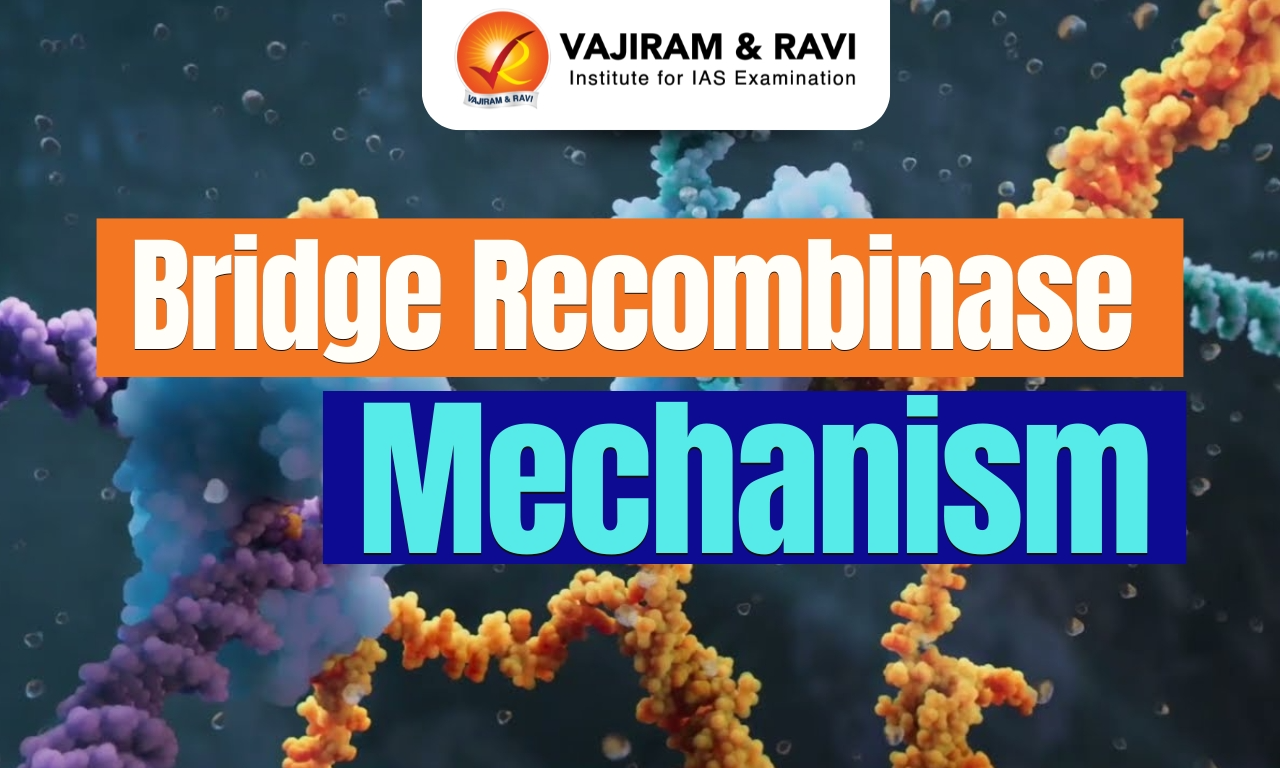
The Bridge Recombinase Mechanism is a next-generation genomic design system that uses jumping genes, particularly the IS110 element, to edit DNA. These jumping genes, also known as transposable elements, naturally move within genomes and are found across all forms of life.
This mechanism allows DNA to be cut, rearranged, and inserted with high precision, without always requiring the double-strand breaks typically seen in older genome-editing techniques.
How the Bridge Recombinase Mechanism Works?
The Bridge Recombinase Mechanism is a genome editing process where programmable RNA loops derived from jumping genes guide precise DNA recombination between donor and target sequences without always requiring double-strand breaks.
- Activation of Jumping Gene (IS110): The IS110 element, a mobile genetic sequence, initiates the recombination process.
- Formation of RNA Structure: Extra DNA at the ends converts into a single-stranded RNA that folds into two loop structures.
- Dual Binding Mechanism: Each RNA loop binds separately to donor DNA and target DNA segments.
- Bridge Formation: The loops act as a molecular bridge, bringing donor and target DNA together.
- Programmable Targeting: Scientists can design loops to bind specific DNA sequences for precise editing.
- DNA Insertion/Recombination: Genetic material is inserted or rearranged between the connected DNA strands.
- Minimal DNA Damage: The process often avoids double-strand breaks, reducing the risk of errors.
Jumping Genes as “Bridges” Significance
Jumping genes act as molecular bridges connecting different DNA sequences:
- They carry genetic information from one location to another.
- They integrate DNA without always causing disruptive cuts.
- Their programmability allows targeted genome editing.


Bridge Recombinase vs CRISPR-Cas9
The Bridge Recombinase Mechanism and CRISPR-Cas9 are advanced genome editing tools, but they differ significantly in how they modify DNA.
| Bridge Recombinase vs CRISPR-Cas9 | ||
|
Feature |
Bridge Recombinase Mechanism |
CRISPR-Cas9 |
|
Basic Principle |
Uses jumping genes (IS110) and recombinase enzymes to insert DNA |
Uses guide RNA and Cas9 enzyme to cut DNA |
|
DNA Cutting Requirement |
Not always required |
Mandatory double-strand break |
|
Mechanism Type |
DNA recombination via RNA loop bridging |
DNA cleavage followed by repair |
|
Key Components |
Recombinase enzyme, IS110 element, RNA loops |
Cas9 enzyme, Guide RNA (gRNA) |
|
Targeting Method |
Programmable donor and target DNA loops |
Guide RNA binds complementary DNA sequence |
|
Precision |
High precision with flexible insertion |
High precision but dependent on repair accuracy |
|
Flexibility |
Allows complex and diverse DNA insertions |
Limited to cut-and-repair modifications |
|
Risk of DNA Damage |
Lower (less reliance on cutting) |
Higher due to double-strand breaks |
|
Off-target Effects |
Potentially lower |
Possible off-target cuts |
|
Natural Occurrence |
Derived from naturally occurring jumping genes |
Derived from bacterial immune system |
|
Applications |
Advanced genome design, synthetic biology |
Gene editing, disease correction, research |

 Last updated on Sep, 2026
→ UPSC 2027 Notification will be released on 13 January 2027 at upsconline.nic.in.
→ Asian Games 2026 are being held in Aichi-Nagoya, Japan, from 19 September to 4 October.
→ Check out the latest UPSC Syllabus here.
→ Download UPSC Model Answers for Mains 2026
→ UPSC Mains Question Paper 2026 is out now for Essay & GS Paper 1, 2, 3 & 4.
→ UPSC Calendar 2027 has been released.
→ Enroll in Vajiram & Ravi’s UPSC Mains Test Series 2027 for structured answer writing practice, expert evaluation, and exam-oriented feedback.
→ Join Vajiram & Ravi’s UPSC Mentorship Program 2027 for personalized guidance, strategy planning, and one-to-one support from experienced mentors.
→ Go through the UPSC Mains Previous Year Papers to enhance your preparation.
→ UPSC has released UPSC Toppers List 2025 with the Civil Services final result on its official website.
→ Also check Best UPSC Coaching in India
Bridge Recombinase Mechanism FAQs
Q1. What is the Bridge Recombinase Mechanism?+
Q2. How does the Bridge Recombinase Mechanism work?+
Q3. What are jumping genes in this mechanism?+
Q4. How is it different from CRISPR-Cas9?+
Q5. What is the role of IS110 in this mechanism?+
Tags: bridge recombinase mechanism genetics molecular biology