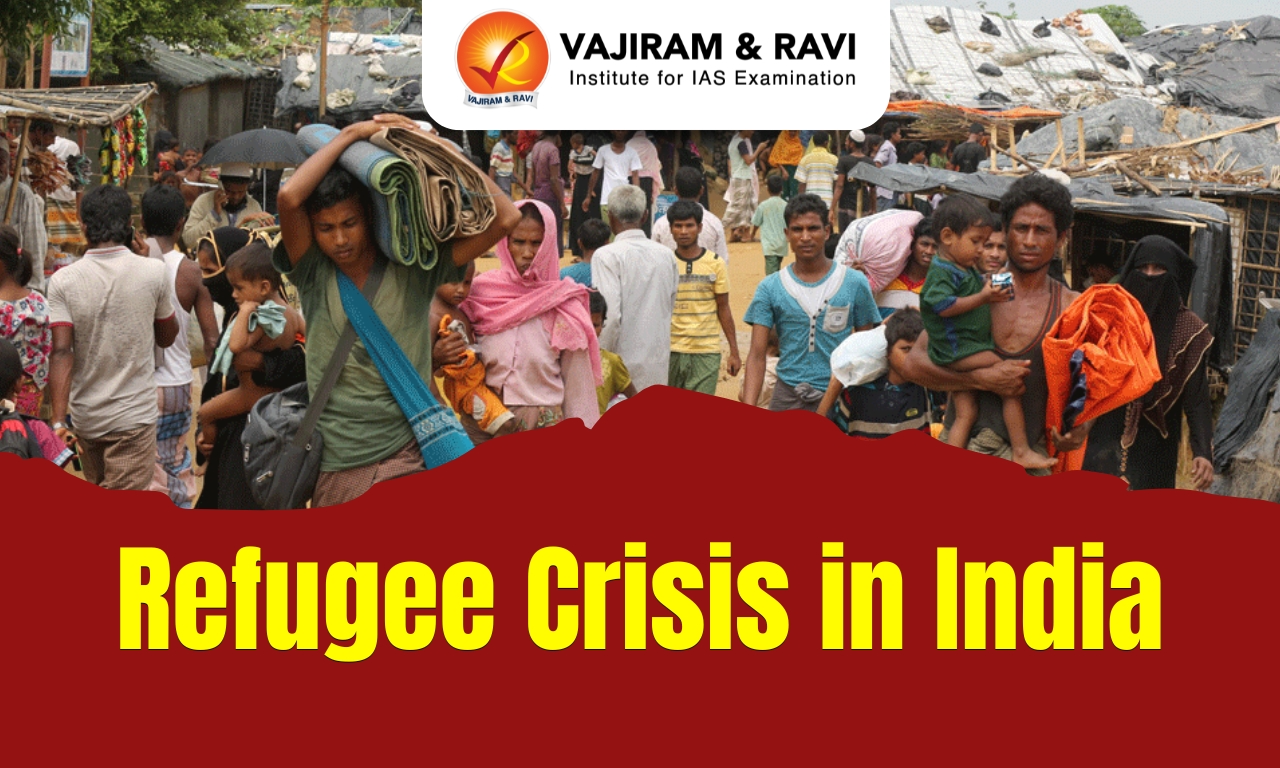
A refugee is a person who is forced to leave their home country because of serious threats such as war, violence, or persecution based on religion, race, nationality, political opinion, or social group. This definition is based on the United Nations Refugee Convention of 1951.
Refugees are different from migrants. Migrants move mainly for better opportunities, while refugees move to save their lives and freedom.
The detailed article on the Refugee Crisis in India has been discussed below in this article.
Refugee Crisis in India
India has a long history of giving shelter to people fleeing persecution. Even though India is not a signatory to international refugee conventions, it has hosted millions of refugees over time. Some major refugee groups in India include:
- Tibetan refugees (since 1959)
- Bangladeshi refugees (1971 war)
- Sri Lankan Tamil refugees
- Afghan refugees
- Rohingya refugees from Myanmar
Key UN Bodies and International Framework
Global refugee protection is guided by institutions and legal frameworks developed under the United Nations system.
1. United Nations High Commissioner for Refugees (UNHCR)
- Established in 1950 to protect refugees and stateless persons
- Main agency responsible for refugee welfare globally
- Registers and identifies refugees
- Provides basic needs such as food, shelter, healthcare, and education
- Facilitates voluntary repatriation, local integration, and resettlement
- Works in India, especially for refugees from non-neighbouring countries
2. United Nations Human Rights Council (UNHRC)
- Intergovernmental body responsible for promoting human rights
- Monitors violations of refugee rights across countries
- Conducts Universal Periodic Review (UPR) of member states
- Raises concerns on discrimination, detention, and deportation of refugees
3. 1951 Refugee Convention
- Core international treaty defining the term “refugee”
- Provides legal rights such as:
- Right to work
- Right to education
- Access to courts
- Establishes the principle of refugee protection globally
4. 1967 Protocol Relating to the Status of Refugees
- Expands the scope of the 1951 Convention
- Removes geographical and time restrictions
- Makes refugee protection universally applicable


India’s Position on Refugee Convention
India is not a signatory to the 1951 Refugee Convention or its 1967 Protocol Relating to the Status of Refugees. The country prefers to handle refugee matters through its own laws and a case-by-case approach rather than being bound by international obligations. This is mainly due to security concerns, regional challenges, and the need for policy flexibility. However, India generally follows humanitarian principles such as Non-refoulement, ensuring that refugees are not forcibly returned to danger.
Legal Framework Governing Refugees in India
India does not have a specific refugee law, so refugees are governed under general laws applicable to foreigners. The legal framework is fragmented, leading to different treatment of refugee groups based on government policies.
- Foreigners Act, 1946
-
- Provides the central government with wide powers over all foreigners
- Allows identification, detention, restriction of movement, and deportation
- Does not differentiate between refugees, asylum seekers, and illegal migrants
- Often used in cases involving Rohingya and undocumented migrants
- Passport (Entry into India) Act, 1920
- Regulates entry of persons into India
- Authorizes authorities to expel individuals without valid documents
- Works alongside the Foreigners Act for border control
- Registration of Foreigners Act, 1939
- Mandates registration of foreigners staying beyond 180 days
- Requires reporting to a Registration Officer within 14 days
- Helps in maintaining records and monitoring foreign nationals
- Citizenship Act, 1955
- Governs citizenship by birth, descent, registration, and naturalization
- Includes provisions for renunciation, termination, and deprivation
- Serves as the base law for all citizenship-related matters
- Citizenship (Amendment) Act, 2019
- Provides fast-track citizenship to persecuted minorities (Hindus, Sikhs, Buddhists, Jains, Parsis, Christians)
- Covers migrants from Pakistan, Bangladesh, and Afghanistan
- Reduces residency requirement from 11 years to 5 years
- Excludes Muslim refugees, including Rohingyas, leading to debates on discrimination
- Has sparked nationwide protests and constitutional challenges
- Standard Operating Procedure (SOP) for Refugees
- Issued by the Government of India to guide officials
- Provides a mechanism to examine asylum claims
- Ensures coordination between central and state authorities
- Applied in a case-by-case manner, not as a formal law
Constitutional and Judicial Safeguards
- The Indian Constitution ensures basic human rights to all persons, including refugees:
- Article 14 – Equality before law
- Article 21 – Right to life and personal liberty
- Article 22 – Protection against arbitrary detention
- The Supreme Court has played a key role in protecting refugee rights:
- In NHRC vs State of Arunachal Pradesh:
- The Court held that refugees cannot be forcibly evicted
- Directed the government to protect life and liberty of Chakma refugees
- Courts have interpreted Article 21 broadly to include:
- Right to dignity
- Protection from inhuman treatment
- Access to basic necessities
- In NHRC vs State of Arunachal Pradesh:
Key Challenges in India’s Refugee Crisis
India’s refugee crisis involves multiple interconnected issues related to law, security, economy, and human rights. The absence of a clear policy framework makes the situation more complex and sensitive.
- India does not have a comprehensive refugee law, and refugees are governed under general laws like the Foreigners Act, 1946, leading to a lack of clarity and consistency.
- There is no clear distinction between refugees, asylum seekers, and illegal migrants, which results in uniform but often inappropriate treatment of different categories.
- The approach of the government is largely ad-hoc and case-by-case, rather than based on a structured national policy.
- Different refugee groups receive unequal treatment depending on political and strategic considerations, creating policy inconsistency and inequality.
- National security concerns remain significant due to porous borders and the risk of infiltration by extremist elements.
- It is often difficult to verify the identity and background of refugees, increasing concerns related to internal security.
- Refugees face several human rights challenges, including risk of detention, deportation, and limited access to basic services like education, healthcare, and employment.
- There are ongoing concerns about adherence to the principle of Non-refoulement, especially in cases of forced return.
- The presence of large refugee populations puts pressure on local resources such as housing, jobs, and public services.
- Refugees may compete with local populations for employment, leading to economic stress and resentment in certain areas.
- Social and cultural differences between refugees and local communities can lead to tensions and conflicts.
- Many refugees lack proper documentation, which creates identity issues and increases the risk of statelessness.
- Administrative challenges include weak coordination between central and state governments and lack of proper data systems for refugee management.
- Political debates and controversies, especially around the Citizenship (Amendment) Act, 2019, have further complicated refugee policy in India.
Way Forward
To address the refugee crisis effectively, India needs a balanced approach that combines humanitarian values, legal clarity, and national security concerns.
- Enact a comprehensive national refugee law to clearly define refugees, asylum seekers, and illegal migrants, ensuring uniform treatment across the country.
- Create a proper legal distinction between refugees and illegal immigrants to avoid misuse of laws like the Foreigners Act, 1946.
- Develop a transparent and structured asylum mechanism for identification, registration, and status determination of refugees.
- Strengthen coordination with international agencies like the United Nations High Commissioner for Refugees for better protection and rehabilitation.
- Ensure protection of basic human rights in line with constitutional provisions, especially Article 14 and Article 21.
- Follow and reinforce the principle of Non-refoulement to prevent forced return of refugees to unsafe conditions.
- Balance humanitarian obligations with national security concerns through better border management and identity verification systems.
- Improve data collection and documentation systems to track refugee populations effectively.
- Promote social integration policies such as access to education, healthcare, and skill development to reduce dependency.
- Encourage international cooperation and burden-sharing, especially with neighboring countries facing similar challenges.

 Last updated on Oct, 2026
→ UPSC 2027 Notification will be released on 13 January 2027 at upsconline.nic.in.
→ Check Nobel Prize 2026 Winners List here.
→ Download PIB PRiSM Monthly Magazine 2026 here.
→ Check UPSC Monthly Current Affairs Magazine The Recitals here.
→ Check out the latest UPSC Syllabus here.
→ Download UPSC Model Answers for Mains 2026
→ UPSC Mains Question Paper 2026 is out now for Essay & GS Paper 1, 2, 3 & 4.
→ UPSC Calendar 2027 has been released.
→ Enroll in Vajiram & Ravi’s UPSC Mains Test Series 2027 for structured answer writing practice, expert evaluation, and exam-oriented feedback.
→ Join Vajiram & Ravi’s UPSC Mentorship Program 2027 for personalized guidance, strategy planning, and one-to-one support from experienced mentors.
→ Go through the UPSC Mains Previous Year Papers to enhance your preparation.
→ UPSC has released UPSC Toppers List 2025 with the Civil Services final result on its official website.
→ Also check Best UPSC Coaching in India
Refugee Crisis in India FAQs
Q1. What is a refugee?+
Q2. Does India have a specific refugee law?+
Q3. Is India a signatory to international refugee conventions?+
Q4. Which UN body works for refugees in India?+
Q5. What is the Citizenship (Amendment) Act, 2019 (CAA)?+
Tags: general studies geography geography notes refugee crisis in india