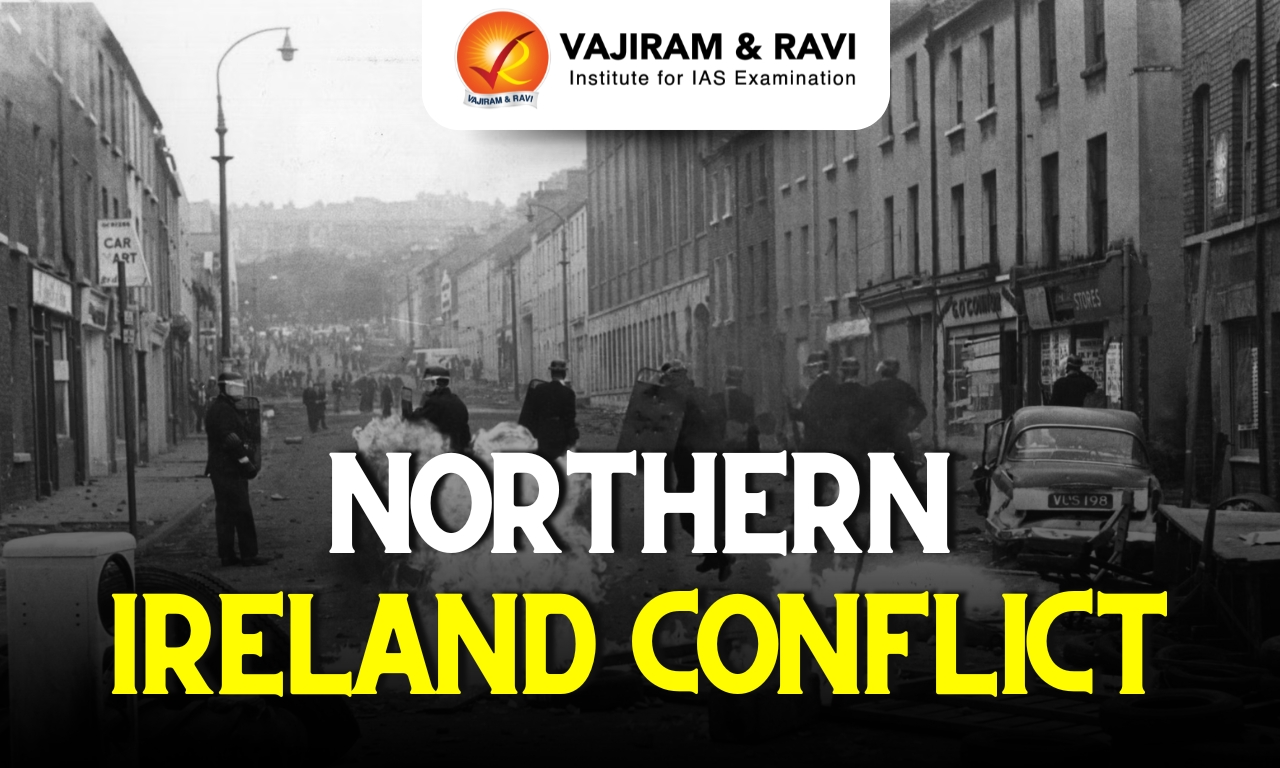
The Northern Ireland conflict, also known as “The Troubles,” was a period of violence from the late 1960s to 1998. It was mainly between Unionists, who wanted Northern Ireland to remain part of the United Kingdom, and Nationalists, who wanted it to join a united Ireland. Although it had a religious angle, with Protestants and Catholics on opposite sides, the conflict was mostly about political identity and control. It led to widespread violence and loss of lives, and was finally brought to an end with the Good Friday Agreement in 1998.
Northern Ireland Conflict Background
- Northern Ireland is a region located in the northern part of the island of Ireland and is currently a part of the United Kingdom. Its history is deeply shaped by migration, colonisation, and cultural mixing over centuries. Different groups such as the Celts, Vikings, Normans, and Anglo-Saxons settled in this region at different times, making it a diverse but also divided society.
- In the early 17th century, an important event called the Plantation of Ulster took place. During this period, the English government encouraged people from England and Scotland, who were mostly Protestants, to settle in Ulster. These settlers were given land that had been taken from native Irish Catholics. This created a clear divide between the Protestant settlers and the Catholic locals, which later became a major source of conflict.
- The division was not just about land but also about religion, culture, and political loyalty. Protestants generally supported British rule, while Catholics wanted independence from Britain. These differences slowly turned into long-term tensions in the region.
Protestants and Catholics Conflict in Ireland
- The conflict between Protestants and Catholics in Ireland became stronger over time due to both religious differences and political control. Across Europe, there were already tensions between these two religious groups, and similar issues affected Ireland as well.
- Ireland was under British rule for many years, and many Irish Catholics felt that they were treated unfairly in terms of land ownership, political rights, and economic opportunities. This led to growing resentment and resistance against British control.
- A major turning point was the Great Potato Famine of 1845, which caused the death of more than one million people due to starvation and disease. Many Irish people believed that the British government did not do enough to help, which increased anger and strengthened nationalist feelings.
- In 1916, during the First World War, Irish nationalists launched the Easter Rising, an armed rebellion against British rule. Although the rebellion was suppressed, it inspired a stronger independence movement across Ireland.


Partition of Ireland and Creation of Northern Ireland
- After years of struggle, Ireland moved closer to independence in the early 20th century. However, there was a major disagreement between different groups within Ireland. Catholics and nationalists wanted a united independent Ireland, while Protestants in Ulster wanted to remain part of the United Kingdom.
- In 1921, the Anglo-Irish Treaty was signed, which led to the division of Ireland into two parts. The southern part became the Irish Free State (now the Republic of Ireland), while six counties in the north, where Protestants were the majority, remained with the United Kingdom. This region became known as Northern Ireland.
- This partition created a political and social divide. Northern Ireland remained part of the UK, but it had a large Catholic minority that did not fully accept British rule. This imbalance later led to unrest and conflict.
Northern Ireland Conflict The Troubles
- From the late 1968 to 1998, Northern Ireland experienced a violent conflict known as The Troubles. This was not a traditional war but a long period of violence involving bombings, shootings, and protests.
- The conflict was mainly between two groups. The Unionists or Loyalists, who were mostly Protestants, wanted Northern Ireland to remain part of the UK. The Nationalists or Republicans, who were mostly Catholics, wanted Northern Ireland to join the Republic of Ireland.
- The British Army was also involved in trying to maintain peace, but at times it became part of the conflict. Paramilitary groups like the Irish Republican Army (IRA) and loyalist groups carried out violent attacks.
- More than 3,500 people lost their lives during this period, and many more were injured. The violence affected daily life, created fear among communities, and deepened divisions between people.
The Good Friday Agreement
- About the Agreement
- The Good Friday Agreement, also called the Belfast Agreement, is a historic peace deal signed on 10 April 1998 in Northern Ireland. It was created to end years of violence and tension that had deeply affected the region during a period known as The Troubles.
- The main aim of the agreement was to bring peace by encouraging cooperation between different communities, especially between Unionists and Nationalists, who had long-standing political and social differences.
- It was supported by the governments of the United Kingdom and Ireland, as well as by most political parties in Northern Ireland. Importantly, it also received public approval through referendums held in both Northern Ireland and the Republic of Ireland. Key Provisions of the Agreement are as follows:
- Power Sharing Government
- The agreement created a system where Unionists and Nationalists share power in the government, ensuring that both communities have a role in decision-making.
- It also led to the formation of the Northern Ireland Assembly for local governance.
- Principle of Consent
- The agreement states that Northern Ireland will remain part of the UK unless a majority votes to join the Republic of Ireland.
- Any change in status can happen only through a peaceful and democratic referendum.
- Human Rights and Equality
- It emphasizes equal rights and protection for all citizens, regardless of religion or background.
- New laws and institutions were created to reduce discrimination and promote fairness.
- Decommissioning of Weapons
- It provided a process for paramilitary groups to gradually give up their weapons.
- This helped reduce violence and build trust among communities.
- Cross-Border Cooperation
- The agreement encouraged better cooperation between Northern Ireland and the Republic of Ireland in areas like trade, transport, education, and culture.
- It led to the creation of joint bodies where leaders from both sides could work together on common issues.
- This helped improve relationships and reduce tensions between the two regions.
- Improved UK-Ireland Relations
- The agreement also strengthened relations between the United Kingdom and Ireland by promoting dialogue and mutual respect.
- Both countries agreed to work together to maintain peace and stability in the region.
- Reduction of Violence and Peace Building
- One of the biggest achievements of the agreement was the significant reduction in violence and conflict in Northern Ireland.
- It created a foundation for long-term peace, even though some challenges and disagreements still remain.
- Over time, it has helped communities move towards reconciliation and a more stable future.
Post-Agreement Developments
- After the Good Friday Agreement, Northern Ireland saw a significant reduction in violence and improvement in economic conditions. Cities like Belfast began to develop and modernise, moving away from their conflict-driven past.
- However, some issues still remained. There are still divisions between communities, and political disagreements sometimes lead to instability in governance.
- The legacy of The Troubles continues to affect society, with unresolved issues related to victims, justice, and reconciliation.
Brexit and the Northern Ireland Issue
- In 2016, the United Kingdom decided to leave the European Union through a referendum known as Brexit. This created a new problem for Northern Ireland because it shares a land border with the Republic of Ireland, which is still part of the EU.
- The main concern was how to manage this border without creating physical checkpoints, which could increase tensions and threaten peace.
- Northern Ireland became the only region of the UK with a direct land border with the EU, making the situation more complicated.
Northern Ireland Protocol and Its Features
- To solve the border issue, the UK and the EU agreed on the Northern Ireland Protocol as part of the Brexit deal. Its main aim was to avoid a hard border between Northern Ireland and the Republic of Ireland while keeping peace intact.
- Under this arrangement, Northern Ireland continues to follow certain EU rules related to trade and goods. This allows goods to move freely across the Irish border without checks.
- Instead of a land border, a new system was created where checks take place on goods moving between Great Britain and Northern Ireland. This effectively created a trade boundary in the Irish Sea.
- The protocol also includes a democratic system where the Northern Ireland Assembly can vote every four years on whether to continue these arrangements.
Political Deadlock and Controversies
- The Northern Ireland Protocol has been a major source of disagreement, especially among Unionist leaders. They believe that the new trade rules separate Northern Ireland from the rest of the UK and weaken its position within the union.
- The Democratic Unionist Party (DUP) strongly opposed the protocol and even withdrew from the power-sharing government in protest. This created a political deadlock and stopped normal governance for some time.
- Businesses also faced practical challenges, such as delays and extra paperwork for goods moving between Great Britain and Northern Ireland. This created confusion and economic difficulties.
- There were also tensions between the UK and the EU, with both sides disagreeing over how the protocol should be implemented. These disagreements raised concerns about the future of peace and stability in the region.
Northern Ireland Conflict Recent Developments
- Over time, efforts were made to resolve the issues related to the protocol through negotiations and adjustments. These efforts aimed to reduce trade barriers and address the concerns of different groups.
- Political parties, including the DUP, eventually showed willingness to return to governance after receiving assurances about Northern Ireland’s position within the UK.
- Today, Northern Ireland continues to move forward with a focus on maintaining peace, improving cooperation, and addressing remaining challenges.
- While the situation is more stable than before, long-term peace depends on continued dialogue, trust-building, and balanced political solutions that respect the concerns of all communities.

 Last updated on Oct, 2026
→ UPSC 2027 Notification will be released on 13 January 2027 at upsconline.nic.in.
→ Check Nobel Prize 2026 Winners List here.
→ Download PIB PRiSM Monthly Magazine 2026 here.
→ Check UPSC Monthly Current Affairs Magazine The Recitals here.
→ Check out the latest UPSC Syllabus here.
→ Download UPSC Model Answers for Mains 2026
→ UPSC Mains Question Paper 2026 is out now for Essay & GS Paper 1, 2, 3 & 4.
→ UPSC Calendar 2027 has been released.
→ Enroll in Vajiram & Ravi’s UPSC Mains Test Series 2027 for structured answer writing practice, expert evaluation, and exam-oriented feedback.
→ Join Vajiram & Ravi’s UPSC Mentorship Program 2027 for personalized guidance, strategy planning, and one-to-one support from experienced mentors.
→ Go through the UPSC Mains Previous Year Papers to enhance your preparation.
→ UPSC has released UPSC Toppers List 2025 with the Civil Services final result on its official website.
→ Also check Best UPSC Coaching in India
Northern Ireland Conflict FAQs
Q1. What was the Northern Ireland conflict ?+
Q2. How did Northern Ireland come into existence?+
Q3. What caused the conflict between Protestants and Catholics?+
Q4. What was the role of the Good Friday Agreement?+
Q5. What is the Northern Ireland Protocol?+
Tags: northern ireland conflict world history