Academic Bank of Credit Latest News
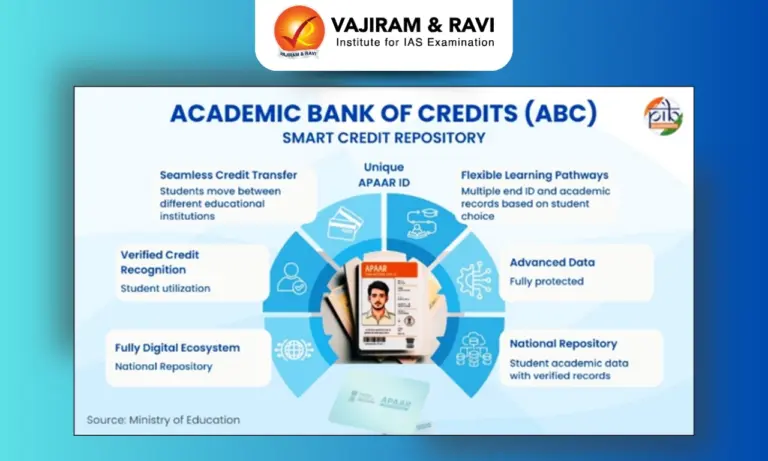
The Academic Bank of Credits (ABC) and the Automated Permanent Academic Account Registry (APAAR) are building a trusted digital ecosystem for academic records, making education more flexible, transparent, and accessible for every learner.
About Academic Bank of Credit
- It is a revolutionary digital platform by the Ministry of Education, Government of India.
- It is regulated by the University Grants Commission (UGC).
- It is built to support every learner’s journey by providing a digital platform for storing, managing, transferring, and redeeming academic credits earned by students from recognised educational institutions.
- Objectives: The main objective of ABC is to create a flexible, learner-friendly education system in which learning achievements can be recognised, stored, and used throughout a person’s life.
- It supports the vision of the National Education Policy (NEP) 2020 and the National Credit Framework (NCrF).


How Does Academic Bank of Credit Work?
- Students register on the ABC portal and receive a unique ABC ID or APAAR ID linked to their Aadhaar and DigiLocker account.
- Students belonging to eligible Higher Education Institutions (HEIs) can use the ABC facility.
- Academic institutions upload credit data directly to the ABC portal against each student’s account.
- Students can accumulate, transfer, and redeem credits across HEIs without losing academic progress.
- Credits are valid for a maximum of 7 years or the duration prescribed by the relevant academic discipline. Once redeemed, credits cannot be reused.
- Credit redemption and certificate issuance are handled by academic institutions via the National Academic Depository (NAD) platform.
- The NAD serves as the backbone of ABC, securely storing all academic awards and records.
Key Features of Academic Bank of Credit
- Academic Mobility: Students can study across multiple HEIs and transfer their credits seamlessly between programmes and institutions.
- ABC provides students with a seamless, consent-based document exchange system that streamlines verification and significantly reduces processing time.
- Multiple Entry and Exit (MEE): ABC enables the MEE framework under NEP 2020.
- SWAYAM Integration: Students may avail up to 40% of credits from the SWAYAM online platform.
- National Credit Framework (NCrF): ABC is aligned with the NCrF, covering academic, vocational, and experiential learning.
Source: PIB

 Last updated on Oct, 2026
→ UPSC 2027 Notification will be released on 13 January 2027 at upsconline.nic.in.
→ Check Nobel Prize 2026 Winners List here.
→ Download PIB PRiSM Monthly Magazine 2026 here.
→ Check UPSC Monthly Current Affairs Magazine The Recitals here.
→ Check out the latest UPSC Syllabus here.
→ Download UPSC Model Answers for Mains 2026
→ UPSC Mains Question Paper 2026 is out now for Essay & GS Paper 1, 2, 3 & 4.
→ UPSC Calendar 2027 has been released.
→ Enroll in Vajiram & Ravi’s UPSC Mains Test Series 2027 for structured answer writing practice, expert evaluation, and exam-oriented feedback.
→ Join Vajiram & Ravi’s UPSC Mentorship Program 2027 for personalized guidance, strategy planning, and one-to-one support from experienced mentors.
→ Go through the UPSC Mains Previous Year Papers to enhance your preparation.
→ UPSC has released UPSC Toppers List 2025 with the Civil Services final result on its official website.
→ Also check Best UPSC Coaching in India
Academic Bank of Credit FAQs
Q1. What is Academic Bank of Credit (ABC)?+
Q2. What is the shelf life of credits in ABC?+
Tags: academic bank of credit