Adi Vaani Platform Latest News
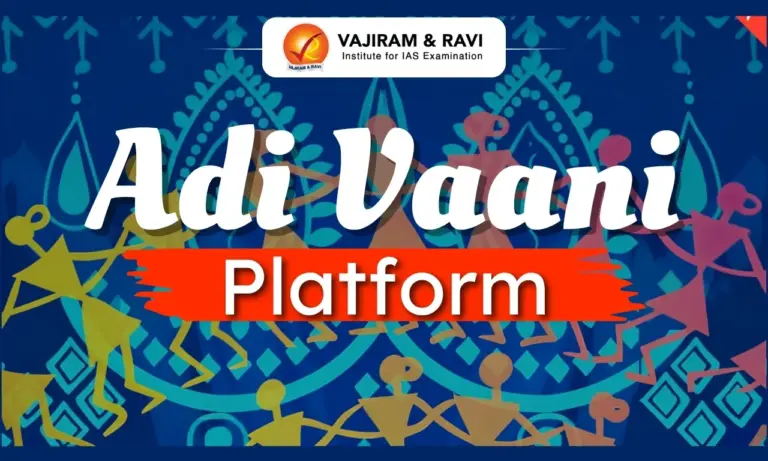
Recently, the Ministry of Tribal Affairs today began the three-day National Conclave on Tribal Languages & Museums in Mysuru, Karnataka in which a full-fledged Adi Vaani Platform was launched.
About Adi Vaani Platform
- It is India’s first AI-powered translator for tribal languages.
- It is designed to bridge communication gaps between tribal and non-tribal communities, while safeguarding endangered tribal languages using advanced Artificial Intelligence (AI).
- It is developed by a national consortium of premier institutions led by IIT Delhi with BITS Pilani, IIIT Hyderabad, and IIIT Nava Raipur in collaboration with Tribal Research Institutes (TRIs) in Jharkhand, Odisha, Madhya Pradesh, Chhattisgarh, and Meghalaya.
- AI Language Models: Refined deployment of models such as No Language Left Behind (NLLB) and IndicTrans2 for low-resource tribal languages.
- It aims to:
- Enable real-time translation (text and speech) between Hindi/English and tribal languages.
- Provide interactive language learning for students and early learners.
- Digitally preserve folklore, oral traditions, and cultural heritage.
- Support digital literacy, healthcare communication, and civic inclusion in tribal communities.
- Awareness of the government schemes and important speeches
- Features
- Multilingual Translator: It converts images and documents to editable text in seconds.
- Audio files to Text: It transcribes live speech or audio files into text and translates into indigenous languages instantly.
- Speech to speech Translation: Speak or upload speech in English or Hindi and listen to real-time voice translation in Santali, Mundari, or Bhili.
Source: PIB


 Last updated on Oct, 2026
→ UPSC 2027 Notification will be released on 13 January 2027 at upsconline.nic.in.
→ Check Nobel Prize 2026 Winners List here.
→ Download PIB PRiSM Monthly Magazine 2026 here.
→ Check UPSC Monthly Current Affairs Magazine The Recitals here.
→ Check out the latest UPSC Syllabus here.
→ Download UPSC Model Answers for Mains 2026
→ UPSC Mains Question Paper 2026 is out now for Essay & GS Paper 1, 2, 3 & 4.
→ UPSC Calendar 2027 has been released.
→ Enroll in Vajiram & Ravi’s UPSC Mains Test Series 2027 for structured answer writing practice, expert evaluation, and exam-oriented feedback.
→ Join Vajiram & Ravi’s UPSC Mentorship Program 2027 for personalized guidance, strategy planning, and one-to-one support from experienced mentors.
→ Go through the UPSC Mains Previous Year Papers to enhance your preparation.
→ UPSC has released UPSC Toppers List 2025 with the Civil Services final result on its official website.
→ Also check Best UPSC Coaching in India
Adi Vaani Platform FAQs
Q1. Which AI models used in Adi Vaani?+
Q2. What is Adi Vaani?+
Tags: adi vaani prelims pointers upsc current affairs upsc prelims current affairs