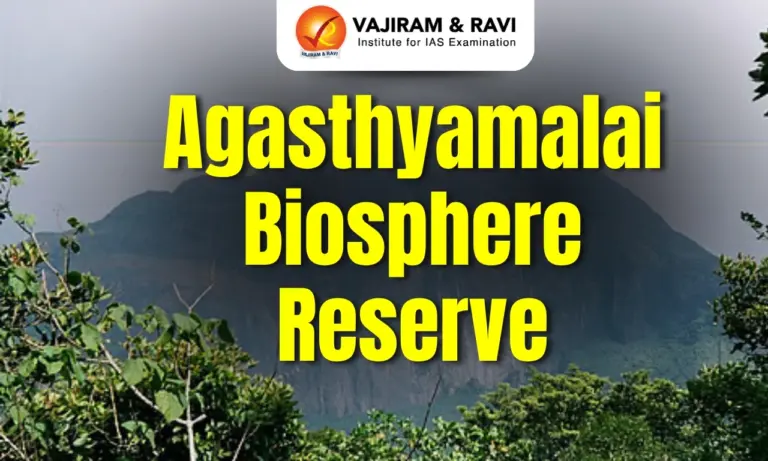
Agasthyamalai Biosphere Reserve is a beautiful and ecologically rich region located in the southern part of the Western Ghats, covering areas of Kerala and Tamil Nadu. It is known for its dense forests, hills, and rich biodiversity, with many species of plants and animals found only in this region. The area is important for maintaining ecological balance and supporting water sources for nearby regions. It is also home to several protected areas and tribal communities who depend on the forest for their livelihood.
Agasthyamalai Biosphere Reserve
- Agasthyamala Biosphere Reserve is a beautiful and ecologically rich region located in the southern part of the Western Ghats in India, spreading across Kerala and Tamil Nadu.
- It is known for its lush forests, rich biodiversity, and cultural importance, making it one of the most important natural regions in peninsular India.
- The reserve was established in 2001 and later included in the UNESCO World Network of Biosphere Reserves in 2016, which highlights its global importance.
- With mountain peaks rising up to 1,868 metres, the area offers a mix of forests, rivers, and wildlife habitats, creating a unique natural environment.
- The Biosphere reserve is split into three major zones viz. Core Zone, Buffer Zone and Transition Zone.
Agasthyamalai Biosphere Reserve Location & Geography
- The biosphere reserve is situated at the southernmost end of the Western Ghats, covering districts like Thiruvananthapuram and Kollam in Kerala and Tirunelveli and Kanniyakumari in Tamil Nadu.
- It covers a large geographical area of about 3,500 square kilometres, consisting of mountains, valleys, forests, and river systems that together form a complex and diverse landscape.
- Important rivers such as Thamirabarani, Neyyar, and Karamana originate from this region, making it crucial for water supply, agriculture, and human settlements in nearby areas.
- The region experiences a tropical monsoon climate with heavy rainfall, especially on the western side, which supports thick vegetation and rich biodiversity throughout the year.


Agasthyamalai Biosphere Reserve Biodiversity and Fauna
- Agasthyamala is recognized as a biodiversity hotspot, meaning it supports a very high number of plant and animal species, many of which are endemic (found only in this region).
- It is home to around 2,254 species of plants, including nearly 400 endemic species, along with a wide variety of rare and medicinal plants used in Ayurveda and traditional medicine.
- The reserve supports 79 species of mammals (20 endemic), 337 species of birds, 88 reptiles, 45 amphibians, and several fish species, showing its exceptional wildlife diversity.
- Important animals found here include the Bengal tiger, Asian elephant, Nilgiri tahr, lion-tailed macaque, Nilgiri marten, and sloth bear, while birds like the Great Indian hornbill add to its ecological richness.
- The presence of such a wide range of species makes the region extremely important for wildlife conservation and ecological research.
Agasthyamalai Biosphere Reserve Vegetation (Flora)
- The reserve has a wide variety of vegetation types such as tropical evergreen forests, semi-evergreen forests, moist deciduous forests, montaneAgasthyamalai B rainforests, and shola-grassland ecosystems, each supporting different species.
- Due to its favourable climate and rainfall, the forests remain green and dense throughout the year, providing ideal conditions for plant growth.
- It is considered a “genetic reservoir” because it preserves valuable plant species like cardamom, pepper, nutmeg, jamun, and plantain, which are important both economically and ecologically.
- The region is also famous for medicinal plants like Arogyapacha, often called the “plant of eternal health”, which has attracted scientific research and pharmaceutical interest.
- Another unique feature is the Neelakurinji flower, which blooms once every 12 years, transforming the landscape into a beautiful purple carpet and attracting tourists and researchers alike.
Protected Areas within the Agasthyamalai Biosphere Reserve
- The biosphere reserve includes several important protected regions, which help in wildlife conservation:
- Shendurney Wildlife Sanctuary
- Peppara Wildlife Sanctuary
- Neyyar Wildlife Sanctuary
- Kalakkad-Mundanthurai Tiger Reserve
- These protected areas ensure the safety of endangered species and maintain ecological balance.
Tribal Communities and Socio-Economic Aspects
- The reserve is inhabited by the Kani tribe, one of the oldest indigenous communities, who have deep knowledge of forest resources, medicinal plants, and sustainable living practices.
- Their lifestyle is closely connected with nature, and they traditionally depend on forests for food, medicine, and livelihood, while generally avoiding large-scale commercial exploitation.
- Apart from tribal populations, there are also non-tribal communities living in tea plantations within the reserve.
- In recent years, efforts have been made to promote sustainable development, alternative livelihoods, and reduce pressure on forest resources, ensuring both conservation and human welfare.
Agasthyamalai Biosphere Reserve Cultural and Historical Significance
- The name Agasthyamala is derived from Sage Agastya, a revered figure in Indian mythology and one of the Saptarishis (seven sages).
- The region is considered a sacred pilgrimage site, with a temple dedicated to the sage located at the mountain peak, attracting devotees from different parts of the country.
- It is also associated with the Ramayana and is believed to be a centre for the development of Ayurveda and Siddha medicine systems.
- This strong connection between nature, spirituality, and traditional knowledge makes the region culturally unique and significant.
Agasthyamalai Biosphere Reserve Importance and Recent Developments
- Agasthyamala plays a crucial role in maintaining ecological balance, conserving rare species, and protecting water resources, which are essential for human survival.
- It is also important for climate regulation, carbon storage, and preservation of traditional medicinal knowledge.
- Recently, the Supreme Court has taken steps to remove illegal encroachments and protect the fragile ecosystem of the region.
- The area is also under consideration for UNESCO World Heritage Site status, which could further strengthen conservation efforts and global recognition.
- Agasthyamala Biosphere Reserve is a perfect example of the harmonious relationship between nature and humans, combining biodiversity, culture, and sustainability.
- Its protection is essential not only for preserving wildlife and forests but also for supporting local communities, traditional knowledge systems, and future environmental security.
- Conserving such regions will ensure that future generations continue to benefit from nature’s richness and ecological balance.

 Last updated on Oct, 2026
→ UPSC 2027 Notification will be released on 13 January 2027 at upsconline.nic.in.
→ Check Nobel Prize 2026 Winners List here.
→ Download PIB PRiSM Monthly Magazine 2026 here.
→ Check UPSC Monthly Current Affairs Magazine The Recitals here.
→ Check out the latest UPSC Syllabus here.
→ Download UPSC Model Answers for Mains 2026
→ UPSC Mains Question Paper 2026 is out now for Essay & GS Paper 1, 2, 3 & 4.
→ UPSC Calendar 2027 has been released.
→ Enroll in Vajiram & Ravi’s UPSC Mains Test Series 2027 for structured answer writing practice, expert evaluation, and exam-oriented feedback.
→ Join Vajiram & Ravi’s UPSC Mentorship Program 2027 for personalized guidance, strategy planning, and one-to-one support from experienced mentors.
→ Go through the UPSC Mains Previous Year Papers to enhance your preparation.
→ UPSC has released UPSC Toppers List 2025 with the Civil Services final result on its official website.
→ Also check Best UPSC Coaching in India
Agasthyamalai Biosphere Reserve FAQs
Q1. Where is Agasthyamalai Biosphere Reserve located?+
Q2. Why is Agasthyamalai considered a biodiversity hotspot?+
Q3. When was Agasthyamalai Biosphere Reserve established?+
Q4. Which rivers originate from Agasthyamalai Biosphere Reserve?+
Q5. What are the major protected areas in Agasthyamalai?+
Q6. Which tribes live in the Agasthyamalai region?+
Q7. What type of vegetation is found in Agasthyamalai Biosphere Reserve?+
Q8. What is special about the Neelakurinji flower?+
Tags: agasthyamalai biosphere reserve biosphere reserve