Agnipath Scheme Latest News
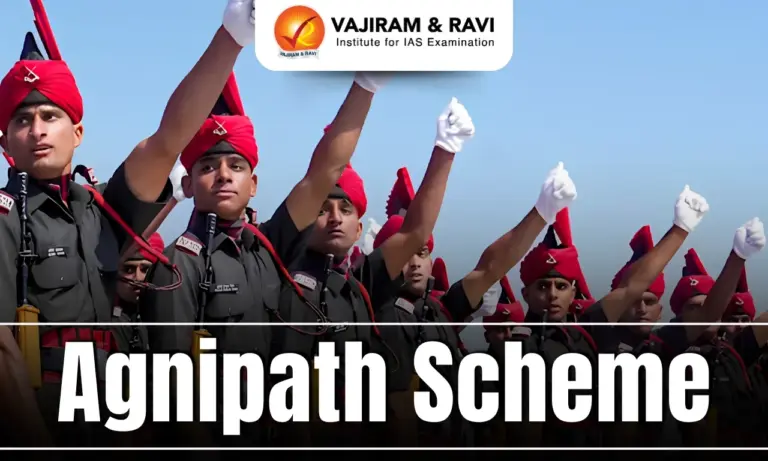
- As the first batch of Agniveers recruited under the Agnipath scheme completes its four-year tenure later in 2026, the Indian Armed Forces are considering increasing the proportion of Agniveers retained as regular personnel.
- While the approved retention rate remains 25% across the Army, Navy and Air Force, internal discussions are underway to revise this based on operational experience, manpower requirements and technological advancements.
The Agnipath Scheme
- Overview:
- It is the Indian government’s short-term military recruitment model (launched in 2022) for personnel below officer ranks.
- Under this scheme, recruits/ “Agniveers” (between 17.5 and 23 years) serve for 4 years (including a 6 month training period).
- It aims to lower the military’s average age (from 32 currently to around 26) and reduce the ballooning pension bill, with only 25% retained for a permanent 15-year commission.
- An attractive, tax-exempt severance (Seva Nidhi Package) of roughly ₹11.71 lakh is provided upon completion (no pension), funded by the recruit’s contributions and matching government funds.
- Compensation for disability (up to Rs 44 lakh, depending on the severity of the disability) and death on duty (a total of Rs 1 crore, including the Seva Nidhi package and the soldier’s unserved salary).
- Current retention framework:
-
- The 25% retention is based on merit and willingness to continue.
- The first batches, inducted in early 2023, will complete their tenure later this year.
- All Agniveers are initially released, and only the selected candidates are re-enrolled as regular soldiers, sailors or airmen.
- Employment opportunities for Agniveers: After completion of 4 year service –
- The Ministry of Home Affairs (MHA) has earmarked 10% of vacancies in the Central Armed Police Forces (CAPFs) and the Assam Rifles for eligible Agniveers.
- The Ministry of Ports, Shipping and Waterways has introduced initiatives to facilitate the smooth induction of former Agniveers into the merchant navy.
- The Ministry of Defence (MoD) will provide 10% reservation for former Agniveers in recruitment to the Indian Coast Guard, all 16 Defence Public Sector Undertakings (DPSUs), etc.
- Ongoing evolution:
- Training infrastructure across the services has expanded significantly.
- Agniveers receive:
- Pay and allowances comparable to regular personnel during service.
- Leave and welfare benefits similar to regular soldiers.
- Multiple support measures through MoUs signed with banks for financial security.


Proposal for Higher Retention
- The three services are reportedly examining an increase in retention. For example,
- Indian Navy: Around 75% retention.
- Indian Army and Indian Air Force: Around 50% retention.
- These proposals are expected to be discussed with the Department of Military Affairs (DMA).
- Although similar proposals were submitted earlier, they were returned for further evaluation.
Why are the Armed Forces Seeking Higher Retention?
- Need for experienced personnel:
- Four years of service provides Agniveers with operational exposure, specialised training and familiarity with advanced weapon systems.
- A larger pool of experienced personnel would improve combat effectiveness during crises and conflicts.
- Lessons from Operation Sindoor:
- Operational experience demonstrated that Agniveers performed effectively.
- However, soldiers with longer service displayed faster decision-making and superior responses due to repeated field deployments and extensive training.
- Technological modernisation:
- The Armed Forces are inducting advanced platforms, modern weapon systems and emerging technologies.
- Personnel operating sophisticated equipment, particularly in the Navy and Air Force, require longer training cycles and sustained experience.
- Higher retention would preserve critical technical expertise.
- Addressing manpower shortages:
- The Army currently faces an estimated shortage of around 1.8 lakh personnel.
- Recruitment is being expanded, with approximately 70,000 Agniveers trained during the previous training cycle, and 90,000 vacancies expected in the upcoming recruitment cycle.
- Greater retention would ease manpower gaps until recruitment reaches desired levels.
- Unit cohesion and professionalism: Longer service helps build camaraderie, leadership qualities and institutional knowledge. Experienced personnel contribute to better teamwork, discipline and operational efficiency.
Alternative Approach Under Consideration
- Even if the overall retention ceiling remains at 25%, the services may adopt differential deployment.
- For example,
- Specialised units requiring higher technical expertise could have a greater proportion of retained Agniveers.
- Regular infantry or conventional units could continue with larger numbers of Agniveers serving their initial four-year tenure.
- Newly raised Bhairav battalions are cited as a possible example of such a model.
Significance for Defence Reforms
- The debate reflects the challenge of balancing two objectives:
- Maintaining a young military profile, one of the core goals of Agnipath.
- Ensuring adequate availability of experienced, technically skilled and combat-ready personnel amid evolving security challenges and rapid military modernisation.
- The eventual decision on retention percentages is likely to shape India’s long-term military manpower policy, operational preparedness and defence reforms.
Conclusion
- Former Army Chief General Upendra Dwivedi described Agnipath scheme as a transformative manpower reform intended to create a younger, technologically capable and future-ready military.
- He emphasised that the scheme remains an evolutionary process, and any modifications should be guided by operational experience, institutional assessment and feedback after completion of the first full cycle.

 Last updated on Oct, 2026
→ UPSC 2027 Notification will be released on 13 January 2027 at upsconline.nic.in.
→ Check Nobel Prize 2026 Winners List here.
→ Download PIB PRiSM Monthly Magazine 2026 here.
→ Check UPSC Monthly Current Affairs Magazine The Recitals here.
→ Check out the latest UPSC Syllabus here.
→ Download UPSC Model Answers for Mains 2026
→ UPSC Mains Question Paper 2026 is out now for Essay & GS Paper 1, 2, 3 & 4.
→ UPSC Calendar 2027 has been released.
→ Enroll in Vajiram & Ravi’s UPSC Mains Test Series 2027 for structured answer writing practice, expert evaluation, and exam-oriented feedback.
→ Join Vajiram & Ravi’s UPSC Mentorship Program 2027 for personalized guidance, strategy planning, and one-to-one support from experienced mentors.
→ Go through the UPSC Mains Previous Year Papers to enhance your preparation.
→ UPSC has released UPSC Toppers List 2025 with the Civil Services final result on its official website.
→ Also check Best UPSC Coaching in India
Agnipath Scheme FAQs
Q1. What is the rationale behind the proposal to increase the retention percentage of Agniveers? +
Q2. How has Operation Sindoor influenced the debate on reforms to the Agnipath scheme? +
Q3. What are the challenges of balancing a youthful military profile with operational effectiveness? +
Q4. Why is specialised training becoming increasingly important in India's Armed Forces? +
Q5. What is the significance of the Agnipath scheme as a military manpower reform in India? +
Tags: agnipath scheme mains articles upsc current affairs upsc mains current affairs