Royal Indian Navy Mutiny of 1946 Latest News
- As India marked its 80th Independence Day (August 15, 2026), naval historians and commentators revisited the Royal Indian Navy (RIN) Mutiny of February 1946 — often called the “last war of independence” — which is credited with rattling the British and accelerating their exit from India.
What Was the RIN Mutiny?
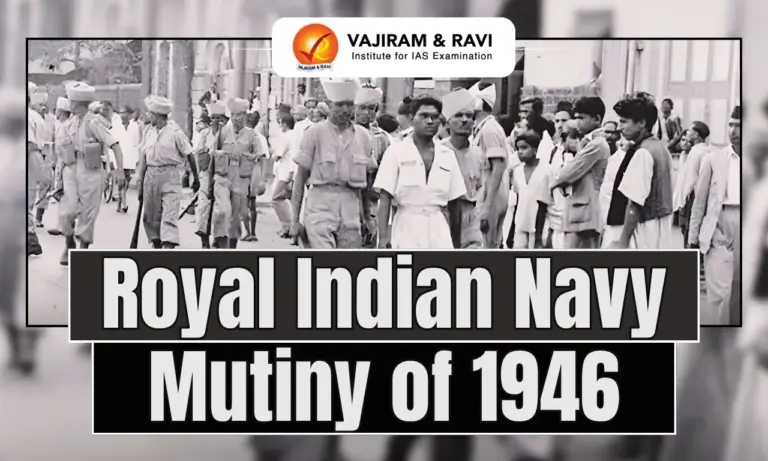
- On February 18, 1946, over a thousand sailors (“ratings”) of the Royal Indian Navy at HMIS Talwar, a naval shore establishment in Bombay, revolted against British rule.
- The revolt cascaded rapidly, eventually involving more than 20,000 sailors across 78 ships and 20 shore establishments, spreading to Karachi, Calcutta, Madras, and Visakhapatnam.


Background: Why Discontent Was Building
- Wartime expansion, post-war contraction: The RIN grew from under 2,000 personnel to nearly 30,000 during World War II, but Britain’s post-war demobilisation cut this back to around 11,000, causing loss of status and job insecurity.
- Racism and poor conditions: Indian ratings faced discriminatory treatment, harsh language, poor food, and inferior living conditions compared to British sailors, despite performing on par with them during the war.
- Prior unrest: Between 1942 and 1945, the RIN had already witnessed nine separate mutinies, reflecting chronic morale and leadership problems under predominantly British officers.
- Political radicalisation: The Indian National Army (INA) trials at the Red Fort and public anger over the treatment of Netaji Subhas Chandra Bose’s men fuelled nationalist sentiment among the ratings.
The Immediate Trigger
- On the eve of Navy Day (December 1, 1945), sailors at HMIS Talwar hoisted brooms and buckets with slogans like “Down with the British” and “Quit India.”
- The new commanding officer, Commander Arthur Frederick King, mishandled the situation and, days before February 18, abused sailors by calling them “sons of coolies,” further inflaming tensions.
- When ratings formally complained against King, he refused to act and instead accused them of lying — the final spark for the mutiny.
- Because the mutiny began among Signal School (communication branch) sailors, who were better trained, the strike call spread quickly via wireless radio to naval stations nationwide.
Demands of the Mutineers
- The demands blended service grievances with larger anti-imperial politics:
- Disciplinary action against Commander King and better service conditions.
- Fair, speedy demobilisation with civilian employment prospects.
- Better rations, pay parity with the Royal Navy, and access to NAAFI canteens (till then reserved for British personnel).
- Political demands: withdrawal of British Indian troops from Indonesia and free trials for INA detainees.
Spread and Character of the Uprising
- The mutineers organised themselves under the Naval Central Strike Committee (NCSC), led by M.S. Khan (President) and Madan Singh (Vice-President).
- They called themselves the “Indian National Navy” and “Azad Hindis,” invoking the legacy of the INA.
- British flags on ships were replaced with a combination of Congress, Muslim League, and Communist Party flags.
- Mutineers took over Butcher Island (now Jawahar Dweep) and trained guns on imperial symbols like the Gateway of India and Taj Mahal Hotel.
- Civilian solidarity was extraordinary: nearly three lakh mill workers, dockyard staff, railway employees, and students in Bombay joined protests; citizens supplied food to the striking sailors.
- Elements of the Royal Indian Air Force and local police also showed sympathetic or “mutinous” conduct, alarming the British further.
British Response and Suppression
- The British responded with disproportionate force, leading to police firing on February 22, 1946, killing an estimated 400–700 people (mostly civilians) and injuring 1,500–2,000.
- Facing the prospect of the Army, Navy, and Air Force turning unreliable, the British recognised they could no longer depend on coercive institutions to maintain control.
Role of National Leadership
- Congress and Muslim League: Sardar Vallabhbhai Patel and Muhammad Ali Jinnah persuaded the mutineers to surrender, fearing that continued violence could derail the Cabinet Mission talks and trigger communal conflict.
- Communists: The Communist Party of India and leaders like Aruna Asaf Ali fully backed the mutiny as a genuine anti-imperialist uprising.
- The strike was called off on February 23, 1946, though the British later prosecuted many mutineers despite assurances of fair treatment.
Historical Significance
- Many historians regard the mutiny as pivotal in convincing the British that Indian armed forces could no longer be relied upon to enforce colonial rule.
- Soon after, Prime Minister Clement Attlee dispatched the Cabinet Mission to India and announced Britain’s withdrawal plan.
- Justice Phani Bhusan Chakravartti later recorded that Attlee himself attributed Britain’s departure to the INA trials and the RIN mutiny.
- Despite its significance, the mutiny received limited post-independence recognition — partly because it lacked a unifying leader like Netaji, and partly because independent India’s new Navy was uncomfortable memorialising a mutiny.
Conclusion
- The 1946 RIN Mutiny exposed the collapse of British authority over India’s armed forces, shattering the myth of unquestioning loyalty.
- Though overshadowed by the freedom movement’s larger narratives, it remains a decisive, if underappreciated, catalyst that hastened Britain’s final exit from India.

 Last updated on Oct, 2026
→ UPSC 2027 Notification will be released on 13 January 2027 at upsconline.nic.in.
→ Check Nobel Prize 2026 Winners List here.
→ Download PIB PRiSM Monthly Magazine 2026 here.
→ Check UPSC Monthly Current Affairs Magazine The Recitals here.
→ Check out the latest UPSC Syllabus here.
→ Download UPSC Model Answers for Mains 2026
→ UPSC Mains Question Paper 2026 is out now for Essay & GS Paper 1, 2, 3 & 4.
→ UPSC Calendar 2027 has been released.
→ Enroll in Vajiram & Ravi’s UPSC Mains Test Series 2027 for structured answer writing practice, expert evaluation, and exam-oriented feedback.
→ Join Vajiram & Ravi’s UPSC Mentorship Program 2027 for personalized guidance, strategy planning, and one-to-one support from experienced mentors.
→ Go through the UPSC Mains Previous Year Papers to enhance your preparation.
→ UPSC has released UPSC Toppers List 2025 with the Civil Services final result on its official website.
→ Also check Best UPSC Coaching in India
Royal Indian Navy Mutiny of 1946 FAQs
Q1. What was the Royal Indian Navy Mutiny of 1946?+
Q2. Why did the Royal Indian Navy Mutiny of 1946 begin?+
Q3. How large was the Royal Indian Navy Mutiny of 1946?+
Q4. What role did national leaders play in the Royal Indian Navy Mutiny of 1946?+
Q5. Why was the Royal Indian Navy Mutiny of 1946 historically significant?+
Tags: mains articles Royal Indian Navy Mutiny of 1946 upsc current affairs upsc mains current affairs