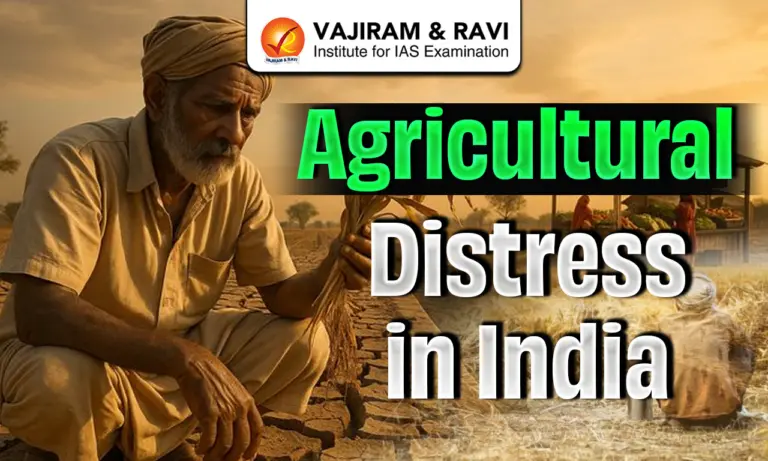
Agricultural Distress in India refers to the ongoing difficulties faced by farmers in sustaining their livelihoods. It arises when agriculture becomes less profitable and more uncertain due to factors like unpredictable weather, fluctuating crop prices, rising input costs, and limited access to resources. These challenges reduce farmers’ income and increase their vulnerability. Since a large section of the population depends on agriculture, such distress has broader economic and social implications for the country.
Agricultural Distress in India Recent Trends
- Fall or stagnation in agricultural prices
- In recent years, market prices of many crops have either remained low or increased very slowly.
- Although the government raises Minimum Support Prices (MSP), the increase has been modest around 5% per year between 2013-14 and 2023-24.
- In many cases, farmers are unable to sell at MSP, which reduces their earnings.
- Decline in real income of farmers
- The real income (income adjusted for inflation) of farming households has seen a decline.
- Between 2012-13 and 2018-19, income from cultivation fell by about 1.4%.
- This happened not only due to low crop prices but also because the cost of inputs like fertilizers, seeds, and fuel has increased significantly in recent years.
- Even today, rising input costs continue to put pressure on farmers’ profits.
- Rising rural unemployment
- Rural unemployment has increased over time, showing lack of sufficient job opportunities.
- Between 2011-12 and 2018-19, unemployment among rural men rose from 1.7% to 5.6%, and among rural women from 1.7% to 3.5%.
- Recent surveys also suggest that underemployment and seasonal unemployment remain serious concerns in rural areas.
- Stagnation in public investment in agriculture
- Public investment in agriculture, especially in areas like irrigation, research, and extension services, has not grown enough over the years.
- In some periods, it has even declined. As a result, capital formation in agriculture and allied sectors has remained weak, affecting long-term growth and productivity.
- Additional recent concerns
- Climate change impacts like irregular rainfall, heatwaves, and floods are increasing risks in farming.
- Dependence on monsoon still remains high in many regions.
- Small and fragmented landholdings continue to limit productivity and income.
- Market volatility and lack of proper storage facilities force farmers to sell at low prices.
Agricultural Distress in India Causes
- Small and fragmented land holdings
- Over time, land has been divided among family members, making farms very small. This makes it difficult to use modern machines or produce enough surplus to earn good income.
- Heavy dependence on monsoon and climate uncertainty
- Rising cost of farming
- Expenses on seeds, fertilizers, pesticides, labour, and irrigation keep increasing, while farmers’ income does not grow at the same pace.
- Low and unstable crop prices
- Farmers often do not get fair prices for their produce. Prices may crash during harvest due to excess supply, forcing farmers to sell at low rates.
- Weak implementation of MSP (Minimum Support Price)
- MSP benefits are limited to a few crops and regions. Many farmers are unable to sell their produce at MSP, reducing their income security.
- Lack of proper market access
- Farmers face difficulties in reaching good markets. Poor infrastructure, limited transport, and dependence on middlemen reduce their earnings.
- Inadequate storage and cold chain facilities
- Due to lack of storage, farmers are forced to sell quickly after harvest. This leads to wastage and distress selling, especially for fruits and vegetables.
- Limited access to formal credit
- Many farmers cannot get loans from banks and depend on moneylenders who charge high interest, pushing them into debt.
- Low use of modern technology
- Limited awareness, high costs, and poor access prevent farmers from using improved seeds, machinery, and scientific methods, affecting productivity.
- Declining soil health and water resources
- Overuse of fertilizers, pesticides, and groundwater has reduced soil fertility and water availability, making farming less sustainable.
- Policy gaps and focus on production over income
- Earlier policies mainly focused on increasing food production rather than improving farmers’ income and welfare.
- Fragmented supply chain
- Poor linkages between farmers, markets, and processing units lead to inefficiency and post-harvest losses.
- Pests, diseases, and input shortages
- Crop losses due to pests, diseases, and lack of quality seeds or irrigation facilities further increase farmers’ risks.


Impacts of Agricultural Distress in India
- Decline in agricultural growth and overall economy
- Agricultural distress slows down farm production and growth, which negatively affects the overall economy since agriculture is a key sector.
- Low and unstable farmer income leading to poverty
- Farmers earn less due to low productivity and poor prices. This reduces their standard of living and increases rural poverty and inequality.
- Fall in rural demand and reduced economic activity
- Lower income means farmers spend less, which decreases demand for goods and services in rural areas and affects local businesses.
- Rising debt burden and increase in NPAs
- Farmers often fail to repay loans due to low income, leading to higher indebtedness and increasing non-performing assets (NPAs) in banks.
- Job losses, reduced opportunities, and migration
- Farming becomes less profitable, reducing employment in rural areas. This forces many people, especially youth, to migrate to cities, putting pressure on urban areas.
- Farmer distress, suicides, and declining interest in farming
- Continuous losses and uncertainty create mental stress among farmers, sometimes leading to suicides. It also discourages the younger generation from taking up farming.
- Impact on food security and agricultural sustainability
- Reduced production and lower investment in agriculture can affect long-term food security and make farming less sustainable.
- Decline in investment in agriculture
- Due to uncertainty and low returns, farmers hesitate to invest in better technology, irrigation, or inputs, which further reduces productivity.
Steps Taken to Address Agricultural Distress in India
- Minimum Support Price (MSP)
- The government announces MSP for major crops to ensure farmers get a minimum guaranteed price and are protected from sudden price drops.
- Crop and livestock insurance
- Schemes like PM Fasal Bima Yojana (PMFBY) and Weather-Based Crop Insurance help farmers recover losses due to floods, droughts, pests, or other risks.
- Access to agricultural credit
- Facilities like Kisan Credit Card provide farmers with loans at lower interest rates for farming, equipment, and related activities.
- Improvement in irrigation
- Programs like Pradhan Mantri Krishi Sinchai Yojana aim to provide water to every farm and reduce dependence on rainfall.
- Market reforms and better price discovery
- Initiatives like e-NAM (online agricultural market) and APLM Act aim to create a transparent and competitive market where farmers can get better prices.
- Direct income support to farmers
- Schemes like PM-KISAN and state schemes (Rythu Bandhu, KALIA) provide direct cash support to farmers to supplement their income.
- Research and development (R&D)
- The government promotes development of better seeds, improved farming methods, and modern technologies to increase productivity.
- Palm Oil Mission
- This initiative aims to increase domestic production of palm oil to reduce dependence on imports and improve farmers’ income through oil palm cultivation.
- Pradhan Mantri Fasal Bima Yojana (PMFBY)
- A crop insurance scheme that provides financial support to farmers in case of crop failure due to natural disasters, pests, or diseases.
- Pradhan Mantri Kisan Samman Nidhi (PM-KISAN)
- Under this scheme, small and marginal farmers receive direct income support from the government to help meet their basic agricultural and household needs.
- AgriStack
- A digital platform that collects and integrates farmers’ data to provide better services like credit, insurance, and advisory support in a more efficient and targeted way.
- Unified Farmer Service Platform
- It is designed to bring multiple agricultural services together in one place, making it easier for farmers to access information, schemes, and support.
- National e-Governance Plan in Agriculture (NeGP-A)
- This initiative promotes the use of digital technology in agriculture by providing farmers with online access to information related to weather, crops, markets, and best practices.
- Sub-Mission on Agricultural Mechanization (SMAM)
- It encourages the use of modern farm machinery by providing subsidies, helping farmers reduce labour costs and improve productivity.
- Additional Measures and Long-Term Solutions
- Use of modern technology: Promoting drip irrigation, mechanisation, and digital tools to improve productivity and reduce costs.
- Diversification of agriculture: Encouraging farmers to shift from only rice and wheat to high-value crops like fruits, vegetables, pulses, livestock, and fisheries.
- Strengthening allied sectors: Promoting activities like dairy, poultry, horticulture, and food processing to create extra income sources.
- Cooperative and group farming: Farmers can pool land and resources to benefit from large-scale farming and reduce costs.
- Improving supply chain and infrastructure: Better storage, cold chains, transport, and food processing facilities to reduce wastage and increase profits.
- Policy reforms and better planning: Shifting focus from just increasing production to improving farmers’ income and welfare.
- Doubling farmers’ income initiative: Focus on increasing productivity, reducing costs, improving prices, and creating non-farm employment opportunities.
Suggestive Measures for Agricultural Distress in India
- Increase farmers’ income and improve productivity
- Farmers’ incomes can be raised by promoting better seeds, modern technology, and improved farming practices.
- Diversification towards high-value crops like fruits, vegetables, livestock, and fisheries can provide better returns.
- Reducing yield gaps through technology and improving water-use efficiency (like drip irrigation) are also important.
- Promote diversification, agripreneurship, and employment
- Since agriculture alone cannot absorb all rural youth, non-farm opportunities like agro-processing, food packaging, rural transport, and agri-services should be encouraged.
- Farmers should also diversify into horticulture and animal husbandry to reduce dependence on a single crop and stabilize income.
- Private sector participation and self-employment need to be promoted.
- Reduce risks and ensure income stability
- Farmers face both production risks (weather, pests) and price risks (market fluctuations).
- A comprehensive system like a Climate Resilience Scheme should cover both.
- While MSP, income support, and price deficiency payments help, they are only partial solutions.
- Long-term stability requires strong market reforms and export-friendly trade policies.
- Strengthen markets, value chains, and infrastructure
- Agriculture should go beyond production and include storage, warehousing, transport, processing, and retail.
- Better value chains can improve farmers’ price realization.
- Investment in cold storage, markets, and agro-processing should be increased through public-private partnerships.
- Promote land consolidation and efficient farming
- Small landholdings reduce productivity. Farmers can voluntarily pool land to benefit from economies of scale in both input purchase and output marketing.
- Shift policy focus and improve governance
- Policies should move away from rice and wheat dominance towards millets, pulses, and high-value crops.
- A unified national agricultural market is needed for better price discovery.
- Direct Benefit Transfers (DBT) should be promoted as an efficient support system instead of relying only on subsidies or loan waivers.
- Improve rural living conditions and social support
- Better access to basic facilities like sanitation, drinking water, healthcare, and education is essential.
- Advisory boards at district and state levels can help address farmer stress and prevent extreme distress situations.
- Promote sustainable and organic farming
- Growing demand for organic products provides new opportunities.
- Government support and incentives can help farmers adopt sustainable practices and access premium markets.
- Better measurement and understanding of distress
- A broader distress index is needed to capture the real situation.
- Loan waivers provide temporary relief but are not a long-term solution.

 Last updated on Oct, 2026
→ UPSC 2027 Notification will be released on 13 January 2027 at upsconline.nic.in.
→ Check Nobel Prize 2026 Winners List here.
→ Download PIB PRiSM Monthly Magazine 2026 here.
→ Check UPSC Monthly Current Affairs Magazine The Recitals here.
→ Check out the latest UPSC Syllabus here.
→ Download UPSC Model Answers for Mains 2026
→ UPSC Mains Question Paper 2026 is out now for Essay & GS Paper 1, 2, 3 & 4.
→ UPSC Calendar 2027 has been released.
→ Enroll in Vajiram & Ravi’s UPSC Mains Test Series 2027 for structured answer writing practice, expert evaluation, and exam-oriented feedback.
→ Join Vajiram & Ravi’s UPSC Mentorship Program 2027 for personalized guidance, strategy planning, and one-to-one support from experienced mentors.
→ Go through the UPSC Mains Previous Year Papers to enhance your preparation.
→ UPSC has released UPSC Toppers List 2025 with the Civil Services final result on its official website.
→ Also check Best UPSC Coaching in India
Agricultural Distress in India FAQs
Q1. What is Agricultural Distress in India?+
Q2. What are the main causes of Agricultural Distress in India?+
Q3. How does agricultural distress affect farmers’ income?+
Q4. What are the impacts of agricultural distress on the economy?+
Q5. What steps has the government taken to reduce agricultural distress?+
Tags: agricultural distress in india economy economy notes