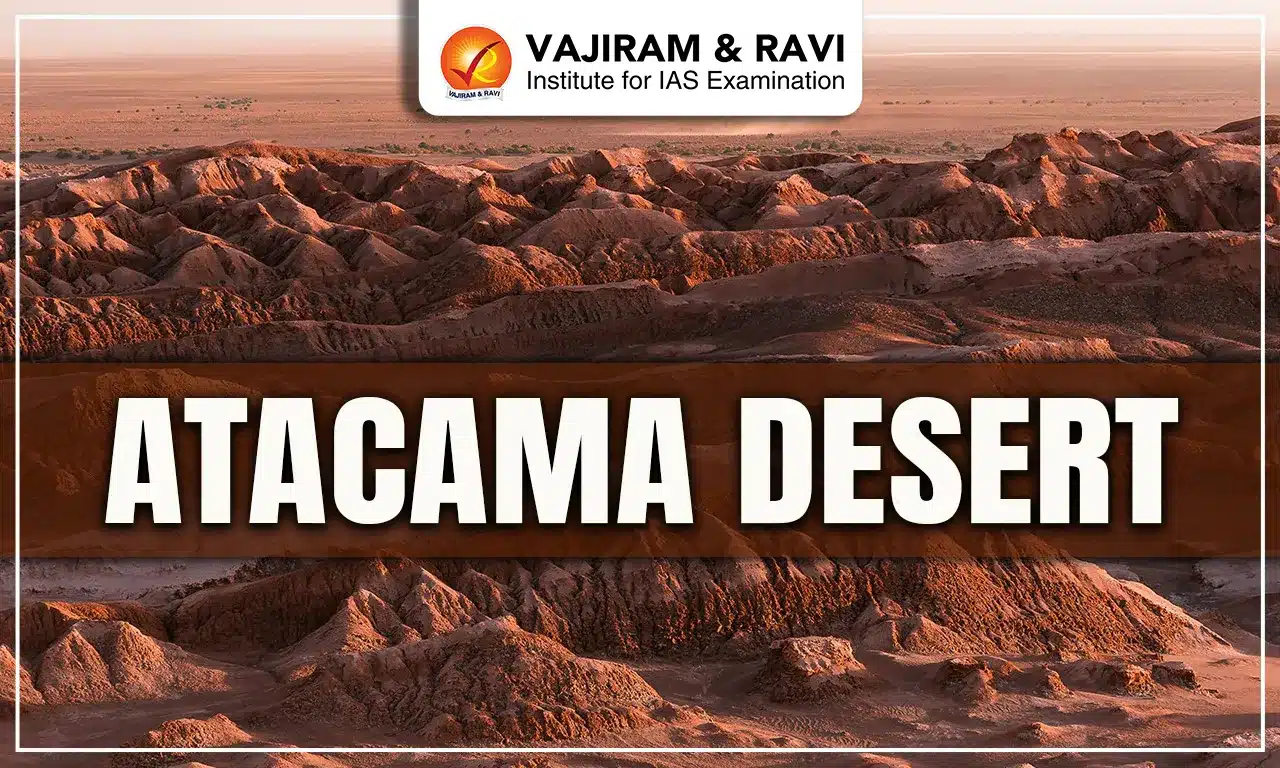
The Atacama Desert is a hyper-arid desert in northern Chile along the Pacific coast of South America. It lies between the Andes and Pacific Ocean and extends for about 1,600 km. It is widely known as the Driest Desert in the World outside polar regions. Its extreme dryness, mineral wealth, salt flats, volcanoes, clear skies and unique biodiversity make it geographically and economically important.
Why is Atacama Desert in News 2026?
The Atacama Desert is in the news in 2026 for two unusual environmental developments. In August 2026, successive winter storms produced rare and widespread snowfall in the Atacama Desert from the Andes almost to the Pacific coast which temporarily covered its normally arid landscape.
Earlier in April 2026, light pollution was reported as a threat to the region’s exceptionally dark skies.
Why does Snow Occur in the Atacama Desert?
Several possible reasons established by the experts for the rare Snowfall at Atacama Desert include:
- Cutoff low: A low pressure system became separated from the main jet stream and generated widespread winter precipitation over northern Chile.
- Large atmospheric trough: The late August 2026 system developed from an unusually large trough extending from southern South America into the subtropics, supporting the exceptional weather event.
- Coastal moisture: Moisture from the Pacific reached the region and combined with cold conditions to produce rain and snow across areas that normally receive almost no precipitation.
- El Niño influence: Strengthening El Niño weakened the subtropical Pacific high and shifted Southern Hemisphere storm tracks equatorward, creating a wetter winter background.
- Widespread snowfall: Snow extended from the Andes across the hyper arid core and nearly reached the Pacific coast south of Antofagasta, making the 2026 event unusually extensive.
- Heavy rainfall: Taltal received nearly 40 mm of rain in three days, around 10 times its annual mean. Such precipitation events occur only a few times, if any, per decade.


Atacama Desert
The Atacama Desert is Famous For extreme dryness, mineral deposits, salt flats, volcanoes, astronomical observatories, Mars like landscapes and exceptional night skies. Its geography, mountain barriers and cold ocean current create exceptionally dry conditions. The key highlights related to the desert are:
- Location: The Atacama Desert is located in northern Chile along the Pacific coast and extends northward toward the Peru border.. It lies between the Andes Mountains to the east and the Pacific Ocean to the west.
- Continent: The Atacama Desert is located in South America. It forms part of the continent’s dry Pacific fringe and extends across the northern third of Chile.
- Extent: The desert stretches for about 1,600 km along the northern third of Chile. Its commonly described narrow coastal strip extends for nearly 1,000 km.
- Neighbouring regions: It borders Peru to the north and lies near Argentina and Bolivia to the east. The Chilean Matorral occurs towards the south.
- Mountain setting: The Andes lie to the east and the Chilean Coast Range lies towards the Pacific. These mountains block major moisture bearing air masses.
- Rainfall: Atacama Desert Rainfall averages around 15 mm annually. Some locations receive only 1 to 3 mm, while certain weather stations have never recorded rain.
- Temperature: Atacama Desert Temperature remains comparatively mild throughout the year. The average temperature is about 63°F or 18°C.
- Volcanoes: The region contains about 12 volcanoes. Numerous volcanic cones occur in the western Andes, with some exceeding 4,900 metres.
- Topography: The landscape includes salt pans, alluvial fans, dunes, coastal cliffs, elevated depressions and high volcanic terrain. The Atacama Plateau reaches about 4,000 metres.
- Night sky: Atacama Desert at Night offers exceptionally clear astronomical conditions. The region has more than 200 cloudless nights annually and very little artificial light.
- Human Settlement: Chinchorro Communities inhabited the region from about 7000 BCE. The oldest artificially mummified human remains have been discovered in the desert.
Atacama Desert Significance
The Atacama Desert combines major mineral resources, scientific facilities, historical sites and renewable energy potential within an exceptionally arid landscape.
- Mineral wealth: The region contains copper, gold, silver, iron, boron, lithium, sodium nitrate and potassium salts. Copper mining remains a major economic activity.
- Sodium nitrate: The desert has the world’s largest natural supply of sodium nitrate. It historically supported fertilizer and explosive production and drove major mining activity.
- Astronomy: Extremely dry air, high elevation, minimal cloud cover and low light pollution make the region one of Earth’s leading locations for astronomical observation.
- Major observatories: The region hosts ALMA, the Very Large Telescope and La Silla Observatory. Cerro Armazones is the site of the future Extremely Large Telescope.
- Scientific research: Mars like soils and extreme aridity have made the desert a testing ground for planetary instruments and research on environments with very limited biological activity.
- Energy potential: Since 2024, Grenergy has been developing the Oasis de Atacama storage project, combining about 2 GW of solar capacity with 11 GWh of storage.
Atacama Desert Biodiversity and Environment
Despite extreme aridity, the Atacama Desert contains specially adapted plants and animals, while fog, rare rainfall and salt flats create important ecological niches.
- Flora: More than 500 plant species have been recorded within the desert. Thyme, llareta, saltgrass, cacti, succulents and other drought adapted plants occur in suitable areas.
- Desert flowering: The Atacama Desert can experience the Desierto Florido Phenomenon after sufficient precipitation. This flowering event is generally observed between September and November.
- Fauna: Species include Andean flamingos, Humboldt penguins, Chilean flamingos, vicuñas, guanacos, viscachas, lizards, beetles and Darwin’s leaf eared mouse.
- Fog ecosystem: Coastal fog, locally called camanchaca, can provide enough moisture for algae, lichens, cacti and seasonal vegetation in otherwise extremely dry areas.
- Environmental pressure: Used clothing dumped in parts of the desert has created pollution concerns. Estimates indicate around 39,000 tonnes of illegally dumped used clothing arrive annually.
- Extreme weather: Rare heavy rainfall has caused destructive mudflows and floods. Major events occurred in 1991 and 2015, while the August 2026 storms again caused flooding and mudflows.
- Dark skies: The exceptionally low light pollution of the Atacama Desert supports world class astronomy. However, increasing artificial light is now threatening this important environmental and scientific asset.

 Last updated on Oct, 2026
→ UPSC 2027 Notification will be released on 13 January 2027 at upsconline.nic.in.
→ Check Nobel Prize 2026 Winners List here.
→ Download PIB PRiSM Monthly Magazine 2026 here.
→ Check UPSC Monthly Current Affairs Magazine The Recitals here.
→ Check out the latest UPSC Syllabus here.
→ Download UPSC Model Answers for Mains 2026
→ UPSC Mains Question Paper 2026 is out now for Essay & GS Paper 1, 2, 3 & 4.
→ UPSC Calendar 2027 has been released.
→ Enroll in Vajiram & Ravi’s UPSC Mains Test Series 2027 for structured answer writing practice, expert evaluation, and exam-oriented feedback.
→ Join Vajiram & Ravi’s UPSC Mentorship Program 2027 for personalized guidance, strategy planning, and one-to-one support from experienced mentors.
→ Go through the UPSC Mains Previous Year Papers to enhance your preparation.
→ UPSC has released UPSC Toppers List 2025 with the Civil Services final result on its official website.
→ Also check Best UPSC Coaching in India
Atacama Desert FAQs
Q1. Which is the world’s highest active volcano located in Atacama region?+
Q2. Why is the Atacama Desert in News in 2026?+
Q3. Atacama Desert in which country?+
Q4. Why did it snow in the Atacama Desert in August 2026?+
Q5. Why is the Atacama Desert called the driest desert in the world?+
Q6. Why is the Atacama Desert important for astronomy?+
Q7. What is the Atacama Desert famous for?+
Q8. How much rainfall does the Atacama Desert receive?+
Q9. Which is the driest desert in the world?+
Q10. Atacama Desert in which continent?+
Tags: atacama desert geography