Auroville is a unique international township in South India, known for bringing people from different countries and cultures together. Founded in 1968, it is based on the ideals of peace, human unity, sustainable living and spiritual growth. Over the years, Auroville has developed into a green and diverse community that continues to explore new ways of living and working together.
Auroville History, Vision and Significance
- Foundation: Auroville was founded on 28 February 1968 by Mirra Alfassa, popularly known as the Mother, the spiritual collaborator of Sri Aurobindo Ghosh.
- Idea and Purpose: The idea of Auroville came from the Mother’s vision of creating a place where people from different countries could live together in peace, harmony and human unity.
- Inauguration: Auroville was inaugurated in 1968 in the presence of representatives from 124 countries and all the states of India. Soil brought from different countries was placed in a lotus-shaped urn during the ceremony.
- Universal Township: Auroville is planned as a universal township that can eventually accommodate up to 50,000 people from across the world.
- Auroville Charter: The Mother gave Auroville its four-point Charter at the time of its inauguration. It highlights human unity, continuous education, progress, and research into human consciousness.
- Human Unity: The main purpose of Auroville is to realise human unity in diversity. Its residents, known as Aurovilleans, come from different countries, cultures, age groups and social backgrounds.
- Development: Auroville has transformed a largely barren landscape into a 3,000-acre green township and bioregion, with millions of trees, rich biodiversity, schools and social enterprises.
Auroville Location, Architecture and Key Features
- Location: Auroville is located mainly in Tamil Nadu, near Puducherry, and is about 150 km from Chennai. It extends across areas of Tamil Nadu and Puducherry.
- Architectural Design: The township was designed by renowned architect Roger Anger, based on the vision of creating a city focused on human unity, sustainable living and collective development.
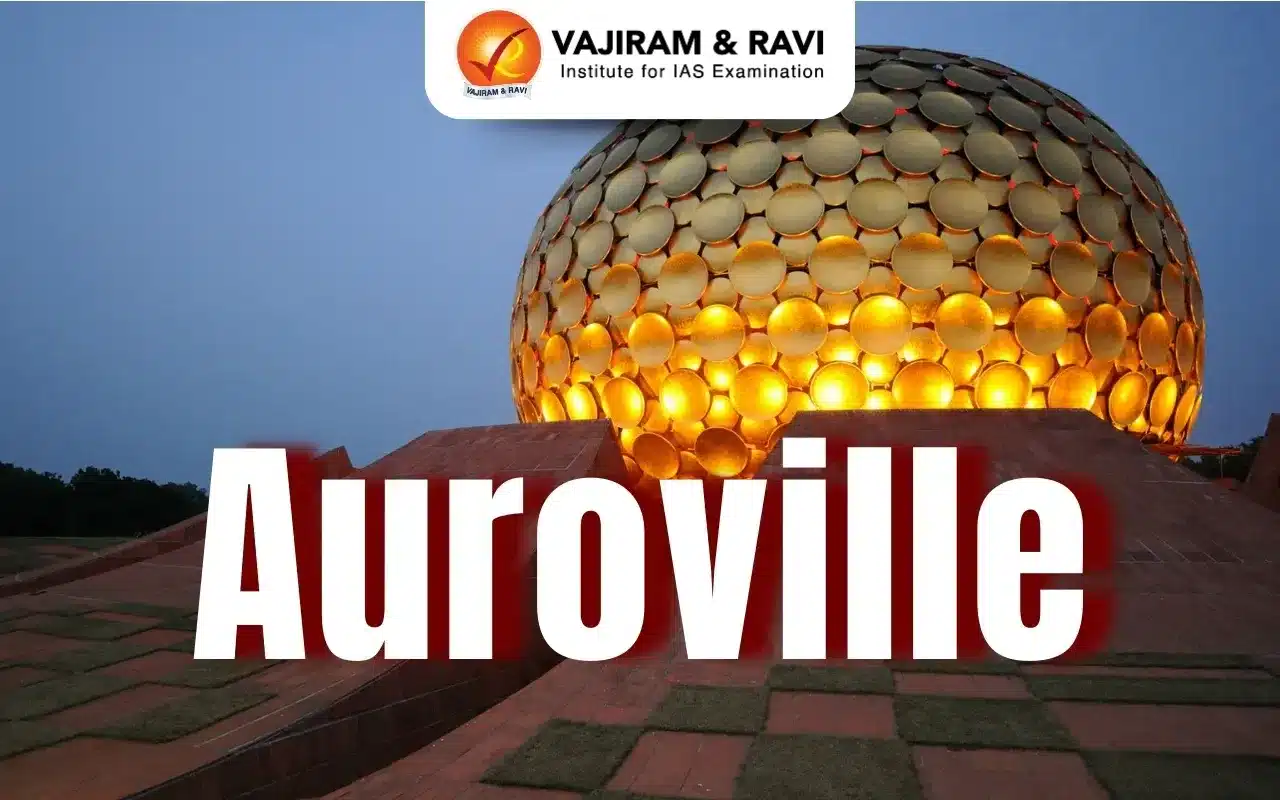
- Matrimandir: At the centre of Auroville stands the Matrimandir, a large golden spherical structure known as the “soul of the city.” It is designed as a place for silent concentration.
- Four Zones: The planned city is divided into four major zones: Industrial, Cultural, Residential and International. Each zone focuses on a different aspect of community life.
- Green Belt: A Green Belt surrounds the township and includes forests, farms and natural areas. Afforestation and environmental restoration have helped improve the region’s biodiversity.
- Sustainable Living: Auroville promotes sustainable living through renewable energy, organic farming, ecological restoration, alternative technologies and community-based enterprises.
- Population: Auroville has around 2,500-3,000 residents from approximately 50-60 countries, representing diverse social, cultural and economic backgrounds.
- Community Life: Auroville encourages people to see work as a form of service and self-development, while education focuses on continuous learning rather than only examinations, certificates or employment.


Auroville UNESCO Recognition and Cultural Importance
- UNESCO Recognition: Auroville received international recognition through UNESCO, which adopted resolutions supporting and encouraging the Auroville project in 1966, 1968, 1970 and 1983.
- 1966 Resolution: In 1966, UNESCO passed a unanimous resolution recognising Auroville as a project of importance to the future of humanity and encouraging international support for its development.
- Government Support: The Government of India supported the development of Auroville as an experiment in international community living and the promotion of human unity.
- Administrative Control: Since 1980, Auroville has been under the administrative control of the Ministry of Education and is governed according to the Auroville Foundation Act, 1988, passed by Parliament.
- Government Funding: Under the Auroville Foundation Act, the Government of India provides grants to the Auroville Foundation for the establishment, maintenance and development of the township.
- Cultural Importance: Auroville brings together people from different nations and backgrounds around common ideals of peace, cooperation, sustainable living and human unity.
- Environmental Importance: Its transformation from a largely barren landscape into a green and biodiverse community makes Auroville an important example of environmental restoration and sustainable community development.
- Global Significance: Auroville continues to function as an experiment in human unity, cultural exchange, sustainable living and social transformation, making it an important example of intentional community living.

 Last updated on Oct, 2026
→ UPSC 2027 Notification will be released on 13 January 2027 at upsconline.nic.in.
→ Check Nobel Prize 2026 Winners List here.
→ Download PIB PRiSM Monthly Magazine 2026 here.
→ Check UPSC Monthly Current Affairs Magazine The Recitals here.
→ Check out the latest UPSC Syllabus here.
→ Download UPSC Model Answers for Mains 2026
→ UPSC Mains Question Paper 2026 is out now for Essay & GS Paper 1, 2, 3 & 4.
→ UPSC Calendar 2027 has been released.
→ Enroll in Vajiram & Ravi’s UPSC Mains Test Series 2027 for structured answer writing practice, expert evaluation, and exam-oriented feedback.
→ Join Vajiram & Ravi’s UPSC Mentorship Program 2027 for personalized guidance, strategy planning, and one-to-one support from experienced mentors.
→ Go through the UPSC Mains Previous Year Papers to enhance your preparation.
→ UPSC has released UPSC Toppers List 2025 with the Civil Services final result on its official website.
→ Also check Best UPSC Coaching in India
Auroville FAQs
Q1. What is Auroville?+
Q2. When was Auroville founded?+
Q3. Where is Auroville located?+
Q4. What is the significance of the Matrimandir in Auroville?+
Q5. What is the Auroville Foundation Act, 1988?+
Q6. What is the main objective of Auroville?+
Tags: history history notes