


What’s in Today’s Article?
- Why in News?
- Major Features of the Ram Temple
Why in News?
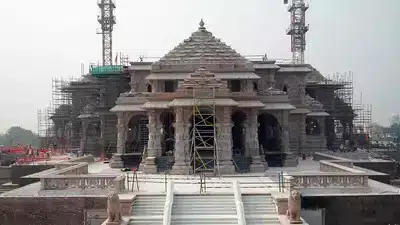
- A new landmark of India – both structural and spiritual – rises on Ayodhya’s horizon as a new-age architectural marvel of elegant sandstones, diligently carved by craftspeople with dedication and devotion to Lord Ram.


Major Features of the Ram Temple

- Main Complex:
- The Ram Mandir is a Hindu temple in Ayodhya, Uttar Pradesh. It is located at the site of Ram Janmabhoomi, the birthplace of Lord Rama.
- No iron or steel has been used in the construction of the grand structure. Stones have been sourced from Rajasthan’s Bansi Paharpur area.
- The temple complex, built in the traditional Nagara style, will be 380 feet long from the east to the west, 250 feet wide and 161 feet high.
- Each floor of the temple will be 20 feet high and have a total 392 pillars and 44 gates.
- Around the grand temple is a rectangular periphery called percota, a feature found in temples in south India, but not generally in north India.
- The percota will be 14 feet wide and the periphery span 732 metres. The temple will be nestled within the percota periphery.
- Images of Lord Hanuman, other deities, peacocks and flower patterns have been carved onto the stones, lending the structure a divine look.
- More than 3,000 kg of flowers of over 20 varieties have been used to decorate the grand structure.
- Main Entrance:
- Ornate statues of elephants, lions, Lord Hanuman and Garuda were installed at the main entrance leading to the temple earlier this month.
- These statues have also been made using sandstone brought from Bansi Paharpur.
- Green Complex:
- A major part of the temple compound will be a green area with hundreds of trees.
- About 70 per cent of the complex will be a green area.
- The complex will have two sewage treatment plants — a water treatment plant and a dedicated electricity line from the power house.
- The fire brigade post will be able to source water from an underground reservoir.

 Last updated on Oct, 2026
→ UPSC 2027 Notification will be released on 13 January 2027 at upsconline.nic.in.
→ Check Nobel Prize 2026 Winners List here.
→ Download PIB PRiSM Monthly Magazine 2026 here.
→ Check UPSC Monthly Current Affairs Magazine The Recitals here.
→ Check out the latest UPSC Syllabus here.
→ Download UPSC Model Answers for Mains 2026
→ UPSC Mains Question Paper 2026 is out now for Essay & GS Paper 1, 2, 3 & 4.
→ UPSC Calendar 2027 has been released.
→ Enroll in Vajiram & Ravi’s UPSC Mains Test Series 2027 for structured answer writing practice, expert evaluation, and exam-oriented feedback.
→ Join Vajiram & Ravi’s UPSC Mentorship Program 2027 for personalized guidance, strategy planning, and one-to-one support from experienced mentors.
→ Go through the UPSC Mains Previous Year Papers to enhance your preparation.
→ UPSC has released UPSC Toppers List 2025 with the Civil Services final result on its official website.
→ Also check Best UPSC Coaching in India








