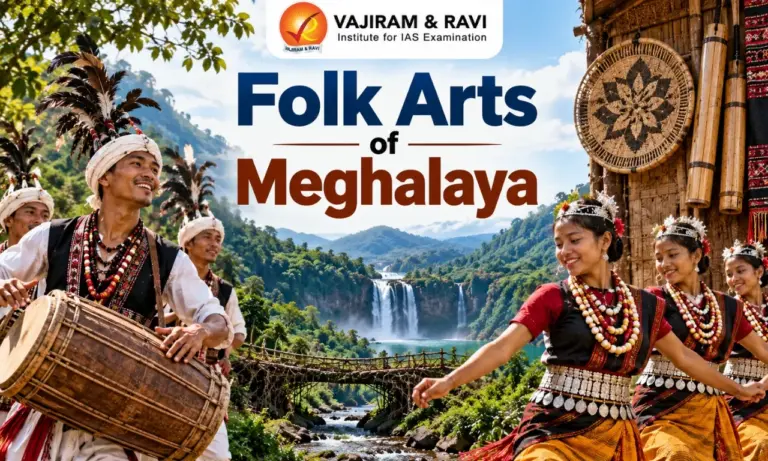
The Folk Arts of Meghalaya reflect the rich cultural traditions of the Khasi, Jaintia (Pnar) and Garo communities. Shaped by their close relationship with nature, agriculture, festivals and traditional beliefs, these arts are an important part of everyday community life.
Major Folk Arts of Meghalaya
The Folk Arts of Meghalaya can be broadly seen in its traditional dances, music, textiles, bamboo and cane crafts, pottery and other forms of indigenous craftsmanship, each reflecting the distinctive skills and practices associated with the state’s communities.
Folk Dances and Festivals
Meghalaya’s traditional dances are closely associated with festivals, agricultural cycles, thanksgiving and religious practices. The Khasi, Jaintia and Garo communities have their own distinctive dance traditions.
- Wangala: Wangala is the major harvest festival of the Garo community, generally celebrated in October-November. It honours Saljong, associated with fertility and the bounties of nature, and marks the end of agricultural toil and the beginning of winter. The festival begins with the Ragula ceremony, followed by Kakkat, when men and women perform in colourful traditional dress to the beat of long oval-shaped drums. It is popularly known as the “100 Drums Festival.”
- Shad Suk Mynsiem: Shad Suk Mynsiem is an important Khasi thanksgiving dance festival, held in April. It marks the beginning of a new agricultural cycle and expresses gratitude for the blessings and harvests received. The dance is performed with traditional dress and symbolic rituals and is an important expression of Khasi cultural identity.
- Nongkrem Dance: Also known as Ka Pomblang Nongkrem, it is a five-day religious festival of the Khasi community, held at Smit near Shillong, generally in November. The festival seeks blessings for prosperity and a good harvest. Unmarried women perform graceful dances, while men perform more vigorous movements with swords and white yak-hair whisks to the accompaniment of drums and the tangmuri.
- Behdienkhlam: Behdienkhlam is the principal festival of the Pnar or Jaintia community, celebrated at Jowai in July after the sowing period. Its central idea is to drive away evil, disease and misfortune and seek blessings for a good harvest. Rituals include striking house roofs with bamboo poles, processions with decorated structures called rots, and the traditional dad-lawakor game played with a wooden ball.
Folk Music and Musical Instruments
Music forms an important part of Meghalaya’s festivals, dances and community life. Traditional instruments include string, wind and percussion instruments.
- Duitara: Duitara is a four-stringed traditional instrument used in Meghalaya. It has a wooden body and is an important part of the region’s indigenous musical tradition.
- Tangmuri: Tangmuri is a traditional wind instrument commonly used during dances and processions. It has seven holes and produces a distinctive sound; it is also played during traditional Khasi ceremonies.
- Sharati: Sharati is another traditional flute-like instrument used along with other indigenous instruments in Meghalaya’s musical traditions.
- Garo Drums: Long, oval-shaped drums are central to Wangala performances and give the festival its popular name, the 100 Drums Festival. Drums are accompanied by gongs, flutes and other traditional instruments.
Traditional Weaving and Textiles
Weaving is an important traditional craft of Meghalaya, particularly among the Garo community. It combines practical use with distinctive local designs and traditional clothing.
- Dakmanda: Dakmanda is a traditional garment woven by Garo women and worn from the waist to below the knee. Garo weavers also produce shirting, bedcovers, bed sheets and tablecloths. The craft remains an important part of the economic and cultural life of the Garo Hills.
- Ryndia: Ryndia is Meghalaya’s traditional Eri silk, known for its texture, durability and sustainable production practices. Ri-Bhoi, particularly the Umden-Diwon area, is an important centre of Eri silk production and weaving. Ryndia received GI registration, strengthening its recognition as a distinctive Meghalaya textile.
- Khasi Handloom: Traditional Khasi handloom products form another important part of Meghalaya’s textile heritage. Meghalaya Khasi Handloom Products received GI registration in 2023, providing legal recognition to the traditional textile tradition.
Bamboo and Cane Crafts
Bamboo and cane work is among the most important traditional crafts of Meghalaya. The abundance of bamboo and cane has encouraged the production of both household and decorative objects, while also supporting local livelihoods.
- Khoh: Khoh is a traditional closed-weave Khasi basket used for carrying goods and general marketing. It is carried on the back with the help of a head strap.
- Meghum Khok: Meghum Khok is an artistic basket made in the Garo Hills. It is used for storing valuable items such as clothes and other belongings.
- Pokerwork: Pokerwork is a distinctive Garo technique in which designs are burnt into bamboo using a heated pointed rod. It combines utility with decorative craftsmanship.
- Kurup and Bamboo Products: Khasi artisans also make bamboo-and-cane products such as kurup, mats, moorahs, baskets, umbrellas and other household articles. These crafts demonstrate the close relationship between local resources and traditional lifestyles.
Woodcarving and Pottery
- Woodcarving: Woodcarving is an established craft tradition in the Khasi, Jaintia and Garo areas. Garo artisans, in particular, are known for woodcarving along with bamboo and cane work.
- Meghalaya Lyrnai Pottery: Lyrnai pottery is a traditional pottery craft of Meghalaya and has received Geographical Indication (GI) registration. It is made through traditional techniques and represents the continuity of indigenous pottery traditions in the state.
Other Traditional Crafts
Meghalaya’s craft traditions also include carpet weaving, jewellery making, musical instruments, clay toys and dolls, and pineapple-fibre products. Pineapple fibre is particularly notable for making items such as nets, bags and purses. These crafts show how local natural resources are incorporated into traditional livelihoods.
Folk Arts of Meghalaya Cultural Significance
- Community identity: Folk arts provide an important expression of Khasi, Jaintia and Garo cultural identities.
- Agricultural connection: Festivals such as Wangala, Shad Suk Mynsiem, Nongkrem and Behdienkhlam are closely connected with sowing, harvest and thanksgiving.
- Living traditions: These arts continue to be practised within communities rather than existing only as historical traditions.
- Women and traditional crafts: Women play an important role in weaving, particularly in Garo textile traditions, linking craft production with household and community life.
- Natural resource-based craftsmanship: Bamboo, cane, wood, silk and plant fibres are transformed into useful and decorative products, reflecting the close relationship between environment and culture.
- Livelihoods: Handloom, bamboo and cane work, pottery and other crafts provide supplementary economic opportunities, particularly in rural areas.


 Last updated on Oct, 2026
→ UPSC 2027 Notification will be released on 13 January 2027 at upsconline.nic.in.
→ Check Nobel Prize 2026 Winners List here.
→ Download PIB PRiSM Monthly Magazine 2026 here.
→ Check UPSC Monthly Current Affairs Magazine The Recitals here.
→ Check out the latest UPSC Syllabus here.
→ Download UPSC Model Answers for Mains 2026
→ UPSC Mains Question Paper 2026 is out now for Essay & GS Paper 1, 2, 3 & 4.
→ UPSC Calendar 2027 has been released.
→ Enroll in Vajiram & Ravi’s UPSC Mains Test Series 2027 for structured answer writing practice, expert evaluation, and exam-oriented feedback.
→ Join Vajiram & Ravi’s UPSC Mentorship Program 2027 for personalized guidance, strategy planning, and one-to-one support from experienced mentors.
→ Go through the UPSC Mains Previous Year Papers to enhance your preparation.
→ UPSC has released UPSC Toppers List 2025 with the Civil Services final result on its official website.
→ Also check Best UPSC Coaching in India
Folk Arts of Meghalaya FAQs
Q1. What are the major Folk Arts of Meghalaya?+
Q2. Which communities are associated with the Folk Arts of Meghalaya?+
Q3. Which Folk Art of Meghalaya is known as the “100 Drums Festival”?+
Q4. Which community is associated with Wangala?+
Q5. Which community celebrates Behdienkhlam?+
Tags: folk Arts of meghalaya