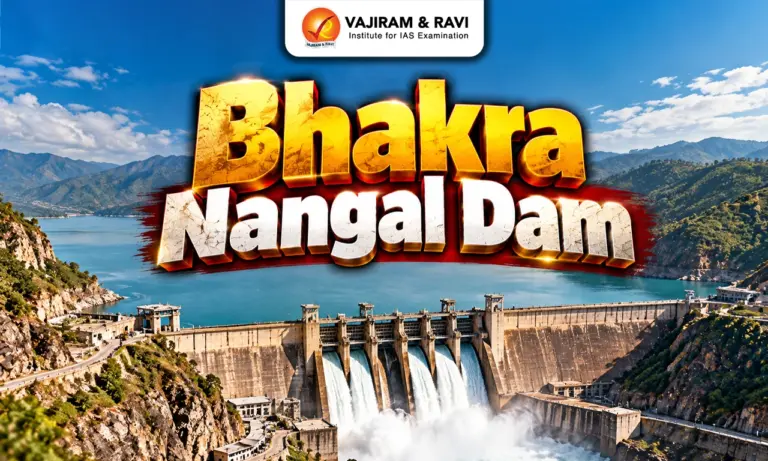
Bhakra Nangal Dam is a major multipurpose river valley project on the Satluj River in northern India. Bhakra Dam is located at Bhakra Village in Bilaspur district, Himachal Pradesh. The project includes Bhakra Dam, Nangal Dam, hydel channels and powerhouses. Bhakra Dam creates the Gobind Sagar Reservoir. It supports irrigation, hydropower generation and flood management across several northern Indian states.
Bhakra Nangal Dam
Bhakra Dam and Nangal Dam are two separate structures. Nangal Dam is located downstream at Nangal in Punjab. They are commonly referred to together as the Bhakra Nangal Dam project.
Bhakra Nangal Dam remains an important infrastructure project because of its role in water storage, irrigation and hydropower generation. The project is managed by the Bhakra Beas Management Board (BBMB). The board regulates water and power supplies from the Bhakra Nangal and Beas projects for Punjab, Haryana, Rajasthan, Himachal Pradesh, Delhi and Chandigarh.
Bhakra Dam
Bhakra Dam is the main upstream structure of the project and creates the large Gobind Sagar reservoir in Bilaspur district.
- Location: Bhakra Dam is located at Bhakra Village in Bilaspur district, Himachal Pradesh. Its coordinates are 31°24′39″N 76°26′0″E.
- River: The dam is constructed across the Sutlej River.
- Type: It is a concrete gravity dam with controlled overflow spillways.
- Height and length: Bhakra Dam is 741 feet or 226 metres high. Its total length is about 1,700 feet or 520 metres.
- Width: The dam has a crest width of 30 feet or 9.1 metres. Its base width reaches 625 feet or 191 metres.
- Gobind Sagar: Bhakra Dam creates the Gobind Sagar reservoir. The reservoir is about 90 km long and covers 168.35 square kilometres.
- Water storage: Gobind Sagar can store up to 9.34 billion cubic metres of water. The reservoir has a maximum water depth of 1,680 feet.
- Power capacity: The Bhakra powerhouses have a combined installed capacity of 1,325 MW. They use five 108 MW and five 157 MW Francis-type turbines.
- Power distribution: Electricity generated at Bhakra is supplied to Himachal Pradesh, Punjab, Haryana, Rajasthan, Chandigarh and Delhi.
- Spillway system: Bhakra Dam has four controlled spillway gates. They are used when the reservoir level rises beyond the permitted maximum level.
- Historical recognition: Jawaharlal Nehru described Bhakra Dam as the “New Temple of Resurgent India”. The project was dedicated to the nation in October 1963.


Nangal Dam
Nangal Dam is the downstream structure of the Bhakra Nangal Project and regulates water released from Bhakra Dam.
- Location: Nangal Dam is situated at Nangal in Punjab. It is located downstream of Bhakra Dam, at a distance of about 10 to 13 km.
- Structure: Nangal Dam is a barrage-type dam. It is separate from Bhakra Dam, although both are commonly referred to together as the Bhakra Nangal Dam.
- Water regulation: Water released from Bhakra Dam reaches Nangal Dam. The structure regulates this flow before it enters the Nangal Hydel Channel.
- Canal system: The Nangal Hydel Channel later becomes the Bhakra Main Line after the Ganguwal and Kotla power plants. It mainly supplies irrigation water to Punjab.
- Additional power: The project has Ganguwal, Kotla and Anandpur Sahib power stations. Their capacities are 77.65 MW, 77.65 MW and 134 MW respectively.
Bhakra Nangal Dam Project
The Bhakra Nangal Dam Project was developed as a multipurpose river valley project for irrigation, power generation and flood management.
- Early concept: Sir Chhotu Ram conceptualised the Bhakra Dam idea in early 1923. An agreement with the Raja of Bilaspur was signed in November 1944.
- Project approval: The project plan was finalised on 8 January 1945. Preliminary work began in 1946, while dam construction formally started in 1948.
- Construction milestone: Jawaharlal Nehru poured the first bucket of concrete into the dry Sutlej riverbed on 17 November 1955.
- Completion: The Bhakra Dam was completed by the end of 1963. Successive stages of the larger project continued into the early 1970s.
- Construction cost: The recorded construction cost was ₹245.28 crore. The project involved large-scale engineering and construction work after independence.
- Project administration: Bhakra Beas Management Board was constituted in 1966. It began administration, maintenance and operation of the Bhakra Nangal Project from 1 October 1967.
Bhakra Nangal Dam Significance
The project combines water storage, irrigation, hydropower generation and flood management, making it significant for the northern Indian river valley system.
- Irrigation: Water from Bhakra supports irrigation across Punjab, Haryana and Rajasthan. The Bhakra Canal system provides irrigation to about 10 million acres or 40,000 km² of agricultural fields.
- Flood Management: The reservoir stores excess monsoon water and allows controlled releases during the year. This helps reduce the risk of flood damage in the Satluj-Beas river valley.
- Hydropower: The 1,325 MW Bhakra power system supplies electricity to partner states and Union Territories. Additional power stations at Ganguwal, Kotla and Anandpur Sahib have capacities of 77.65 MW, 77.65 MW and 134 MW respectively.
- Water and Power Distribution: BBMB regulates water and power supplies from the Bhakra Nangal and Beas projects. The beneficiary regions include Punjab, Haryana, Rajasthan, Himachal Pradesh, Delhi and Chandigarh.
- Fisheries: Gobind Sagar supports several fish species, including the endangered Mahseer. Commercial fishing in the reservoir provides a source of revenue for local communities.
- Displacement: Creation of the large reservoir submerged about 371 villages in Bilaspur district. The displacement and resettlement of affected people remain an important social aspect of the project.

 Last updated on Oct, 2026
→ UPSC 2027 Notification will be released on 13 January 2027 at upsconline.nic.in.
→ Check Nobel Prize 2026 Winners List here.
→ Download PIB PRiSM Monthly Magazine 2026 here.
→ Check UPSC Monthly Current Affairs Magazine The Recitals here.
→ Check out the latest UPSC Syllabus here.
→ Download UPSC Model Answers for Mains 2026
→ UPSC Mains Question Paper 2026 is out now for Essay & GS Paper 1, 2, 3 & 4.
→ UPSC Calendar 2027 has been released.
→ Enroll in Vajiram & Ravi’s UPSC Mains Test Series 2027 for structured answer writing practice, expert evaluation, and exam-oriented feedback.
→ Join Vajiram & Ravi’s UPSC Mentorship Program 2027 for personalized guidance, strategy planning, and one-to-one support from experienced mentors.
→ Go through the UPSC Mains Previous Year Papers to enhance your preparation.
→ UPSC has released UPSC Toppers List 2025 with the Civil Services final result on its official website.
→ Also check Best UPSC Coaching in India
Bhakra Nangal Dam FAQs
Q1. Where is Bhakra Nangal Dam located?+
Q2. What is the height of Bhakra Dam?+
Q3. Which reservoir is created by Bhakra Dam?+
Q4. What is the power generation capacity of Bhakra Dam?+
Q5. Why is Bhakra Nangal Dam important?+
Tags: bhakra bhakra nangal dam