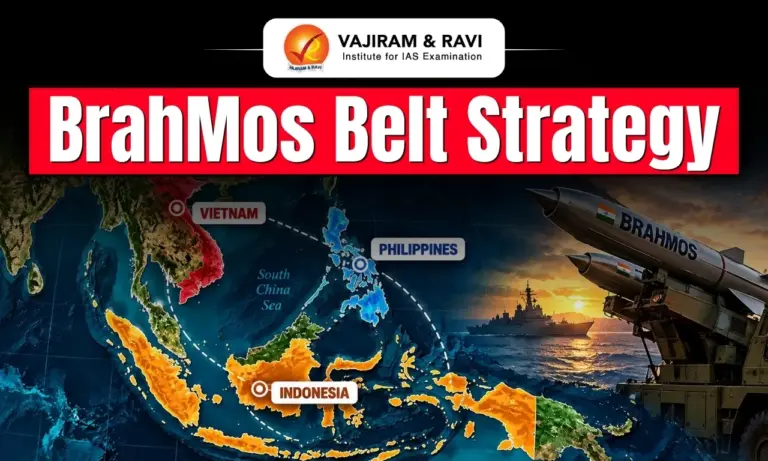
BrahMos Belt Strategy refers to the emerging network of BrahMos missile partnerships between India and Southeast Asian countries located around the South China Sea. The idea is being discussed as India expands BrahMos exports to countries such as the Philippines, Vietnam and Indonesia, while other countries including Thailand and Malaysia have shown interest.
What is the BrahMos Belt Strategy?
The BrahMos Belt Strategy is not a formal military alliance or treaty. It is a term used by strategic experts to describe India’s growing network of BrahMos missile cooperation with countries around the South China Sea that have maritime security concerns.
The Philippines became the first foreign buyer of BrahMos in 2022. India has subsequently expanded cooperation with other Southeast Asian countries, including Vietnam and Indonesia. If more countries in the region acquire the system, these separate missile deployments could form a strategic chain around China’s maritime periphery.
BrahMos Missile
BrahMos missile is a supersonic cruise missile jointly developed by India and Russia. It is designed for precision strikes against land and maritime targets and is known for its high speed, accuracy and versatility.
Key Features of the BrahMos Missile
- Joint Development: BrahMos was developed through cooperation between India’s DRDO and Russia’s NPO Mashinostroyenia.
- Name: The name BrahMos is derived from the Brahmaputra River of India and the Moskva River of Russia.
- Supersonic Speed: It can travel at around Mach 2.8–3, making it much faster than conventional subsonic cruise missiles.
- Cruise Missile: It uses an air-breathing propulsion system and flies within the atmosphere towards its target.
- Multi-Platform Capability: BrahMos can be launched from land-based launchers, warships, submarines and aircraft.
- Anti-Ship Capability: It can be used against enemy naval vessels, making it important for maritime warfare and sea-denial operations.
- Land-Attack Capability: The missile can also conduct precision strikes against land-based targets.
- High Precision: Its advanced guidance and navigation systems allow it to accurately engage designated targets.
- Low-Level Flight: During parts of its flight, BrahMos can fly at a low altitude, making detection and interception more difficult.
- Short Reaction Time: Its high speed gives an opponent limited time to detect, identify and respond to an incoming missile.
- Export Potential: The Philippines became the first foreign customer for the BrahMos missile, marking an important step in India’s defence exports.


Countries Linked to the BrahMos Belt
The BrahMos network is gradually expanding across Southeast Asia.
1. Philippines
The Philippines was the first foreign country to purchase BrahMos, signing a deal in 2022 for a shore-based anti-ship missile system. The acquisition is particularly significant because the Philippines faces maritime security challenges in the South China Sea.
2. Vietnam
Vietnam has emerged as another important potential user of BrahMos. Its strategic location along the South China Sea gives the missile considerable relevance for coastal defence and maritime deterrence. Recent reporting has highlighted a major BrahMos deal with Vietnam.
3. Indonesia
Indonesia has also moved towards acquiring BrahMos systems. Its geographical position around key maritime routes makes it strategically important for India’s wider Indo-Pacific and maritime security outreach.
4. Thailand and Malaysia
Thailand is evaluating the BrahMos system, while Malaysia has also been identified as a potential future customer. If more countries acquire the missile, the geographical network of BrahMos-equipped coastal states could become wider.
BrahMos Belt Strategy Purpose
BrahMos Belt Strategy aims to build a network of defence partnerships and maritime deterrence around the Indo-Pacific by supplying BrahMos missiles to strategically located Southeast Asian countries.
- Strengthen regional deterrence against potential maritime threats.
- Enhance the coastal defence capabilities of partner countries.
- Support maritime security in the South China Sea and surrounding waters.
- Expand India’s defence exports and defence-industrial partnerships.
- Deepen strategic ties with Southeast Asian countries.
- Strengthen India’s role in the Indo-Pacific region.
- Promote capacity building through training, logistics and defence cooperation.
- Provide an alternative to excessive dependence on major external military powers.
BrahMos Belt Strategy Significance
BrahMos Belt Strategy is significant because it combines India’s defence exports, strategic diplomacy and maritime security objectives, while expanding its influence in the Indo-Pacific without establishing permanent military bases.
- Boosts Defence Diplomacy: BrahMos exports create long-term military and strategic partnerships with recipient countries.
- Strengthens Indo-Pacific Presence: It expands India’s strategic footprint across Southeast Asia.
- Improves Maritime Deterrence: BrahMos gives partner countries a credible anti-ship and coastal strike capability.
- Supports ASEAN Engagement: Defence cooperation strengthens India’s relationship with ASEAN countries.
- Counters Strategic Vulnerability: Stronger coastal capabilities can make regional countries less vulnerable to maritime coercion.
- Promotes Defence Exports: BrahMos strengthens India’s position as an emerging defence equipment exporter.
- Supports Make in India: Growing exports can encourage domestic defence manufacturing and technology development.
- Protects Sea Lanes: Better maritime capabilities can contribute to the security of important Sea Lines of Communication (SLOCs).
- Enhances Strategic Autonomy: India can build partnerships without entering into a formal military alliance.

 Last updated on Oct, 2026
→ UPSC 2027 Notification will be released on 13 January 2027 at upsconline.nic.in.
→ Check Nobel Prize 2026 Winners List here.
→ Download PIB PRiSM Monthly Magazine 2026 here.
→ Check UPSC Monthly Current Affairs Magazine The Recitals here.
→ Check out the latest UPSC Syllabus here.
→ Download UPSC Model Answers for Mains 2026
→ UPSC Mains Question Paper 2026 is out now for Essay & GS Paper 1, 2, 3 & 4.
→ UPSC Calendar 2027 has been released.
→ Enroll in Vajiram & Ravi’s UPSC Mains Test Series 2027 for structured answer writing practice, expert evaluation, and exam-oriented feedback.
→ Join Vajiram & Ravi’s UPSC Mentorship Program 2027 for personalized guidance, strategy planning, and one-to-one support from experienced mentors.
→ Go through the UPSC Mains Previous Year Papers to enhance your preparation.
→ UPSC has released UPSC Toppers List 2025 with the Civil Services final result on its official website.
→ Also check Best UPSC Coaching in India
BrahMos Belt Strategy FAQs
Q1. What is the BrahMos Belt Strategy?+
Q2. Is the BrahMos Belt Strategy a formal military alliance?+
Q3. Which country was the first foreign buyer of BrahMos?+
Q4. Why is BrahMos important for Southeast Asian countries?+
Q5. Which countries are associated with the BrahMos Belt?+
Tags: brahMos belt strategy current affairs international relations