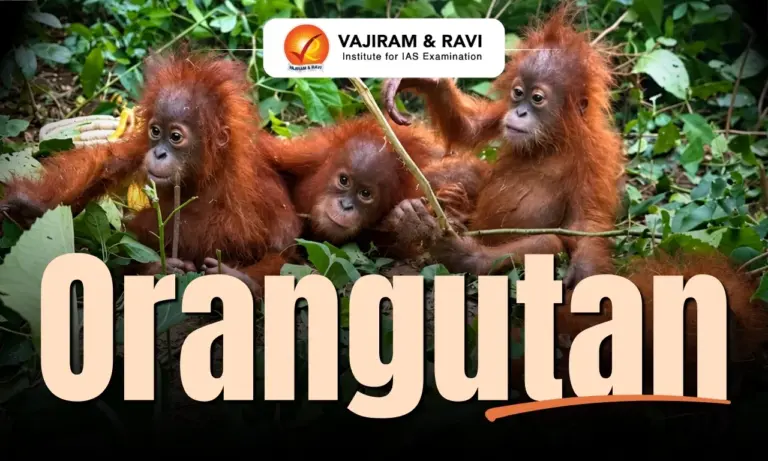
Orangutans are among the most distinctive great apes and are widely recognised for their long reddish-orange hair. They are the largest tree dwelling mammals and spend more than 90% of their waking hours in trees. Orangutans are found naturally only on Borneo and Sumatra in Southeast Asia. Their intelligence, unique physical features and critically endangered status make their conservation globally important.
Why are Orangutans in News?
Orangutans are in news after five juvenile Orangutans were found near Badapai village forest in the Bhograi area of Odisha’s Balasore district. The unusual sighting has raised concerns about illegal wildlife trafficking because Odisha is outside their natural range. The five animals measured about 1 to 1.5 feet and were rescued by forest officials. Their arrival is under investigation.
What are Orangutans?
Orangutans are Asia’s only great apes and the largest arboreal mammals on Earth. They share 96.4% of their genes with humans. Their natural range is limited to Indonesian Sumatra and Malaysian and Indonesian parts of Borneo. They inhabit forests ranging from lowland peat swamps to mountainous areas reaching nearly 1.6 kilometres above sea level.


Orangutan Features
Orangutans have several distinctive physical and behavioural features that help them survive in dense tropical forests and spend most of their lives in trees.
- Species: There are three recognised species of Orangutans, namely Bornean, Sumatran and Tapanuli Orangutans. All three species occur naturally in Southeast Asia.
- Distribution: Wild Orangutans are restricted to Sumatra and Borneo. Their natural distribution does not extend to India, including Odisha, which makes the Balasore discovery unusual.
- Body Size: Adult males are generally about twice the size of females. Males can reach 1.3 metres in height and weigh up to 130 kg in the wild.
- Physical Features: Orangutans have long, sparse orange or reddish hair, very long arms and shorter legs. Their hands and feet have long curved fingers and toes for gripping branches.
- Male Characteristics: Mature males develop prominent cheek pads. This feature is particularly distinctive among primates and becomes more noticeable as males mature.
- Arboreal Behaviour: Orangutans spend more than 90% of their waking hours in trees. Their strong arms, hands and feet help them move through the forest canopy.
- Diet: Orangutans mainly eat fruits and leaves, including lychees and figs. Their diet can also include nuts, bark, insects and occasionally bird eggs.
- Social Structure: Orangutans are highly solitary among great apes. They usually live alone but may form temporary groups called parties when food is abundant.
- Intelligence: Orangutans are highly intelligent animals. Their 96.4% genetic similarity with humans adds importance to protecting their populations and natural habitats.
- Lifespan: Orangutans can live up to 50 years in the wild. Odisha forest officials stated that they generally live up to 40 years in the wild and can exceed 50 to 55 years in captivity.
- Habitat: Their habitat includes lowland peat swamp forests and mountainous forests. Some populations occur at elevations approaching 1.6 kilometres above sea level.
Orangutan Conservation Status
All three Orangutan species face a severe survival threat because habitat destruction, poaching and illegal trafficking continue to affect their populations.
- IUCN Status: Bornean, Sumatran and Tapanuli Orangutans are all classified as ‘Critically Endangered’ on the IUCN Red List, placing them at an extremely high risk of extinction.
- Tapanuli Population: The Tapanuli Orangutan was identified as a separate species in 2017. Fewer than 800 individuals remain in a single forest patch.
- Wildlife Trafficking: Orangutans are targeted by illegal wildlife traders. Officials have described Orangutan trafficking as a multi million dollar criminal industry.
- Major Threats: Habitat loss, poaching and illegal trafficking are major threats. Their restricted distribution makes local population losses particularly serious for long term survival.
Orangutan Found in Odisha
The discovery of five juvenile Orangutan in Balasore is significant because the animals are thousands of kilometres outside their known natural range.
- Location: Five juvenile Orangutans were spotted around 6 am near the Badapai village forest in Bhograi, Balasore. Local residents gathered rapidly after noticing the unusual animals.
- Rescue Operation: Forest officials rescued all five Orangutans and shifted them to the forest office. Four were reported healthy, eating food and drinking ORS while receiving veterinary observation.
- Smuggling Concern: Officials suspect a possible international wildlife smuggling operation. The Balasore DFO said natural migration was unlikely because there is no corridor link to the area.
- Investigation: The forest department launched a field investigation and lodged a formal complaint under relevant wildlife laws. Police assistance was also sought to identify possible individuals or networks.
- WCCB Role: The Wildlife Crime Control Bureau is expected to investigate the suspected trafficking angle. Odisha’s Forest and Environment Minister Ganesh Ram Singh Khuntia indicated central agency involvement.
- Why It Matters: The case highlights the risks posed by illegal wildlife trafficking to critically endangered species. It also shows the importance of rapid rescue, quarantine and coordinated wildlife crime investigations.
- Nandankanan Transfer: Officials planned to shift the rescued Orangutans to Nandankanan Zoological Park in Bhubaneswar after necessary procedures. The animals would undergo quarantine following their transfer.
- Earlier Odisha Record: Nandankanan previously housed an Orangutan named Binny. Binny died in February 2019 at 41 from respiratory issues after being brought to the zoo from Pune in 2003.
Also Read: Species in News 2026


 Last updated on Oct, 2026
→ UPSC 2027 Notification will be released on 13 January 2027 at upsconline.nic.in.
→ Asian Games 2026 are being held in Aichi-Nagoya, Japan, from 19 September to 4 October.
→ Check Nobel Prize 2026 Winners List here.
→ Download PIB PRiSM Monthly Magazine 2026 here.
→ Check UPSC Monthly Current Affairs Magazine The Recitals here.
→ Check out the latest UPSC Syllabus here.
→ Download UPSC Model Answers for Mains 2026
→ UPSC Mains Question Paper 2026 is out now for Essay & GS Paper 1, 2, 3 & 4.
→ UPSC Calendar 2027 has been released.
→ Enroll in Vajiram & Ravi’s UPSC Mains Test Series 2027 for structured answer writing practice, expert evaluation, and exam-oriented feedback.
→ Join Vajiram & Ravi’s UPSC Mentorship Program 2027 for personalized guidance, strategy planning, and one-to-one support from experienced mentors.
→ Go through the UPSC Mains Previous Year Papers to enhance your preparation.
→ UPSC has released UPSC Toppers List 2025 with the Civil Services final result on its official website.
→ Also check Best UPSC Coaching in India
Orangutan FAQs
Q1. What are Orangutans?+
Q2. How many species of Orangutans are there?+
Q3. What is the conservation status of Orangutans?+
Q4. Why were five Orangutans found in Odisha?+
Q5. Where do Orangutans naturally live?+
Tags: environment and ecology orangutans species in news species in news 2025-2026