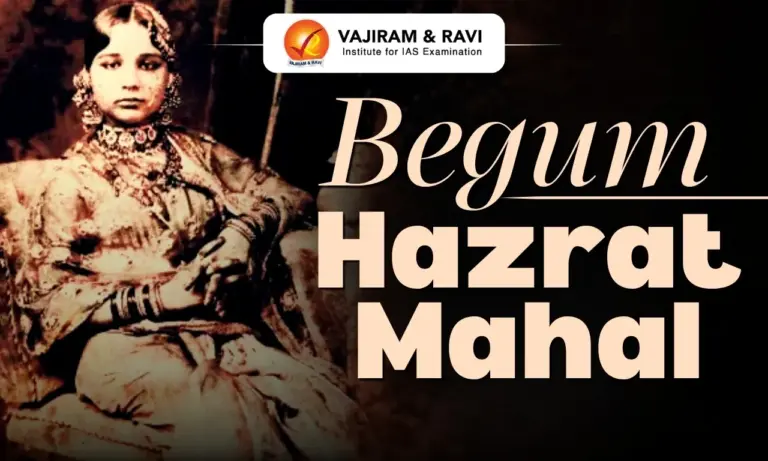
Begum Hazrat Mahal was a prominent leader of the 1857 rebellion in Awadh. She was the second wife of Nawab Wajid Ali Shah and became regent after the British annexed Awadh in 1856. She declared her son Birjis Qadr as ruler and led resistance from Lucknow. Her refusal to accept British authority continued even after she was forced into exile in Nepal.
Who was Begum Hazrat Mahal?
Begum Hazrat Mahal was born around 1820 in Faizabad, the former capital of Awadh. Her birth name was Muhammadi Khanum. She later entered the royal household and became the wife of Nawab Wajid Ali Shah.
- Muhammadi Khanum was born in Faizabad around 1820. She was sold by her parents and entered the Awadh royal household through royal agents.
- She entered the court as a Khawasin and was later promoted to a pari. She became associated with the royal harem of Nawab Wajid Ali Shah.
- She became the junior wife of Nawab Wajid Ali Shah. The title Hazrat Mahal was given to her after the birth of their son, Birjis Qadr.
- Her son Birjis Qadr was born in 1845. He later became the political basis of her claim to continue the Awadh monarchy after British Annexation.
- The British East India Company annexed Awadh on February 7, 1856. Wajid Ali Shah was subsequently exiled to Calcutta on March 13, 1856.
- Begum Hazrat Mahal stayed in Lucknow with Birjis Qadr. This decision brought her directly into the political struggle that followed the Annexation of Oudh.
Begum Hazrat Mahal Role in Freedom Struggle
Begum Hazrat Mahal transformed her position within the Awadh royal family into political leadership during the 1857 rebellion against British Rule.
- Leadership in 1857: When rebellion spread across Awadh, Begum Hazrat Mahal assumed responsibility for protecting the interests of the displaced royal family and opposing Company authority.
- Proclamation of Birjis Qadr: On July 5, 1857, Birjis Qadr was proclaimed ruler of Awadh at Lucknow. Begum Hazrat Mahal acted as regent because of his young age.
- Administration of Awadh: She took charge of the rebel administration in Lucknow. She coordinated political activities and supported resistance against British forces operating in the region.
- Alliance with revolutionaries: Begum Hazrat Mahal worked with important rebel leaders, including Nana Saheb and Maulavi Ahmad Ula Shah. Her resistance was connected with the wider rebellion across northern India.
- Religious concerns: She strongly criticised British policies affecting Hindu and Muslim religious institutions. Her proclamation questioned British claims that their rule would not interfere with religion.
- Defence of Lucknow: She encouraged rebel forces during the fighting around Lucknow. She reportedly appeared on an elephant on February 25, 1858, while issuing instructions concerning military movements.
- British reconquest: British forces under Sir Colin Campbell launched a major offensive against Lucknow in 1858. Moosa Bagh, Char Bagh and Kesar Bagh were among the important positions captured by March 19, 1858.
- Retreat from Awadh: The British regained control over Lucknow and much of Awadh. Begum Hazrat Mahal was forced to leave the region with Birjis Qadr and her supporters.
- Refusal of British amnesty: She rejected British offers of surrender and refused to accept assurances made under Queen Victoria’s proclamation. Her decision reflected her continued opposition to British authority.
- Exile in Nepal: Begum Hazrat Mahal eventually crossed into Nepal. Nepalese authorities initially hesitated to provide asylum but later allowed her to remain there.
- Continued resistance: Her refusal to surrender made her different from leaders who accepted British terms after the rebellion. She remained outside British controlled India for the rest of her life.


Begum Hazrat Mahal Death
Begum Hazrat Mahal spent her final years in Kathmandu after leaving Awadh. She died in Nepal in 1879 and was buried near Kathmandu’s Jama Masjid.
- Life in Nepal: After reaching Nepal, Begum Hazrat Mahal was permitted to stay there despite initial opposition from Rana Prime Minister Jung Bahadur.
- Death: Begum Hazrat Mahal died on April 7, 1879, in Kathmandu. She died in exile after refusing to accept British authority or return under their conditions.
- Burial: She was buried in a nameless grave in the grounds of Kathmandu’s Jama Masjid. Her burial site remains associated with her memory.
Begum Hazrat Mahal Memorial
Begum Hazrat Mahal’s legacy is remembered through memorials, a commemorative postage stamp and public recognition in India and Nepal.
- Kathmandu tomb: Her tomb is located near Jama Masjid in central Kathmandu, close to Ghantaghar and Darbar Marg. The Jama Masjid Central Committee looks after the site.
- Lucknow Memorial: On August 15, 1962, she was honoured at Old Victoria Park in Hazratganj, Lucknow. The park was renamed and a marble memorial was constructed in her honour. The Lucknow memorial contains a marble tablet with four round brass plaques. These plaques carry the coat of arms of the Awadh royal family.
- Commemorative stamp: The Government of India issued a commemorative postage stamp in her honour on May 10, 1984. The stamp recognised her contribution to the 1857 rebellion.
- National scholarship: The Ministry of Minority Affairs introduced the Begum Hazrat Mahal National Scholarship for meritorious girls belonging to minority communities. The Maulana Azad Education Foundation implements the scholarship.
- Historical legacy: Begum Hazrat Mahal is remembered as one of the major women Freedom Fighters of the 1857 rebellion. Her leadership in Awadh and refusal to accept British amnesty remain central to her historical importance.

 Last updated on Oct, 2026
→ UPSC 2027 Notification will be released on 13 January 2027 at upsconline.nic.in.
→ Check Nobel Prize 2026 Winners List here.
→ Download PIB PRiSM Monthly Magazine 2026 here.
→ Check UPSC Monthly Current Affairs Magazine The Recitals here.
→ Check out the latest UPSC Syllabus here.
→ Download UPSC Model Answers for Mains 2026
→ UPSC Mains Question Paper 2026 is out now for Essay & GS Paper 1, 2, 3 & 4.
→ UPSC Calendar 2027 has been released.
→ Enroll in Vajiram & Ravi’s UPSC Mains Test Series 2027 for structured answer writing practice, expert evaluation, and exam-oriented feedback.
→ Join Vajiram & Ravi’s UPSC Mentorship Program 2027 for personalized guidance, strategy planning, and one-to-one support from experienced mentors.
→ Go through the UPSC Mains Previous Year Papers to enhance your preparation.
→ UPSC has released UPSC Toppers List 2025 with the Civil Services final result on its official website.
→ Also check Best UPSC Coaching in India
Begum Hazrat Mahal FAQs
Q1. Who was Begum Hazrat Mahal?+
Q2. What was Begum Hazrat Mahal's role in the 1857 revolt?+
Q3. Who was the son of Begum Hazrat Mahal?+
Q4. When and where did Begum Hazrat Mahal die?+
Q5. Where is Begum Hazrat Mahal's tomb located?+
Tags: begum hazrat mahal hazrat mahal