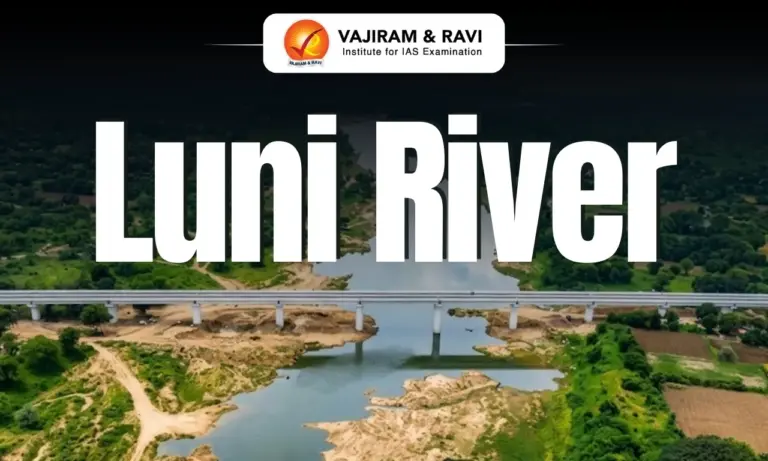
The Luni River is the largest river of the Thar Desert and a major west flowing seasonal river of northwestern India. It rises in the Aravalli Range near Ajmer, Rajasthan and flows southwest through the arid districts before reaching the Rann of Kachchh in Gujarat. The river is important for irrigation, agriculture and local water needs despite becoming highly saline downstream.
Luni River
The Luni River connects the Aravalli hills with the Thar Desert and follows an important westward drainage system across Rajasthan and Gujarat.
- Luni River Origin: The Luni River Origin lies in the Naga Hills of the western Aravalli Range near Pushkar valley in Ajmer district at about 772 metres elevation. It is initially known as Sagarmati.
- Formation of Luni: After passing Govindgarh, the river meets Sarsuti, which originates from Pushkar Lake. From this point, the river is known as Luni.
- Flow Direction: The river generally flows southwestward. It passes through the plains of the Marwar region before entering the Thar Desert and continuing towards Gujarat.
- Luni River Length: The Luni River Length is about 495 km according to the principal course description. Another supplied figure gives its length as 511 km, while some descriptions cite about 530 km.
- Luni River End Point: The Luni River End Point is the marshy region of the Rann of Kutch in Gujarat. Its water spreads into the marsh and does not reach the Arabian Sea.
- Luni River In Which State: The Luni River flows mainly through Rajasthan and finally enters Gujarat.
- Luni River District: Its basin includes parts of Ajmer, Barmer, Jalore, Jodhpur, Nagaur, Pali and Sirohi, along with Banaskantha and Patan.
- River Basin: The Luni basin covers about 32,879 sq km in the detailed basin description. Another supplied estimate gives approximately 37,363 sq km, reflecting different basin delineations.
- Luni River Tributaries: Major tributaries include Jawai, Sukri, Guhiya, Bandi, Khari, Mithri, Sagi and Jojari. Jojari is the only major tributary joining the right bank.
- Salinity: The river is not highly saline in its upper course. Salinity increases around Balotra because of salt rich soils, evaporation and downstream conditions.
- Irrigation Projects: Important irrigation structures associated with the system include Jaswant Sagar, Sardar Samand and Jawai Dam. Sardar Samand Dam was constructed in 1905.
- Jaswant Sagar: Maharaja Jaswant Singh II constructed Jaswant Sagar in 1892 at Pichiyak village in Jodhpur district. The artificial lake irrigates more than 12,000 acres.
Luni River Biodiversity
The seasonal Luni River supports freshwater and saline aquatic habitats along with desert vegetation adapted to limited rainfall and high evaporation.
- Fish Diversity: Cyprinids dominated the recorded fish diversity. Samdhari and Gandhav recorded the highest diversity, with 12 species reported at each location.
- Invasive Species: African Catfish (Clarias gariepinus) and Mozambique tilapia (Oreochromis mossambicus) were widely recorded during the fish diversity assessment.
- Vegetation: The river passes through arid and semi arid landscapes dominated by vegetation adapted to low rainfall, seasonal water availability, saline conditions and high evaporation.
- Desert Ecosystem: The Luni supports a riverine ecological corridor across the Thar region. Seasonal water availability also supports livestock, agriculture and local habitats along its course.


Luni River Challenges
The Luni River faces pollution, salinity, flooding, encroachment and declining water quality, which directly affect agriculture, groundwater and surrounding ecosystems.
- Industrial Pollution: Textile industries around Balotra, Bithuja, Jasol and Pali have discharged hazardous pollutants into the river. This has degraded surface water and affected groundwater quality.
- Irrigation Impact: The National Green Tribunal declared polluted Luni water unfit for irrigation in a case involving textile dyeing units. Around 800 textile units were ordered to shut for violating environmental norms.
- Groundwater Contamination: Industrial pollutants entering the river can contaminate nearby groundwater and surface water bodies. This creates risks for agriculture and communities dependent on local water resources.
- Salinity: Salinity becomes a major downstream concern, particularly around Balotra. Saline water can enter nearby agricultural fields during rainfall and reduce soil fertility.
- Encroachment: Encroachments in the river catchment reduce the natural drainage space. The absence of adequate embankments also increases the risk of saline water reaching farmland.
- Flash Floods: Heavy monsoon rainfall can rapidly increase discharge because of the shallow riverbed. The 2006 flood demonstrated the vulnerability of settlements and agricultural areas.
Mahi-Luni Link Project
The proposed Mahi-Luni Link Project seeks to use surplus Mahi water for water scarce areas while supporting irrigation, drinking water supply and groundwater recharge.
- Project Objective: The Mahi-Luni Link Project aims to utilise surplus water of the Mahi River. It also seeks to improve water availability in water scarce Jalore district.
- Feasibility Study: WAPCOS is preparing the feasibility report for the Western Rajasthan Canal Project. The work examines options for connecting the Mahi and Luni River systems.
- Water Management: The project proposes better water conservation and recharge of existing water sources. Dam recharging is also being considered under the Run off Water Grid Scheme.
- Project Reports: Feasibility studies, the Detailed Project Report (DPR) and Pre Feasibility Report (PFR) are part of the planning process. Water supply options are also being examined through the Sujalam-Sufalam project.

 Last updated on Oct, 2026
→ UPSC 2027 Notification will be released on 13 January 2027 at upsconline.nic.in.
→ Check Nobel Prize 2026 Winners List here.
→ Download PIB PRiSM Monthly Magazine 2026 here.
→ Check UPSC Monthly Current Affairs Magazine The Recitals here.
→ Check out the latest UPSC Syllabus here.
→ Download UPSC Model Answers for Mains 2026
→ UPSC Mains Question Paper 2026 is out now for Essay & GS Paper 1, 2, 3 & 4.
→ UPSC Calendar 2027 has been released.
→ Enroll in Vajiram & Ravi’s UPSC Mains Test Series 2027 for structured answer writing practice, expert evaluation, and exam-oriented feedback.
→ Join Vajiram & Ravi’s UPSC Mentorship Program 2027 for personalized guidance, strategy planning, and one-to-one support from experienced mentors.
→ Go through the UPSC Mains Previous Year Papers to enhance your preparation.
→ UPSC has released UPSC Toppers List 2025 with the Civil Services final result on its official website.
→ Also check Best UPSC Coaching in India
Luni River FAQs
Q1. Where does the Luni River originate?+
Q2. Where does the Luni River end?+
Q3. What is the length of the Luni River?+
Q4. Which are the major tributaries of the Luni River?+
Q5. Why does the Luni River become saline?+
Tags: luni river