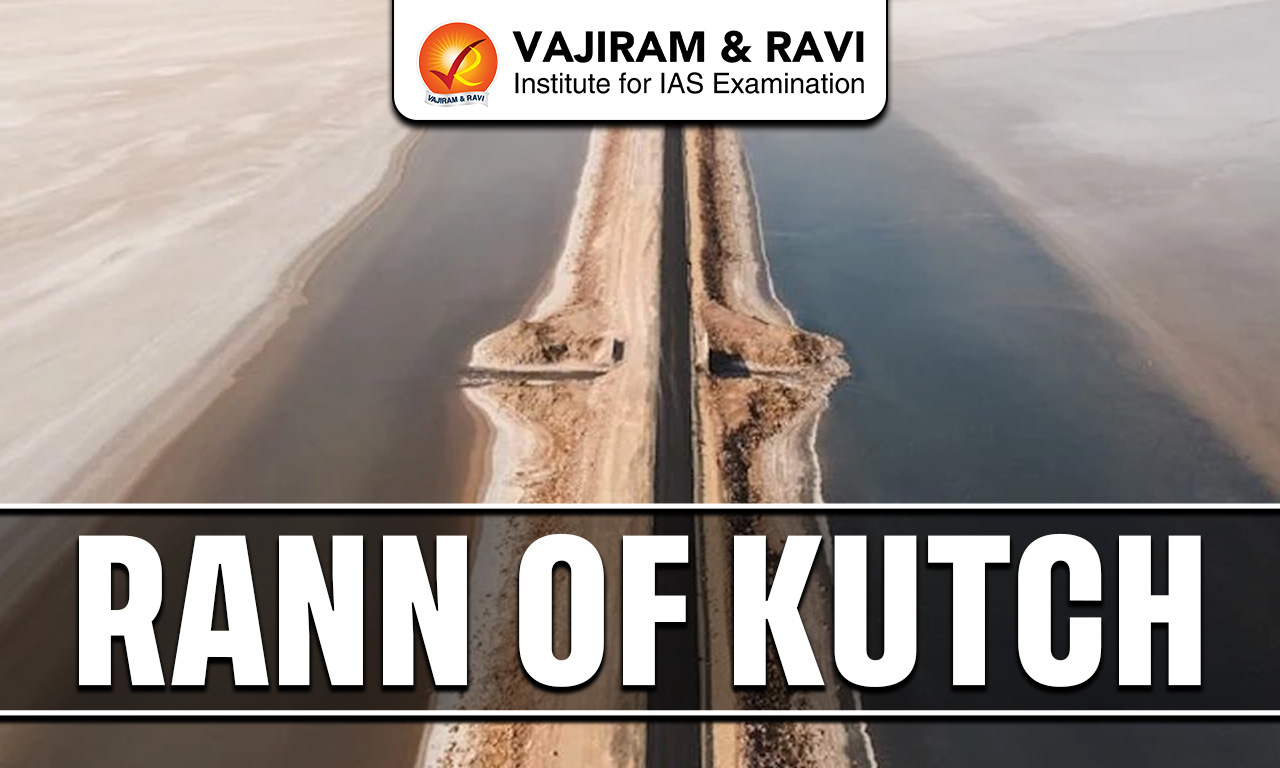
The Rann of Kutch is a vast salt marsh located in the northwestern Indian subcontinent. It spans the India and Pakistan border and covers more than 27,000 km² of area. It lies mainly in the Kutch district of Gujarat with a small extension into Sindh province of Pakistan. It is considered to be formed from a former seabed of the Arabian Sea and transforms seasonally between a flooded wetland and a dry white salt desert, creating a unique and dynamic ecosystem.
Rann of Kutch Features
The Rann of Kutch is a distinctive geographical region known for its seasonal transformation, flat terrain, saline landscape and strategic location between desert and sea ecosystems. The key highlighting features have been listed below:
- Location: It is situated in Gujarat’s Kutch district and extending into Sindh. It lies between the Thar Desert in the north and the Arabian Sea to the south, forming a transitional ecological zone.
- Divisions: It is divided into the Great Rann in the north and the Little Rann in the southeast, with the latter extending towards the Gulf of Kutch and forming saline wetlands.
- Extent: The region spans about 27,454 km². It is one of the largest salt deserts with vast white salt flats visible after monsoon evaporation.
- Terrain: The surface is flat and close to sea level, with elevated islands called “bets” rising 2-3 metres, providing refuge to flora and fauna during seasonal flooding.
- Hydrology: Rivers like Luni, Banas, Saraswati, Rupen, Machchhu and others flow into the Rann, while Kori Creek and Sir Creek connect it to the Indus delta region.
- Climate: It experiences tropical semi arid conditions with summer temperatures reaching 50°C and highly seasonal rainfall concentrated during the southwest monsoon months of June to September.
Rann of Kutch Biodiversity
The Rann of Kutch hosts a unique mix of desert, grassland and wetland ecosystems, supporting diverse flora and fauna adapted to extreme salinity and climatic conditions.
- Vegetation: Dominated by grasslands and thorn scrub, species include Apluda Aristata, Cenchrus, Cymbopogon and Eragrostis, while Prosopis Juliflora grows on elevated bets providing food and shelter.
- Mammals: Around 50 species are found, including Indian Wild Ass (Equus Hemionus Khur), Chinkara, Nilgai, Blackbuck, Indian Wolf, Striped Hyena, Desert Wildcat and Caracal adapted to harsh environments.
- Avifauna: Over 200 bird species exist, including Lesser Flamingo, Demoiselle Crane, Lesser Florican and Houbara Bustard, with wetlands acting as key migratory and breeding habitats.
- Unique Ecosystem: It is the only large flooded grassland zone in the Indomalayan realm, combining marine, desert and wetland ecosystems within a single landscape.
- Adaptations: Species survive extreme heat, salinity and seasonal flooding through behavioral and physiological adaptations, making it a biodiversity rich yet fragile ecosystem.


Rann of Kutch Conservation
The Rann of Kutch has several protected areas and conservation measures aimed at preserving its fragile ecosystem, endangered species and unique saline desert environment.
- Protected Area Coverage: Around 20,946 km² of the region is designated as protected area, ensuring conservation of habitats, wildlife species and ecological processes in the salt marsh ecosystem.
- Kutch Desert Wildlife Sanctuary: Established in 1986, it covers 7,506.22 km² in the Great Rann, protecting desert wildlife, migratory birds and saline wetland ecosystems.
- Indian Wild Ass Sanctuary: Created in 1973 in the Little Rann, covering 4,953.71 km², it protects the last remaining population of Indian wild ass (khur), a flagship species.
- International Protection: Pakistan’s Rann of Kutch Wildlife Sanctuary safeguards the northern portion of the Great Rann and adjacent Thar Desert, ensuring cross border ecological conservation.
- Biosphere Reserve Status: Declared as a Biosphere Reserve in 2008, it focuses on conserving biodiversity, traditional communities and sustainable use of natural resources.
Rann of Kutch Significance
The Rann of Kutch holds immense importance due to its ecological uniqueness, cultural heritage, economic activities and strategic location along the international border.
- Strategic Importance: Located along the India-Pakistan border, it has military and geopolitical significance, highlighted during the 1965 conflict and ongoing border management considerations.
- Economic Role: It contributes significantly to salt production in India, especially in the Little Rann, where traditional salt farming supports local livelihoods.
- Livelihood Support: Communities depend on animal husbandry, handicrafts and salt extraction, with groups like Rabari and Agariya sustaining traditional practices.
- Cultural Heritage: Ancient sites like Dholavira of the Indus Civilization and the Rann Utsav festival showcase rich cultural traditions and historical continuity.
- Environmental Value: It acts as an ecotone between marine and terrestrial systems, supporting biodiversity, migratory birds and maintaining ecological balance in arid regions.
Rann of Kutch Challenges
Despite its importance, the Rann of Kutch faces several environmental, ecological and socio-economic challenges that threaten its sustainability and biodiversity.
- Climate Extremes: Rising temperatures, erratic rainfall and prolonged dry seasons due to climate change threaten the fragile wetland and desert ecosystem balance.
- Habitat Degradation: Expansion of salt pans, industrial activities and infrastructure development disturb wildlife habitats and reduce ecological integrity.
- Water Scarcity: Limited freshwater availability affects both human settlements and wildlife, especially during prolonged dry periods.
- Human-Wildlife Conflict: Increasing human activity, livestock grazing and migration create conflicts, especially impacting species like the Indian Wild Ass and Nilgai.
- Salinisation and Desertification: Overextraction of groundwater and intensive salt production increase soil salinity, degrading land quality and reducing productivity.

 Last updated on Oct, 2026
→ UPSC 2027 Notification will be released on 13 January 2027 at upsconline.nic.in.
→ Check Nobel Prize 2026 Winners List here.
→ Download PIB PRiSM Monthly Magazine 2026 here.
→ Check UPSC Monthly Current Affairs Magazine The Recitals here.
→ Check out the latest UPSC Syllabus here.
→ Download UPSC Model Answers for Mains 2026
→ UPSC Mains Question Paper 2026 is out now for Essay & GS Paper 1, 2, 3 & 4.
→ UPSC Calendar 2027 has been released.
→ Enroll in Vajiram & Ravi’s UPSC Mains Test Series 2027 for structured answer writing practice, expert evaluation, and exam-oriented feedback.
→ Join Vajiram & Ravi’s UPSC Mentorship Program 2027 for personalized guidance, strategy planning, and one-to-one support from experienced mentors.
→ Go through the UPSC Mains Previous Year Papers to enhance your preparation.
→ UPSC has released UPSC Toppers List 2025 with the Civil Services final result on its official website.
→ Also check Best UPSC Coaching in India
Rann of Kutch FAQs
Q1. What is the Rann of Kutch famous for?+
Q2. Where is the Rann of Kutch located?+
Q3. What are the two divisions of the Rann of Kutch?+
Q4. Which famous animal is found in the Rann of Kutch?+
Q5. Why does the Rann of Kutch appear white?+
Tags: geography geography notes rann of kutch