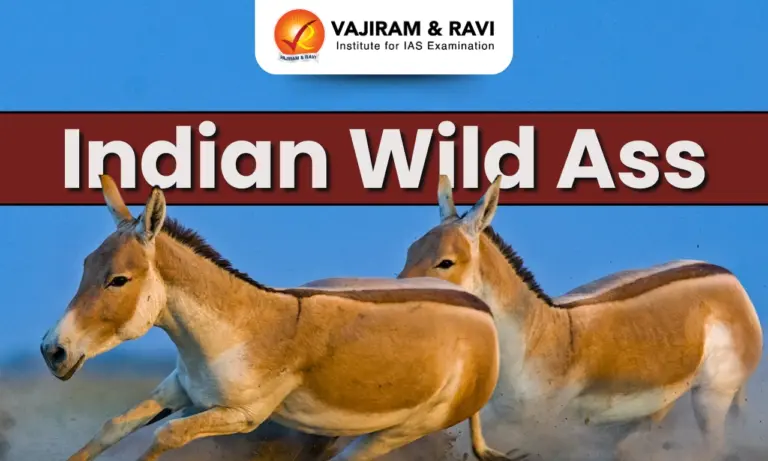
Indian Wild Ass are popularly known as the Khur or Ghudkhar in Gujarat. It is a unique subspecies of the Asiatic Wild Ass and the last surviving wild equid of India. Once distributed across northwestern India, present day Pakistan and parts of Central Asia, it is now largely confined to the Little Rann of Kutch in Gujarat. This hardy animal survives in harsh desert and grassland ecosystems and plays an important ecological role through seed dispersal and habitat maintenance. Continuous conservation efforts have helped its population recover significantly over recent decades.
Indian Wild Ass Features
The Indian Wild Ass is specially adapted to survive in arid landscapes and extreme climatic conditions.
- Identity: The Indian Wild Ass (Equus hemionus khur) is a subspecies of the Asiatic Wild Ass or Onager. It belongs to the family Equidae and is an odd toed ungulate closely related to horses and zebras.
- Local Names: In Gujarat, the species is widely known as khur, ghudkhar, or ghorkhad. These names are commonly used by local communities living around the Little Rann of Kutch.
- Physical Appearance: It has a sandy coloured coat ranging from reddish grey fawn to pale chestnut. Distinctive white patches occur on the shoulder and rump, while a dark stripe bordered by white runs along the back.
- Body Structure: The animal possesses an erect dark mane extending from the head along the neck. Its strong limbs and muscular body help it move efficiently across salt marshes, grasslands and desert terrain.
- Habitat: The species survives in harsh desert and grassland ecosystems where temperatures are extreme and water availability is limited. Its adaptability allows it to thrive in the challenging environment of the Rann.
- Distribution Range: Historically, the khur inhabited northwestern India, Pakistan and parts of Central Asia. Today, its main natural range is restricted to the Little Rann of Kutch, with some populations extending into nearby districts.
- Feeding Behaviour: It is a generalist herbivore that feeds mainly on grasses growing on desert islands called bets. During dry periods, it consumes Prosopis leaves, pods and other available vegetation.
- Social Behaviour: Indian Wild Asses are generally shy animals occurring at low densities. They often move in herds led by stallions and migrate between grassy patches in search of food and water.
- Speed: The species is known for remarkable speed and stamina, capable of running at around 70 km per hour, helping it escape predators and travel long distances.
- Ecological Importance: By dispersing seeds through grazing activities, the species supports vegetation growth. It also creates pathways in dense grasslands, improving habitat accessibility for several other wildlife species.
What are the Threats to Indian Wild Ass?
Human activities and environmental pressures continue to affect the long term survival of the Indian Wild Ass.
- Expansion of Human Activities: Increasing salt farming, agricultural expansion and settlement growth around the Little Rann of Kutch are reducing habitat quality and disturbing wildlife movement patterns.
- Excessive Livestock Grazing: Uncontrolled grazing by domestic cattle and Maldhari livestock creates competition for food resources and puts additional pressure on the fragile desert ecosystem.
- Illegal Salt Panning: Large scale unauthorized salt extraction activities inside and around the sanctuary alter habitat conditions and disturb breeding and feeding areas used by wild asses.
- Habitat Degradation by Invasive Plants: The spread of invasive shrubs changes natural grassland composition, reducing the availability of preferred forage and affecting the nutritional requirements of the species.
- Soil Salinity Increase: Irrigation canals reaching the southern edge of the Little Rann can increase soil salinity, affecting vegetation growth and reducing the productivity of grazing habitats.
- Disease Outbreaks: During the late 1950s, the fly borne disease Surra severely impacted populations. By 1961, the number of Indian Wild Asses had fallen drastically to around 870 individuals.
Also Read: Species in News 2026


Indian Wild Ass Conservation
Conservation measures have played a major role in the recovery of this species from near extinction.
- Conservation Status: The Indian Wild Ass is listed as Near Threatened by the IUCN, included in Appendix II of CITES and receives the highest legal protection under Schedule I of the Wildlife Protection Act 1972.
- Flagship Species: The Indian Wild Ass serves as a flagship species of the Little Rann of Kutch, helping conserve the broader biodiversity and ecological integrity of the region.
- Conservation Measures:
- Forest authorities have created additional water holes in drought prone areas to ensure a reliable water supply during harsh summer months.
- Expansion of fodder plots and habitat improvement initiatives has increased food availability and supported population growth within protected landscapes.
- Modern conservation surveys increasingly use drones, camera traps and scientific population estimation methods to improve monitoring and management effectiveness.
- The Thar Desert of Rajasthan has been identified by the Gujarat government and the Gujarat Ecological Education and Research Foundation (GEER) as a potential reintroduction site.
Indian Wild Ass Population
Recent surveys indicate a strong recovery trend in the Indian Wild Ass species over the last several decades.
- Following disease outbreaks and habitat pressures, the population declined to around 870 individuals in 1961, making conservation intervention critically important.
- Population estimates increased from 4,038 in 2009 to 4,451 in 2014 and the 2020 census recorded 6,082 Indian Wild Asses, representing an increase of about 34% compared with the 2014 estimate.
- According to the 10th Wild Ass Population Estimation (2024), the population reached 7,672 individuals, showing a 26.14% rise from the 2020 count.
- The highest numbers were recorded in Surendranagar (2,705), followed by Kutch (1,993), Patan (1,615), Banaskantha (710), Morbi (642) and Ahmedabad (7).
- Forest area estimates reported 2,569 females, 1,114 males, 584 young individuals and 2,206 unclassified wild asses, indicating a healthy breeding population.
Indian Wild Ass Sanctuary
The Indian Wild Ass Sanctuary (Ghudkhar Wildlife Sanctuary) forms the core refuge of this species and remains vital for its survival.
- Location: The sanctuary is situated in the Little Rann of Kutch, Gujarat, covering approximately 4,954 square kilometres of protected landscape.
- Establishment: It was established in 1972 under the Wildlife Protection Act 1972, specifically to safeguard the remaining population of Indian Wild Asses.
- Ecosystem: The Little Rann of Kutch displays dual ecological characteristics of a wetland and desert, creating a rare habitat mosaic supporting diverse wildlife.
- Significance: It represents the world’s last major natural refuge of the Indian Wild Ass, making it one of the most important conservation landscapes for wild equids.

 Last updated on Oct, 2026
→ UPSC 2027 Notification will be released on 13 January 2027 at upsconline.nic.in.
→ Asian Games 2026 are being held in Aichi-Nagoya, Japan, from 19 September to 4 October.
→ Check Nobel Prize 2026 Winners List here.
→ Download PIB PRiSM Monthly Magazine 2026 here.
→ Check UPSC Monthly Current Affairs Magazine The Recitals here.
→ Check out the latest UPSC Syllabus here.
→ Download UPSC Model Answers for Mains 2026
→ UPSC Mains Question Paper 2026 is out now for Essay & GS Paper 1, 2, 3 & 4.
→ UPSC Calendar 2027 has been released.
→ Enroll in Vajiram & Ravi’s UPSC Mains Test Series 2027 for structured answer writing practice, expert evaluation, and exam-oriented feedback.
→ Join Vajiram & Ravi’s UPSC Mentorship Program 2027 for personalized guidance, strategy planning, and one-to-one support from experienced mentors.
→ Go through the UPSC Mains Previous Year Papers to enhance your preparation.
→ UPSC has released UPSC Toppers List 2025 with the Civil Services final result on its official website.
→ Also check Best UPSC Coaching in India
Indian Wild Ass FAQs
Q1. What is the Indian Wild Ass?+
Q2. What is the conservation status of the Indian Wild Ass?+
Q3. Where is the Indian Wild Ass found in India?+
Q4. What does the Indian Wild Ass eat?+
Q5. What was the Indian Wild Ass population in 2024?+
Tags: indian wild ass species in news species in news 2025-2026