PowerBank-50 Latest News
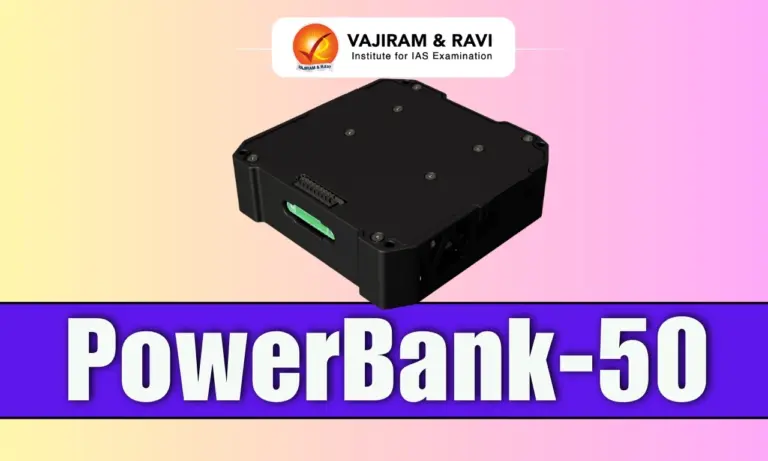
Hyderabad-based space startup TakeMe2Space recently announced that its PowerBank-50 satellite battery pack has now earned the ‘flight heritage’ tag.
About PowerBank-50
- It is an indigenously built satellite battery pack developed by Hyderabad-based spacetech startup TakeMe2Space.
- It is India’s first indigenously developed satellite battery to earn the coveted ‘flight heritage’ status.
- The recognition comes after the battery pack has successfully completed its first mission aboard Skyroot Aerospace’s Vikram-1 on its maiden flight — Mission ‘Aagaman’.
- Vikram-1 became the first privately developed Indian rocket to reach orbit, making India only the third country in the world, after the United States and China, where a private company has achieved orbital launch capability.
- A PowerBank-50 unit powered Cosmoserve Space’s experimental payload aboard the rocket’s Orbital Adjustment Module (OAM) at an altitude of 450 km.
- The battery performed as designed throughout launch and in the harsh conditions of space, including vacuum, radiation, and extreme temperature fluctuations.


PowerBank-50 Features
- It is a compact lithium-ion battery pack designed specifically for small satellites.
- Weighing just 380 grams and roughly the size of a paperback book, it stores over 50 Wh of energy and is equipped with an intelligent battery management system, onboard heaters, and an aluminium flight enclosure.
- Multiple PowerBank-50 units can be stacked together to power CubeSats and microsatellites, with an operational life of up to five years in low-Earth orbit.
Why ‘Flight Heritage’ Matter?
- In the satellite industry, ‘flight heritage’ is the hardest credential to earn.
- Satellite builders, launch providers, and insurers are deeply reluctant to fly components that have never flown, because a single subsystem failure can end a multi-crore mission.
- This creates a well-known barrier for new suppliers: you cannot get ‘heritage’ without flying, and you cannot fly without that tag.
- The bar is highest of all for batteries that are among the most safety scrutinised components on any rocket.
- Batteries must survive intense launch vibration and shock, then operate reliably in vacuum through extreme hot and cold cycles every orbit.
News: TOI

 Last updated on Oct, 2026
→ UPSC 2027 Notification will be released on 13 January 2027 at upsconline.nic.in.
→ Check Nobel Prize 2026 Winners List here.
→ Download PIB PRiSM Monthly Magazine 2026 here.
→ Check UPSC Monthly Current Affairs Magazine The Recitals here.
→ Check out the latest UPSC Syllabus here.
→ Download UPSC Model Answers for Mains 2026
→ UPSC Mains Question Paper 2026 is out now for Essay & GS Paper 1, 2, 3 & 4.
→ UPSC Calendar 2027 has been released.
→ Enroll in Vajiram & Ravi’s UPSC Mains Test Series 2027 for structured answer writing practice, expert evaluation, and exam-oriented feedback.
→ Join Vajiram & Ravi’s UPSC Mentorship Program 2027 for personalized guidance, strategy planning, and one-to-one support from experienced mentors.
→ Go through the UPSC Mains Previous Year Papers to enhance your preparation.
→ UPSC has released UPSC Toppers List 2025 with the Civil Services final result on its official website.
→ Also check Best UPSC Coaching in India
PowerBank-50 FAQs
Q1. What is PowerBank-50?+
Q2. Which company developed PowerBank-50?+
Q3. Why is PowerBank-50 significant?+
Q4. What is meant by 'flight heritage' status?+
Tags: powerbank-50 prelims pointers upsc current affairs upsc prelims current affairs