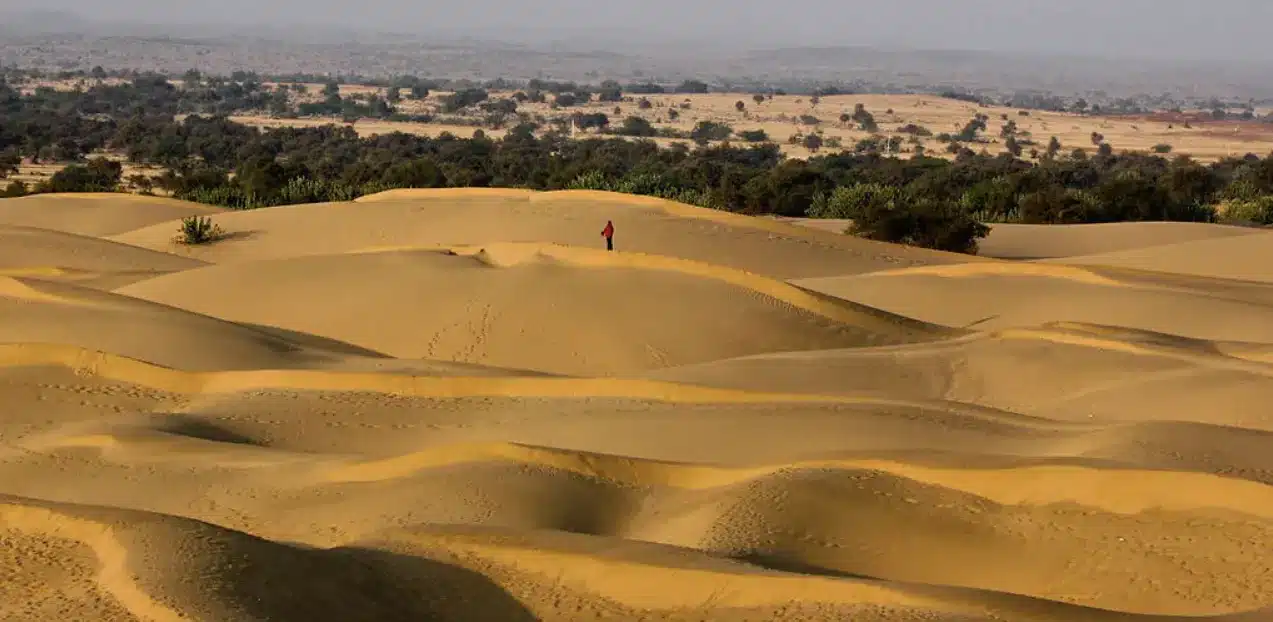
About Thar Desert
- The Thar Desert, also known as the Great Indian Desert, is an arid region of rolling sand hills on the Indian subcontinent.
- It is one of the largest subtropical deserts in the world.
- Location: It is located partly in northwestern India, and partly in eastern Pakistan.
- It extends across the states of Rajasthan, Gujarat, and Haryana in India, and the provinces of Sindh and Punjab in Pakistan.
- It covers more than 77,000 square miles (200,000 sq. km).
- The majority of the Thar desert is in India (15 percent lies in Pakistan).
- It is bordered by the irrigated Indus River plain to the west, the Punjab Plain to the north and northeast, the Aravalli Range to the southeast, and the Rann of Kachchh to the south.
- The desert is separated from the Greater Rann of Kutch to the west by the low-lying marshy lands of the Luni River.
- Climate:
- The desert features a hot and arid climate, with temperatures often reaching over 50 degrees Celsius during the day and dropping significantly at night.
- Rainfall is scarce, with the majority of the desert receiving less than 50mm of rain annually.
- Landscape:
- It is characterized by a vast and rugged landscape, with a variety of different terrains.
- It is known for its vast expanses of rolling dunes, which can reach heights of up to 200 meters.
- The desert is also characterized by rocky outcroppings, which are clusters of large rocks that rise from the desert floor.
- It is also home to large salt flats, which are areas of flat land covered with a layer of salt.
- Large, flat plains, which are covered with a thin layer of soil and vegetation, are also found here.
- Mineral Resource:
- It is rich in a variety of minerals, including one of the largest coal reserves in India.
- It is also a major source of gypsum, Limestone, salt, Bauxite, silica, etc.
Q1: What is a Dune?
A dune is a mound of sand that is formed by the wind, usually along the beach or in a desert. Dunes form when wind blows sand into a sheltered area behind an obstacle.
Source: Shifting sands: why the Thar desert on the borders of India and Pakistan is getting greener


 Last updated on Oct, 2026
→ UPSC 2027 Notification will be released on 13 January 2027 at upsconline.nic.in.
→ Check Nobel Prize 2026 Winners List here.
→ Download PIB PRiSM Monthly Magazine 2026 here.
→ Check UPSC Monthly Current Affairs Magazine The Recitals here.
→ Check out the latest UPSC Syllabus here.
→ Download UPSC Model Answers for Mains 2026
→ UPSC Mains Question Paper 2026 is out now for Essay & GS Paper 1, 2, 3 & 4.
→ UPSC Calendar 2027 has been released.
→ Enroll in Vajiram & Ravi’s UPSC Mains Test Series 2027 for structured answer writing practice, expert evaluation, and exam-oriented feedback.
→ Join Vajiram & Ravi’s UPSC Mentorship Program 2027 for personalized guidance, strategy planning, and one-to-one support from experienced mentors.
→ Go through the UPSC Mains Previous Year Papers to enhance your preparation.
→ UPSC has released UPSC Toppers List 2025 with the Civil Services final result on its official website.
→ Also check Best UPSC Coaching in India