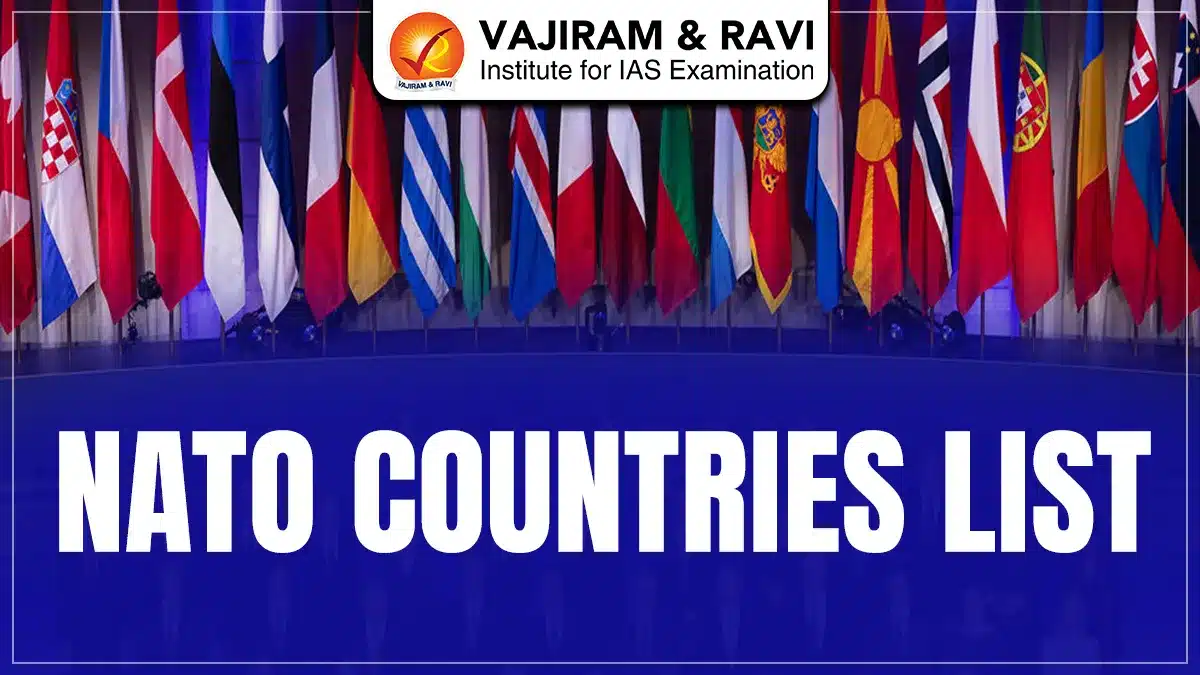
NATO Countries form a transatlantic political and military alliance. NATO has 32 member countries in 2026. The North Atlantic Treaty Organization (NATO) brings together countries from North America and Europe to ensure collective security, defense cooperation and regional stability. The alliance began with 12 founding members from Europe and North America and expanded through 10 rounds of enlargement.
What is NATO (North Atlantic Treaty Organization)?
The North Atlantic Treaty Organization (NATO) is an intergovernmental military alliance dedicated to promoting peace and security among its member states. It operates under the principle of collective defense, as discussed in Article 5 of the NATO Treaty, which states that an attack on one member is considered an attack on all. NATO continues to adapt to emerging global security challenges through collective defense, crisis management and cooperative security initiatives.
What are NATO Countries?
NATO Countries are sovereign states that participate in the alliance’s political consultations, security cooperation and collective decision making by consensus. Article 10 provides the framework for admitting eligible European states. The NATO Countries include 12 Founder Countries and 20 Member Countries, counting to total 32 Participant Nations.
NATO Founder Countries
Belgium, Canada, Denmark, France, Iceland, Italy, Luxembourg, The Netherlands, Norway, Portugal, the United Kingdom and the United States signed the treaty on 4 April 1949.
NATO Member Countries
The NATO Countries List 2026 contains a total 20 members excluding the founding countries as: Albania, Bulgaria, Croatia, Czechia, Estonia, Finland, Germany, Greece, Hungary, Latvia, Lithuania, Montenegro, North Macedonia, Poland, Romania, Slovakia, Slovenia, Spain, Sweden and Türkiye.


NATO Countries List 2026
NATO Countries List 2026 Year Wise comprises 32 member countries, expanding from its original 12 founding nations. Below is a table listing the 32 NATO Countries along with their capitals:
| NATO Countries List 2026 Year Wise With Flags | ||
|---|---|---|
| Country | Year Joined NATO | NATO Countries Flag |
| Belgium | 1949 (Founding Member) |  |
| Canada | 1949 (Founding Member) |  |
| Denmark | 1949 (Founding Member) |  |
| France | 1949 (Founding Member) |  |
| Iceland | 1949 (Founding Member) |  |
| Italy | 1949 (Founding Member) |  |
| Luxembourg | 1949 (Founding Member) |  |
| The Netherlands | 1949 (Founding Member) |  |
| Norway | 1949 (Founding Member) |  |
| Portugal | 1949 (Founding Member) |  |
| United Kingdom | 1949 (Founding Member) |  |
| United States | 1949 (Founding Member) |  |
| Greece | 1952 |  |
| Turkey | 1952 |  |
| Germany (West Germany at accession) | 1955 |  |
| Spain | 1982 |  |
| Czechia (Czech Republic) | 1999 |  |
| Hungary | 1999 |  |
| Poland | 1999 |  |
| Bulgaria | 2004 |  |
| Estonia | 2004 |  |
| Latvia | 2004 |  |
| Lithuania | 2004 |  |
| Romania | 2004 |  |
| Slovakia | 2004 |  |
| Slovenia | 2004 |  |
| Albania | 2009 |  |
| Croatia | 2009 |  |
| Montenegro | 2017 |  |
| North Macedonia | 2020 |  |
| Finland | 2023 |  |
| Sweden | 2024 |  |
NATO Countries Objectives
NATO Countries coordinate defence and security policies to deter aggression, protect members and strengthen stability through political consultation and collective action.
- Collective Defence: NATO protects members through Article 5, which treats an armed attack against one or more members as an attack against all.
- Political Consultation: Members discuss political and security concerns and take major NATO decisions through consensus among all Allies.
- Crisis Management: NATO has supported security operations and cooperation beyond its traditional territory when such activities affect Allied security interests.
- Cooperative Security: NATO develops partnerships and security cooperation with countries outside the alliance to strengthen wider Euro-Atlantic stability.
NATO Countries Features
Key features of NATO Countries explain its structure, membership, decision making process and collective security framework in simple and factual terms.
- Full Form: NATO Full Form is North Atlantic Treaty Organization. The alliance was created on 4 April 1949 through the North Atlantic Treaty.
- Headquarter: NATO’s Headquarter is in Brussels, Belgium. Its military headquarters, SHAPE, is located in Mons, Belgium.
- Article 5: Article 5 establishes collective defence. An armed attack against one or more members is considered an attack against them all.
- Membership: NATO has 32 members in 2026. The alliance displays 32 national flags at its headquarters in Brussels.
- Decision Making: NATO decisions are based on consensus. The North Atlantic Council is the alliance’s principal political decision making body.
- Membership Rule: Article 10 allows membership for European states able to advance treaty principles and contribute to North Atlantic security.
NATO Historical Evolution
NATO’s historical evolution reflects major changes in European security, Cold War politics and the post Cold War international order from 1949 to the present.
- Origin: NATO was established on 4 April 1949 through the North Atlantic Treaty in Washington, D.C., creating a collective security framework for Europe and North America.
- Cold War Security: During the Cold War, NATO became the principal Western military alliance opposing the Soviet led security bloc. The alliance focused on deterrence, collective defence and maintaining transatlantic security.
- 1966 French Withdrawal: France withdrew from NATO’s integrated military command structure while remaining politically involved in the organisation. However, rejoined in 2009.
- 1989-1991 Transformation: The fall of the Berlin Wall in 1989 and dissolution of the Soviet Union in 1991 ended the Cold War and forced NATO to reconsider its strategic role and future priorities.
- Post Cold War Operations: NATO expanded its security role beyond traditional collective defence by undertaking major crisis management and peace support operations, including in the Balkans and Afghanistan.
- 2014-2022 Security Shift: Russia’s annexation of Crimea in 2014 and full scale invasion of Ukraine in 2022 significantly changed NATO’s security priorities, strengthening its eastern flank deterrence and defence posture.
Which Countries Recently Joined NATO 2026?
In recent years, two Countries Joined NATO including Finland in 2023 and Sweden in 2024 as highlighted below:
1. Finland Joined NATO in 2023
Finland Joined NATO as 31st member marks a significant shift in the security landscape of northeastern Europe. With an 832-mile border with Russia, Finland’s membership not only strengthens its own security but also extends NATO’s direct frontier with Russia, altering regional dynamics.
This expansion challenges Russia’s influence, potentially escalating tensions between Moscow and the West. Finland’s inclusion supports NATO’s strategic presence in the Baltic Sea region, reshaping the balance of power. Beyond Europe, it also impacts Arctic geopolitics, as Finland’s military capabilities strengthen Western influence in the Nordic region. Given India’s observer role in the Arctic Council, this development could have implications for global governance in the polar north.
2. Sweden Joined NATO in 2024
Sweden officially joined NATO on March 7, 2024, becoming the 32nd member of the alliance. This marked a historic shift in Sweden’s long-standing policy of military neutrality, which it had maintained for over 200 years. The decision to join NATO was largely influenced by the changing security landscape in Europe following Russia’s invasion of Ukraine in 2022. Sweden’s membership aims to strengthen regional security in Northern Europe and enhance cooperation with other NATO countries, especially neighboring Finland, which joined the alliance in 2023.
Is India Part of NATO?
No, India is not a NATO Member; it maintains a close partnership with the alliance. India has contributed to NATO-led missions, including the International Security Assistance Force (ISAF) in Afghanistan. In recent years, there have been growing assumptions about India potentially joining NATO, but the Indian government has not expressed any intent to seek membership but remains open to strengthening cooperation.
In 2021, India and NATO signed a “Framework for Enhanced Cooperation”, which was a collaboration on various security issues. While the future of India’s NATO relationship remains uncertain, both sides are expected to continue working together on global security challenges.
| Also Read | |
| World Health Organization | United Nations |
| World Bank | ASEAN |

 Last updated on Oct, 2026
→ UPSC 2027 Notification will be released on 13 January 2027 at upsconline.nic.in.
→ Check Nobel Prize 2026 Winners List here.
→ Download PIB PRiSM Monthly Magazine 2026 here.
→ Check UPSC Monthly Current Affairs Magazine The Recitals here.
→ Check out the latest UPSC Syllabus here.
→ Download UPSC Model Answers for Mains 2026
→ UPSC Mains Question Paper 2026 is out now for Essay & GS Paper 1, 2, 3 & 4.
→ UPSC Calendar 2027 has been released.
→ Enroll in Vajiram & Ravi’s UPSC Mains Test Series 2027 for structured answer writing practice, expert evaluation, and exam-oriented feedback.
→ Join Vajiram & Ravi’s UPSC Mentorship Program 2027 for personalized guidance, strategy planning, and one-to-one support from experienced mentors.
→ Go through the UPSC Mains Previous Year Papers to enhance your preparation.
→ UPSC has released UPSC Toppers List 2025 with the Civil Services final result on its official website.
→ Also check Best UPSC Coaching in India
NATO Countries List 2026 FAQs
Q1. How many countries are in the NATO Treaty?+
Q2. What is the full meaning of NATO?+
Q3. What countries are in NATO in 2024?+
Q4. Is India a member of NATO?+
Q5. How many countries are in BRICS?+
Tags: international organisations list of world organisations and their headquarters NATO nato contries nato countries list 2026