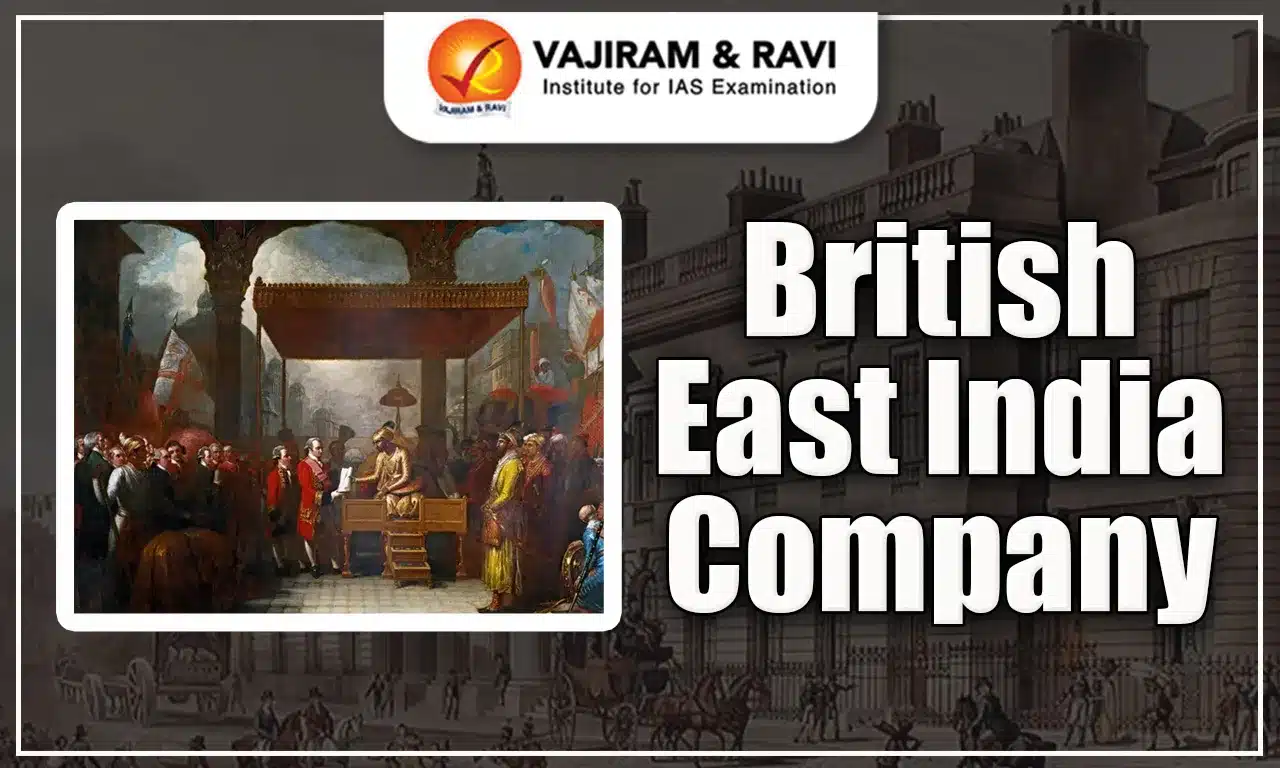
The British East India Company in India was established in the year 1600 as a trading company and later turned into a ruling body in 1765. This transition was attained after East India Company obtained the Diwani Rights to collect revenue of Bengal, Bihar and Orissa in the treaty of Allahabad. This way the British East India Company got to interfere in the Indian Affairs. The East India Company ruled in India until the Government of India Act of 1858. This resulted in the formation of a new British Raj and the British finally gained complete control over India. In this article, we are going to cover all about the British East India Company.
British East India Company First Factory
The British East India Company established its first temporary factory at Masulipatnam in 1605 to begin trade with India. Later, it set up its first permanent factory at Surat in 1613 after getting permission from Mughal Emperor Jahangir. This marked the official start of British commercial presence in India and laid the foundation for future colonial expansion.
British East India Company History
The British East India Company was a trading company established by the British that gradually expanded its political and military influence, laying the foundation for British rule in India.
- Founded on 31 December 1600 by a royal charter granted by Queen Elizabeth I.
- Initially established to conduct trade with the East Indies, particularly in spices, silk, cotton, tea, and other goods.
- Set up its first factory at Surat in 1613 after obtaining trading rights from the Jahangir.
- Established major trading centers at Madras, Bombay, and Calcutta.
- Defeated the Nawab of Bengal in the Battle of Plassey, marking the beginning of British political dominance in India.
- Secured the Diwani Rights of Bengal, Bihar, and Orissa in 1765, gaining authority to collect revenue.
- Expanded its control through wars, alliances, annexations, and policies such as the Subsidiary Alliance and Doctrine of Lapse.
- Played a significant role in transforming India’s economy by promoting British trade interests and exploiting local resources.
- Faced widespread opposition, culminating in the Revolt of 1857, the first major uprising against British rule.
- Following the Revolt of 1857, the company was abolished, and governance of India was transferred directly to the British Crown through the Government of India Act, 1858.


British East India Company Timeline
The British East India Company was founded in 1600 as a joint stock company to carry out trade in the Indian Ocean. The company started conducting its business with the East Indies and then East Asia and finally dissolved by order of the British Parliament in 1874. Following is the timeline of British East India Company in India:
| Timeline of the British East India Company in India (From 1600 to 1858) | |
| Year | Events |
|
1600 |
A Royal charter from the British Queen Elizabeth I was obtained by the Governor and Company of Merchants of London Trading to the East India Company. |
|
1601 |
The first East India Company Voyage was led by Sir James Lancaster aboard the Red Dragon. |
|
1609 |
Sir William Hawkins fails to obtain a permit for a factory in Surat during the reign of Jahangir due to Portuguese influence in the Mughal Court. |
|
1611 |
The East India Company established its first factory at Masulipatnam (now Machilipatnam), Andhra Pradesh. |
|
1612 |
Battle of Suvali (Sawally)
|
|
1613 |
EIC got permission from Jahangir to build a factory in Surat (the first permanent factory). |
|
1615 -1619 |
Sir Thomas Roe was the British ambassador at Jahangir’s court.
|
|
1616 |
EIC established a permanent factory at Masulipatnam. |
|
1632 |
The Sultan of Golconda had granted the “Golden Farman” to EIC. |
|
1633 |
EIC established factories in Balasore, Odisha, and Hariharpur on the Mahanadi delta. |
|
1639 |
The Chandragiri ruler gave the EIC permission to construct a fortified factory in Madras that would later become known as Fort St. George.
|
|
1651 |
Mughal Bengal governor Shah Shuja allowed the English to trade in Bengal without paying any customs duties in exchange for an annual lump sum of Rs. 3000.
|
|
1658 |
At Kasimbazar, another factory was opened. |
|
1662 |
King Charles II of Britain receives Bombay from Portugal as a dowry for Princess Catherine.
|
|
1668 |
Britain leased Bombay to the EIC for €10 per year.
|
|
1686 – 1689 |
A series of battles erupted between Mughal and EIC. |
|
1689 |
The Mughal Navy, led by Admiral Sidi Yukub, launched an attack on Bombay. |
|
1690 |
EIC was forced to surrender and beg Aurangzeb for forgiveness EIC was also forced to sign a treaty with Mughal, which included:
|
|
1696 |
Sutanuti was fortified following a conflict with the local Zamindars. |
|
1698 |
EIC paid 1200 rupees for the zamindari of three villages: Sutanuti, Gobinpur, and Kalighat (Kalikata, letter Calcutta/Kolkata). |
|
1700 – 1701 |
Fort William, named after King William III of England, was built in Sutanuti. |
|
1701 – 1708 |
Formation of the “United Company of Merchants of England Trading to the East Indies”. |
|
1717 |
Farrukhsiyar, the Mughal emperor, issued royal farmans to the EIC (the British mission led by John Surman). In Bengal
In Hyderabad
In Surat
By this farman, EIC coins were permitted in all Mughal territories. |
|
1740 – 1763 |
The Carnatic Wars (the English-French rivalry) began.
|
|
1756 |
Black Hole of Calcutta or Black hole tragedy
|
|
1757 |
Treaty of Alinagar
|
|
1757 |
|
|
1759 |
Battle of Chinsurah
|
|
1760 |
|
|
1761 |
The East India Company captured Pondichery from French forces in India. |
|
1764 |
|
|
1765 |
Treaty of Allahabad It was signed on August 12, 1765, in the aftermath of the Battle of Buxar, by Mughal Emperor Shah Alam II, Shuja-ud-daulah, and Robert Clive of the East India Company. With Shuja-Ud-Daulah of Awadh
With Shah Alam II of Delhi
|
|
1765 – 1772 |
Dual System of Government in Bengal
|
|
1767-1769 |
First Anglo-Mysore War
|
|
1769 – 1772 |
Great Bengal Famine |
|
1773 |
Regulating Act 1773 |
|
1775 – 1782 |
First Anglo-Maratha War
|
|
1780 – 1784 |
Second Anglo-Mysore War
|
|
1781 |
Amending Act of 1781 or Act of Settlement of 1781 |
|
1784 |
|
|
1790 – 1792 |
Third Anglo-Mysore War
|
|
1791 |
Charles Cornwallis introduced a regular Police force system in India. |
|
1793 |
Introduction of the Cornwallis Code
|
|
1799 |
Fourth Anglo-Mysore War
Introduction of Censorship of Press Act in India
|
|
1803 -1805 |
Second Anglo-Maratha War
|
|
1806 |
Vellore Mutiny
|
|
1809 |
Treaty of Amritsar
|
|
1813 |
Introduction of the Charter Act of 1813 |
|
1814 -1816 |
Anglo-Nepalese War
|
|
1817 – 1819 |
Third Anglo-Maratha War
|
|
1820 |
Royatwari system was established by Thomas Munro. |
|
1824 – 1826 |
First Anglo-Burmese War
|
|
1826 |
Siege of Bharatpur |
|
1829 |
Bengal Sati Regulation Act
|
|
1830 |
Suppression of thugis by Colonel Sleemen. |
|
1833 |
The creation of coins bearing the name of the Mughal emperor was stopped. |
|
1834 |
Law Commission under Macaulay
|
|
1835 |
Macaulay Committee for educational reforms constituted in India.
Introduction of the Press Act or Metcalf Act. |
|
1837 |
The Post Office Act
|
|
1838 – 1842 |
First Anglo-Afghan War
|
|
1843 |
Sindh was annexed by the East India Company under Charles Napier. |
|
1845 – 1846 |
First Anglo-Sikh War
|
|
1848 – 1849 |
Second Anglo-Sikh War
|
|
1848-1856 |
Dalhousie initiated the “doctrine of lapse” which was an annexation policy. In India, 4000 miles of telegraph lines were laid down under the supervision of O’Shaughnessy.
|
|
1852 – 1853 |
Second Anglo-Burmese War
|
|
1853 |
History of Railways (British India): Railway expansion work was started in India under James Broun Ramsay (Lord Dalhousie).
Introduction of the Charter Act of 1853. |
|
1854 |
Wood’s Despatch for Indian Education System was introduced.
The Macaulay Committee (committee on Indian civil services) was formed. |
|
1856 |
Awadh was annexed by Dalhousie. Widow Remarriage Act Passed.
|
|
1857 |
Revolt of 1857: Sepoy Mutiny
|
|
1858 |
Queen Victoria’s Proclamation
Introduction of Government of India Act, 1858.
|
|
1 Jun 1874 |
The British Parliament formally dissolved the East India Company. |
British East India Company
The British East India Company has the following important facts to be remembered:
| British East India Company | |
| Established | 31st December 1600 |
|
Type |
State-owned company partially |
|
Headquarters |
East India House, London, Great Britain |
|
Dissolved |
The East India Company was formally dissolved on June 1, 1874 in accordance with the provisions of the East India Stock Dividend Redemption Acct 1873. On June 1, 1874, the East India Company was formally dissolved in accordance with the provisions of the East India Stock Dividend Redemption Act 1873. |

 Last updated on Oct, 2026
→ UPSC 2027 Notification will be released on 13 January 2027 at upsconline.nic.in.
→ Check Nobel Prize 2026 Winners List here.
→ Download PIB PRiSM Monthly Magazine 2026 here.
→ Check UPSC Monthly Current Affairs Magazine The Recitals here.
→ Check out the latest UPSC Syllabus here.
→ Download UPSC Model Answers for Mains 2026
→ UPSC Mains Question Paper 2026 is out now for Essay & GS Paper 1, 2, 3 & 4.
→ UPSC Calendar 2027 has been released.
→ Enroll in Vajiram & Ravi’s UPSC Mains Test Series 2027 for structured answer writing practice, expert evaluation, and exam-oriented feedback.
→ Join Vajiram & Ravi’s UPSC Mentorship Program 2027 for personalized guidance, strategy planning, and one-to-one support from experienced mentors.
→ Go through the UPSC Mains Previous Year Papers to enhance your preparation.
→ UPSC has released UPSC Toppers List 2025 with the Civil Services final result on its official website.
→ Also check Best UPSC Coaching in India
British East India Company FAQs
Q1. When did British East India come to India?+
Q2. What did the British do to the East India Company?+
Q3. Who founded the British East India Company?+
Q4. What is the old name of East India Company?+
Q5. Who wrote the economic history of India?+
Tags: british east india company