


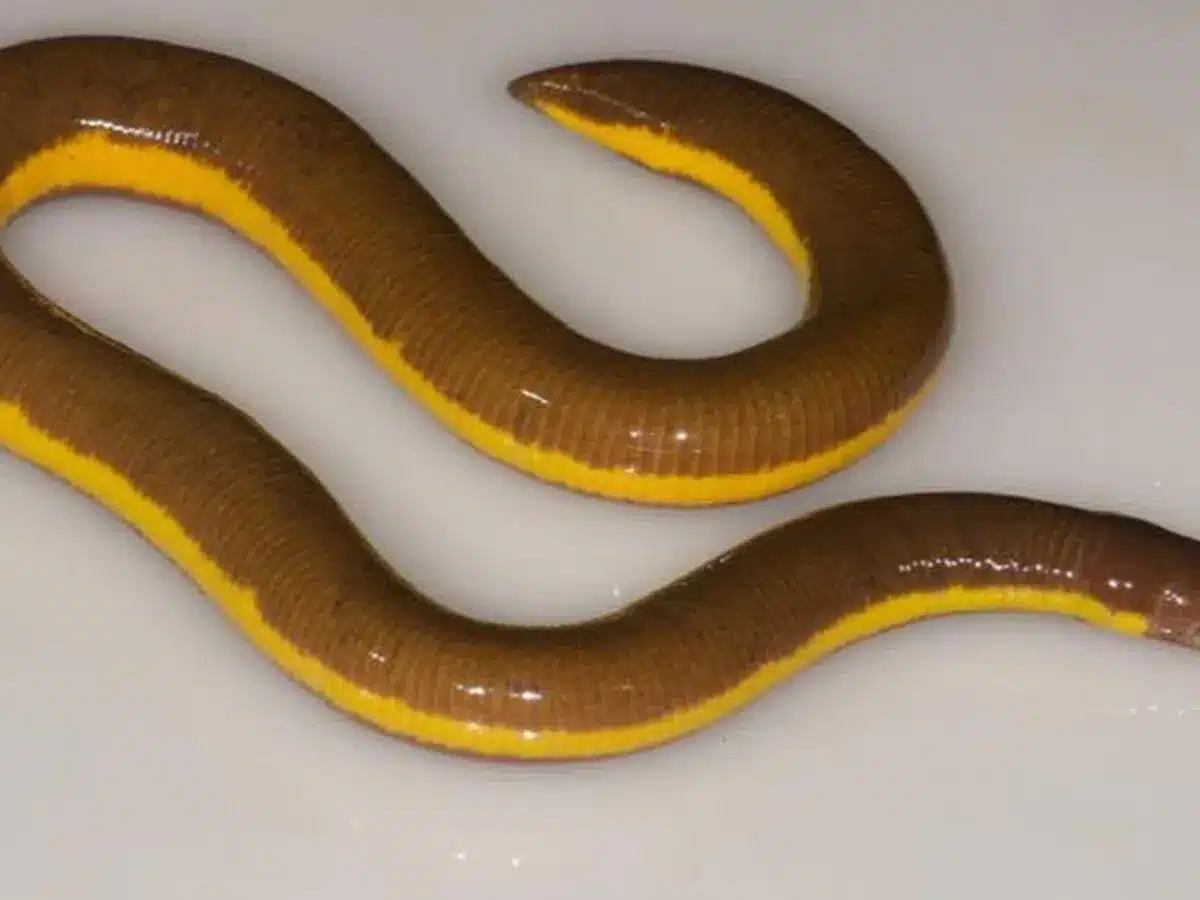
About Caecilians
- The Caecilians are elongated, segmented, limbless amphibians.
- They are classified in the order Gymnophiona or Apoda (“without legs”).
- They belong to the same group of animals that includes frogs and salamanders.
- Lacking limbs, caecilians resemble earthworms or snakes in appearance.
- The name Caecilian means “blind“. Some caecilian species are eyeless, while others have small eyes hidden under their skin.
- There are about 200 known caecilian species.
- Habitat:
- Most caecilians inhabit moist tropical and subtropical regions of South and Central America, South and Southeast Asia, and Sub-Saharan Africa.
- Almost all caecilians are terrestrial, but they are elusive as they spend the majority of their lives underground.
- They burrow primarily in forests, but also in grassland, savanna, shrubland, and wetlands.
- Other Features:
- The smaller species measure less than three inches, but the largest one (Caecilia thompsoni from Colombia) grows to almost five feet long.
- A hard, thick skull with a pointy snouthelps them move effectively through dirt or mud.
- Their shiny skin is ringed with skin folds called annuli.
- They usually come in shades of gray, brown, black, orange, or yellow.
- Some have tiny, fishlike scales within the rings.
- They have short, sensory tentacles located between their eyes and nostrils that help them probe their environment and find prey.
Q1: What are amphibians?
Amphibians are cold-blooded vertebrates (vertebrates have backbones) that don’t have scales. They live part of their lives in water and part on land. The species in this group include frogs, toads, salamanders, and newts. All can breathe and absorb water through their very thin skin. Amphibians also have special skin glands that produce useful proteins. Some transport water, oxygen, and carbon dioxide either into or out of the animal. Others fight bacteria or fungal infections. And at least one—in each species—is used for defense.
Source: Limbless amphibian added to Kaziranga’s fauna


 Last updated on Oct, 2026
→ UPSC 2027 Notification will be released on 13 January 2027 at upsconline.nic.in.
→ Check Nobel Prize 2026 Winners List here.
→ Download PIB PRiSM Monthly Magazine 2026 here.
→ Check UPSC Monthly Current Affairs Magazine The Recitals here.
→ Check out the latest UPSC Syllabus here.
→ Download UPSC Model Answers for Mains 2026
→ UPSC Mains Question Paper 2026 is out now for Essay & GS Paper 1, 2, 3 & 4.
→ UPSC Calendar 2027 has been released.
→ Enroll in Vajiram & Ravi’s UPSC Mains Test Series 2027 for structured answer writing practice, expert evaluation, and exam-oriented feedback.
→ Join Vajiram & Ravi’s UPSC Mentorship Program 2027 for personalized guidance, strategy planning, and one-to-one support from experienced mentors.
→ Go through the UPSC Mains Previous Year Papers to enhance your preparation.
→ UPSC has released UPSC Toppers List 2025 with the Civil Services final result on its official website.
→ Also check Best UPSC Coaching in India








