What are Carbon Markets?
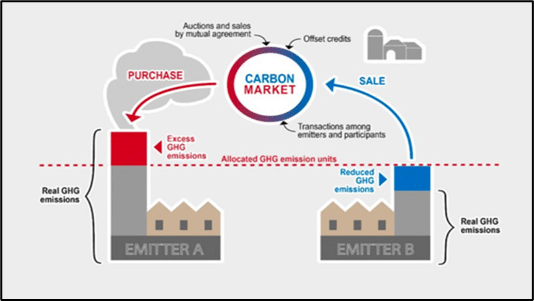
- Carbon markets are essentially a tool for putting a price on carbon emissions— they establish trading systems where carbon credits or allowances can be bought and sold.
- A carbon credit is a kind of tradable permit that, per United Nations standards, equals one tonne of carbon dioxide removed, reduced, or sequestered from the atmosphere.
- Carbon allowances or caps, meanwhile, are determined by countries or governments according to their emission reduction targets.
- A United Nations Development Program release this year noted that interest in carbon markets is growing globally, i.e., 83% of NDCs submitted by countries mention their intent to make use of international market mechanisms to reduce greenhouse gas emissions.
Two types of Carbon Markets:
- Compliance Market –
- These are set up by policies at the national, regional, and/or international level— are officially regulated.
- Entities in this sector are issued annual allowances or permits by governments equal to the emissions they can generate.
- If companies produce emissions beyond the capped amount, they have to purchase additional permit, either through official auctions or from companies which kept their emissions below the limit, leaving them with surplus allowances.
- The market price of carbon gets determined by market forces when purchasers and sellers trade in emissions allowances.
Voluntary Market:
- These are markets in which emitters— corporations, private individuals, and others— buy carbon credits to offset the emission of one tonne of CO2 or equivalent greenhouse gases.
- Such carbon credits are created by activities which reduce CO2 from the air, such as afforestation.
- In a voluntary market, a corporation looking to compensate for its unavoidable GHG emissions purchases carbon credits from an entity engaged in projects that reduce, remove, capture, or avoid emissions.
Q1) Is greenhouse gas good or bad?
In the right amounts, greenhouse gases, like carbon dioxide, methane, nitrous oxide, are helpful, rather than harmful, because they can help regulate the temperature of the planet.


 Last updated on Oct, 2026
→ UPSC 2027 Notification will be released on 13 January 2027 at upsconline.nic.in.
→ Check Nobel Prize 2026 Winners List here.
→ Download PIB PRiSM Monthly Magazine 2026 here.
→ Check UPSC Monthly Current Affairs Magazine The Recitals here.
→ Check out the latest UPSC Syllabus here.
→ Download UPSC Model Answers for Mains 2026
→ UPSC Mains Question Paper 2026 is out now for Essay & GS Paper 1, 2, 3 & 4.
→ UPSC Calendar 2027 has been released.
→ Enroll in Vajiram & Ravi’s UPSC Mains Test Series 2027 for structured answer writing practice, expert evaluation, and exam-oriented feedback.
→ Join Vajiram & Ravi’s UPSC Mentorship Program 2027 for personalized guidance, strategy planning, and one-to-one support from experienced mentors.
→ Go through the UPSC Mains Previous Year Papers to enhance your preparation.
→ UPSC has released UPSC Toppers List 2025 with the Civil Services final result on its official website.
→ Also check Best UPSC Coaching in India