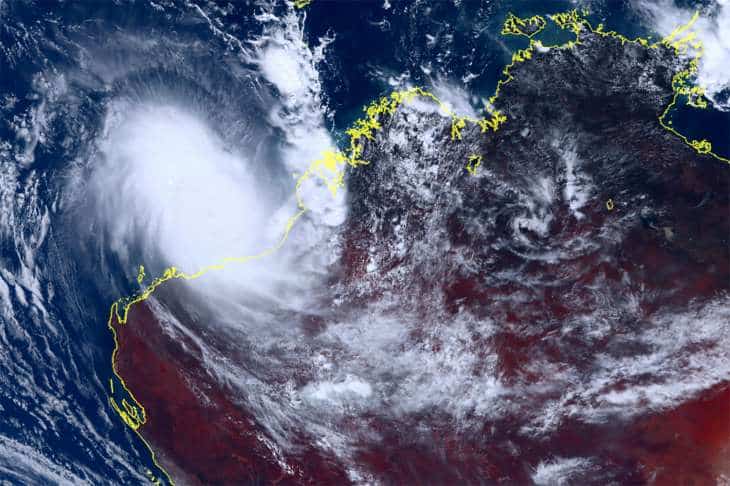
About Cyclone Mocha:
- It is a tropical cyclone formed over the southern Bay of Bengal.
- The cyclone’s name ‘Mocha’ is suggested by Yemen and was named after the Red Sea port city, which is known to have introduced coffee to the world.
- How a Tropical Cyclone Formed?
- A tropical cyclone is formed only over warm ocean waters near the equator.
- Warm, moist air rises up and away from the ocean surface, creating an area of low pressure.
- It causes the air from surrounding areas with higher pressure to move towards the low-pressure area.
- This leads to the warming up of air and causes it to rise above.
- As the air rises & cools, the water in the air forms clouds.
- This complete system of clouds and wind spins & grows, along with the ocean’s heat.
- As the wind rotation speed increases, an eye gets formed in the middle.
- Characteristics of a Tropical Cyclone:
- The centre of a cyclone is very calm and clear with very low air pressure.
- The average speed is 120 kmph.
- They have closed isobars which leads to greater velocity. Isobars are imaginary lines on a weather map that connect locations with equal atmospheric pressure.
- They develop over oceans and seas only.
- They move from east to west under the influence of trade winds.
- They are seasonal in nature.
- How are Cyclones Classified? Cyclones are classified on the basis of wind speed by the Indian Meteorological Department (IMD):
- Depression: Wind speeds of between 31–49 km/h
- Deep Depression: Between 50-61 km/h
- Cyclonic Storm: Between 62–88 km/h
- Severe Cyclonic Storm: Between 89-117 Km/h
- Very Severe Cyclonic Storm: Between 118-166 Km/h
- Extremely Severe Cyclonic Storm: Between 166-221 Km/h
- Super Cyclonic Storm: Above 222 Km/h
Q1) What is a Tropical Cyclone?
A tropical cyclone is a rapid rotating storm originating over tropical oceans from where it draws the energy to develop. It has a low pressure centre and clouds spiraling towards the eyewall surrounding the “eye”, the central part of the system where the weather is normally calm and free of clouds. Its diameter is typically around 200 to 500 km, but can reach 1000 km.
Source: Cyclone Mocha to intensify into severe cyclonic storm; IMD issues warning


 Last updated on Oct, 2026
→ UPSC 2027 Notification will be released on 13 January 2027 at upsconline.nic.in.
→ Check Nobel Prize 2026 Winners List here.
→ Download PIB PRiSM Monthly Magazine 2026 here.
→ Check UPSC Monthly Current Affairs Magazine The Recitals here.
→ Check out the latest UPSC Syllabus here.
→ Download UPSC Model Answers for Mains 2026
→ UPSC Mains Question Paper 2026 is out now for Essay & GS Paper 1, 2, 3 & 4.
→ UPSC Calendar 2027 has been released.
→ Enroll in Vajiram & Ravi’s UPSC Mains Test Series 2027 for structured answer writing practice, expert evaluation, and exam-oriented feedback.
→ Join Vajiram & Ravi’s UPSC Mentorship Program 2027 for personalized guidance, strategy planning, and one-to-one support from experienced mentors.
→ Go through the UPSC Mains Previous Year Papers to enhance your preparation.
→ UPSC has released UPSC Toppers List 2025 with the Civil Services final result on its official website.
→ Also check Best UPSC Coaching in India