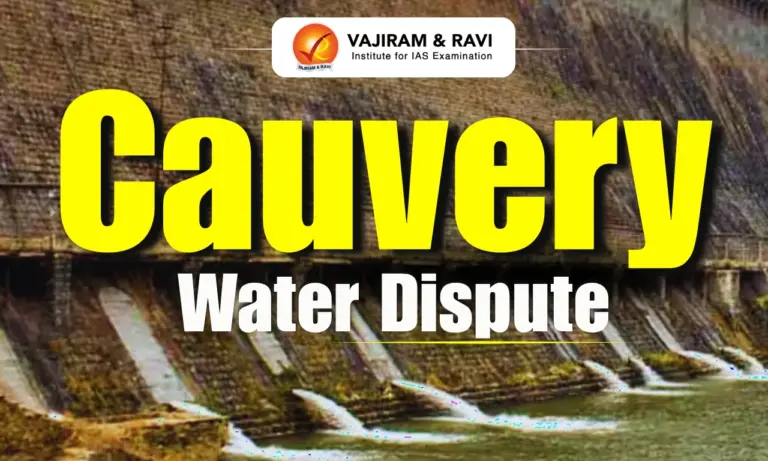
The Cauvery Water Dispute is one of India’s oldest and most complex inter-state river water disputes. It concerns the sharing of the waters of the Cauvery River among Karnataka, Tamil Nadu, Kerala, and the Union Territory of Puducherry. The river is the lifeline for millions of people, supporting agriculture, drinking water supply, industries, and ecosystems across southern India.
Why in News?
The Cauvery Water Dispute has resurfaced following renewed differences over Karnataka’s proposed Mekedatu Balancing Reservoir Project on the Cauvery River.
Recently, Tamil Nadu Chief Minister C. Joseph Vijay wrote to Prime Minister Narendra Modi, urging the Central Government to ensure that no statutory or administrative approval is granted to the Mekedatu project unless it fully complies with the Cauvery Water Disputes Tribunal (CWDT) Award of 2007 and the Supreme Court’s 2018 judgment on the sharing of Cauvery waters.
Cauvery Water Dispute History
The Cauvery Water Dispute has evolved over more than a century, beginning with colonial-era agreements and continuing through tribunal awards, Supreme Court judgments, and the establishment of institutional mechanisms for equitable water sharing.
- 1892 Agreement: Signed between the Madras Presidency and the Princely State of Mysore, requiring Mysore to obtain prior consent before undertaking major irrigation projects.
- 1924 Agreement: Replaced the 1892 agreement, allowing the construction of the Krishnarajasagar Dam and Mettur Dam; remained valid for 50 years.
- 1974: Karnataka considered the 1924 agreement to have expired, leading to fresh disagreements over water sharing.
- 1990: The Central Government constituted the Cauvery Water Disputes Tribunal (CWDT) under the Inter-State River Water Disputes Act, 1956.
- 1991 Interim Award: The Tribunal directed Karnataka to release a specified quantity of water to Tamil Nadu, triggering protests in both states.
- 2007 Final Tribunal Award: The CWDT allocated Cauvery waters among Karnataka, Tamil Nadu, Kerala, and Puducherry based on basin requirements.
- 2013: The Central Government notified the Tribunal’s final award in the Official Gazette, making it legally enforceable.
- 2018 Supreme Court Judgment: The Supreme Court modified the Tribunal’s allocation, increased Karnataka’s share by 14.75 TMC, and directed the establishment of the Cauvery Water Management Authority (CWMA).
- 2018: The CWMA and the Cauvery Water Regulation Committee (CWRC) were established to implement the water-sharing arrangement and monitor compliance.
- 2025-26: The dispute resurfaced over Karnataka’s proposed Mekedatu Balancing Reservoir Project, with Tamil Nadu seeking strict adherence to the 2007 Tribunal Award and the 2018 Supreme Court judgment before any approval is granted.


Supreme Court Judgment (2018) on Cauvery Water Dispute
In February 2018, the Supreme Court delivered its final verdict on the Cauvery Water Dispute, modifying the 2007 Cauvery Water Disputes Tribunal (CWDT) Award and laying down a permanent framework for equitable water sharing among the basin states.
- Karnataka’s allocation increased by 14.75 TMC, raising its total share to 284.75 TMC.
- Tamil Nadu’s allocation reduced from 419 TMC to 404.25 TMC.
- Kerala (30 TMC) and Puducherry (7 TMC) retained their allocations.
- Directed Karnataka to ensure the annual release of 177.25 TMC of water to Tamil Nadu at Biligundlu.
- Recognised Bengaluru’s growing drinking water needs as a key reason for increasing Karnataka’s share.
- Held that inter-state river water is a national resource and no state can claim exclusive ownership.
- Reaffirmed the principle of equitable and reasonable utilisation of inter-state river waters.
- Directed the Central Government to establish the Cauvery Water Management Authority (CWMA) and Cauvery Water Regulation Committee (CWRC) for implementation and monitoring.
- Declared the judgment final and binding, providing the legal basis for future water-sharing and dispute resolution.
What is the Mekedatu Project?
The Mekedatu Project is a proposed balancing reservoir and drinking water project on the Cauvery River near Mekedatu in Ramanagara district, Karnataka. The project is being developed by the Government of Karnataka to store excess monsoon water and meet the growing drinking water needs of Bengaluru and nearby regions.
- Location: Mekedatu, Ramanagara district, Karnataka, on the Cauvery River.
- Purpose: To provide drinking water, regulate river flow, and generate hydroelectric power.
- Implementing Agency: Government of Karnataka.
- Storage Capacity: Proposed reservoir with a storage capacity of about 67.16 TMC (Thousand Million Cubic Feet).
- Drinking Water Supply: Intended to supply drinking water to Bengaluru and surrounding areas.
- Hydropower Generation: Proposed installed capacity of around 400 MW.
- Estimated Cost: Approximately ₹9,000 crore (subject to revision).
Cauvery Water Management Authority (CWMA)
The Cauvery Water Management Authority (CWMA) is a statutory body established by the Central Government in June 2018 to implement the Supreme Court’s 2018 judgment and ensure the equitable sharing of Cauvery River waters among the basin states. Key Functions of the CWMA are:
- Implements the Cauvery Water Disputes Tribunal (CWDT) Award and the Supreme Court’s 2018 judgment.
- Monitors water levels in reservoirs across the Cauvery basin.
- Ensures monthly water releases among Karnataka, Tamil Nadu, Kerala, and Puducherry as per the approved schedule.
- Coordinates with the Cauvery Water Regulation Committee (CWRC) for monitoring rainfall, inflows, and reservoir storage.
- Resolves operational issues related to water sharing among the basin states.
- Collects and analyses hydrological and meteorological data for effective water management.
- Submits reports and recommendations to the Central Government on Cauvery water management.
- Promotes compliance with legal and institutional mechanisms to reduce inter-state disputes.
Constitutional and Legal Framework
The Constitutional and Legal Framework governing the Cauvery Water Dispute provides the basis for adjudicating inter-state river water disputes and ensuring equitable sharing of river waters among the basin states.
- Article 262: Empowers Parliament to enact laws for the adjudication of inter-state river water disputes and permits it to exclude the jurisdiction of courts in such matters.
- Entry 56 of the Union List (Seventh Schedule): Authorises the Central Government to regulate and develop inter-state rivers and river valleys in the public interest.
- Inter-State River Water Disputes Act, 1956: Provides for the constitution of Water Disputes Tribunals to resolve disputes over inter-state rivers; the Cauvery Water Disputes Tribunal (CWDT) was established under this Act in 1990.
- River Boards Act, 1956: Enables the establishment of River Boards for the regulation and development of inter-state river basins, though no River Board has been constituted under the Act.
About the Cauvery River
The Cauvery River, often called the “Ganga of South India”, is one of the most important east-flowing rivers of peninsular India. It is a major source of irrigation, drinking water, and hydropower for the southern states.
- Origin: Rises at Talakaveri in the Brahmagiri Hills of the Western Ghats, Kodagu district, Karnataka.
- Length: Flows for approximately 800 km before emptying into the Bay of Bengal.
- Basin States: The river basin extends across Karnataka, Tamil Nadu, Kerala, and the Union Territory of Puducherry.
- Drainage Area: Covers about 81,155 sq. km, making it one of the major river basins in southern India.
- Major Tributaries: Kabini, Hemavati, Harangi, Shimsha, Arkavathi, Bhavani, Amaravati, and Noyyal.
- Major Dams: Krishnarajasagar (KRS), Mettur Dam, Kabini Dam, Hemavati Dam, and Harangi Dam.
- Mouth: Empties into the Bay of Bengal near Poompuhar (Kaveripoompattinam), Tamil Nadu, forming a fertile delta.
- Economic Importance: Supports agriculture, drinking water supply, hydroelectric power generation, fisheries, and industries across the basin states.

 Last updated on Sep, 2026
→ UPSC 2027 Notification will be released on 13 January 2027 at upsconline.nic.in.
→ Asian Games 2026 are being held in Aichi-Nagoya, Japan, from 19 September to 4 October.
→ Check out the latest UPSC Syllabus here.
→ Download UPSC Model Answers for Mains 2026
→ UPSC Mains Question Paper 2026 is out now for Essay & GS Paper 1, 2, 3 & 4.
→ UPSC Calendar 2027 has been released.
→ Enroll in Vajiram & Ravi’s UPSC Mains Test Series 2027 for structured answer writing practice, expert evaluation, and exam-oriented feedback.
→ Join Vajiram & Ravi’s UPSC Mentorship Program 2027 for personalized guidance, strategy planning, and one-to-one support from experienced mentors.
→ Go through the UPSC Mains Previous Year Papers to enhance your preparation.
→ UPSC has released UPSC Toppers List 2025 with the Civil Services final result on its official website.
→ Also check Best UPSC Coaching in India
Cauvery Water Dispute FAQs
Q1. What is the Cauvery Water Dispute?+
Q2. Why is the Mekedatu Project controversial?+
Q3. What is the role of the Cauvery Water Management Authority?+
Q4. Which law governs inter-state river water disputes in India?+
Q5. Why is the Cauvery River important?+
Tags: cauvery dispute cauvery water dispute