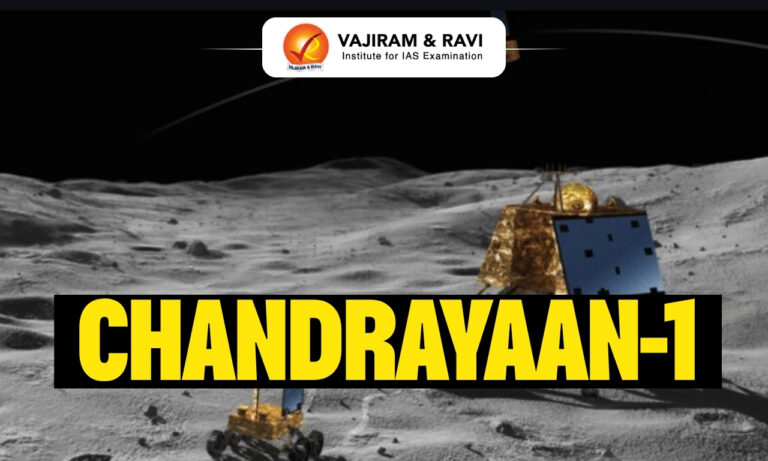
Chandrayaan 1 was India’s first mission to the Moon and first deep space mission. It was launched by ISRO on October 22, 2008, using PSLV C11 from Satish Dhawan Space Centre, Sriharikota. The 1,380 kg spacecraft entered lunar orbit on November 8, 2008. The mission made a major contribution to the discovery of water on the Moon and operated until August 28, 2009.
What is Mission Chandrayaan 1?
Chandrayaan 1 was India’s first lunar space probe developed to study the Moon through remote sensing and an impact probe. It mapped the lunar surface in visible, infrared and X ray wavelengths. The key features of the Mission Chandrayaan 1 are:
- Launch Vehicle: PSLV C11
- Launch Site: Satish Dhawan Space Centre, Sriharikota, Andhra Pradesh
- Launch Date: October 22, 2008
- Organization: Indian Space Research Organisation (ISRO)
- Cost: about Rs. 386 Crores
- End of Mission: August 29, 2009 (communication lost)
Chandrayaan 1 Objectives
The Chandrayaan 1 Mission focused on detailed lunar mapping, mineral studies, water ice searches and technology development for future lunar missions.
- Lunar Mapping: It aimed to prepare three dimensional maps of the near and far sides of the Moon with 5-10 metre spatial and altitude resolution.
- Mineral Mapping: The mission studied the Moon’s chemical and mineral composition, including magnesium, aluminium, silicon, calcium, iron and titanium.
- Water Ice Search: Chandrayaan 1 searched for surface and subsurface water ice, particularly in the permanently shadowed polar regions.
- Polar Studies: It examined the north and south polar regions and studied lunar highland rocks, craters and the South Pole Aitken Region.
- Technology Testing: The Moon Impact Probe tested systems and provided experience for future landing missions.


Chandrayaan 1 Timeline
The Chandrayaan 1 Mission progressed through planning, launch, lunar orbit insertion, scientific operations and an early communication loss.
- Planning: The idea of an Indian lunar mission emerged in 1999. The Astronautical Society of India supported planning in 2000. Over 100 scientists endorsed the proposal in April 2003.
- Approval: The government formally approved Chandrayaan 1 in November 2003 after ISRO’s National Lunar Mission Task Force assessed India’s capability.
- Launch: PSLV C11 launched Chandrayaan 1 from Satish Dhawan Space Centre, Sriharikota. Its launch mass was 1,380 kg.
- Lunar Orbit: After successive orbit raising manoeuvres, the spacecraft entered lunar orbit. It was gradually lowered to an operational altitude of 100 km.
- Impact Probe: The 29 kg Moon Impact Probe was released from 100 km altitude. It impacted near the lunar south pole after a 25 minute descent.
- Orbit Change: The spacecraft was moved to a 200 km lunar orbit because of abnormally high temperatures affecting operations.
- Mission End: Radio contact with Chandrayaan 1 was lost. The mission had completed at least 95% of its objectives before ending.
Chandrayaan 1 Structure and Design
Chandrayaan 1 combined an Indian spacecraft platform with scientific instruments from several international partners.
- Spacecraft: The cuboid spacecraft measured about 1.5 metres. It used three axis stabilisation and carried reaction wheels, sensors, gyroscopes and attitude control thrusters.
- Power System: A solar panel generated about 750 W of peak power. A 36 Ah lithium ion battery supplied power during eclipses.
- Propulsion: Its propulsion system used one 440 N engine and eight 22 N thrusters for lunar orbit insertion and orbital control.
- Scientific Payload: The spacecraft carried 11 scientific instruments. Five were Indian instruments and six came from international partners.
- Indian Instruments: Major payloads included TMC, HySI, LLRI, HEX, CIXS and MIP. TMC produced 5 metre resolution stereo images.
- International Instruments: NASA contributed M3 and Mini SAR. ESA contributed SIR 2 and SARA. Bulgaria provided RADOM 7.
Chandrayaan 1 Findings
Chandrayaan 1 generated important evidence about lunar water, minerals, topography and the Moon’s surface environment.
- Water on Moon: NASA’s M3 detected absorption features associated with hydroxyl and water bearing materials. The findings provided crucial evidence of water on the lunar surface.
- Water Evidence by MIP: CHACE recorded 650 mass spectra during the Moon Impact Probe’s descent. Its observations indicated the presence of water in the lunar atmosphere.
- Magmatic Water: Later analysis of M3 data provided evidence of water molecules locked within mineral grains, indicating water originating from the Moon’s interior.
- Lunar Mapping: TMC produced more than 70,000 three dimensional images. TMC and HySI together covered about 70% of the lunar surface.
- Polar Observations: Mini SAR provided coverage of both polar regions and investigated possible water ice. LLRI also studied both lunar poles.
- Mineral Detection: C1XS detected titanium and confirmed calcium. It also obtained measurements of magnesium, aluminium and iron.
- Lunar Caves: Chandrayaan 1 imagery identified an uncollapsed section of a lunar lava tube near the equator. The feature was about 2 km long and 360 metres wide.
- Tectonic Activity: Mini SAR data revealed faults and fractures that indicated past tectonic activity on the lunar surface.
Chandrayaan 1 Significance
Chandrayaan 1 established India as an important participant in lunar exploration and created scientific and technological foundations for later missions.
- Water Discovery: Its observations transformed understanding of lunar resources by providing strong evidence that water and hydroxyl exist on the Moon.
- International Cooperation: The mission carried instruments developed by India, the United States, United Kingdom, Germany, Sweden and Bulgaria.
- Scientific Advancement: It improved knowledge of lunar topography, mineral composition, chemical characteristics, polar regions and solar wind interactions.
- Future Missions: The mission developed capabilities valuable for later interplanetary and lunar exploration, including landing related technology through the Moon Impact Probe.
- Mission Success: Although planned for two years, Chandrayaan 1 ended in August 2009. ISRO stated that at least 95% of its mission objectives had been achieved.
Chandrayaan Missions
Chandrayaan 1 began India’s dedicated lunar exploration programme. Further Chandrayaan Missions subsequently expanded its objectives.
- Chandrayaan 1: Launched in 2008, it orbited the Moon and deployed the Moon Impact Probe. Its major achievement was evidence of water on the Moon.
- Chandrayaan 2: Launched on July 22, 2019, using GSLV Mark III. It consisted of an orbiter, Vikram lander and Pragyan rover. Communication with Vikram was lost at about 2 km altitude before landing.
- Chandrayaan 3: Launched as India’s first successful lunar landing mission. It achieved a soft landing in the Moon’s south polar region in 2023.
- Chandrayaan 4: Planned for around 2027-2028, it will target the Mons Mouton region near the Moon’s south pole and return about 3 kg of lunar regolith and rock samples to Earth using five modules.
- Chandrayaan 5 / LUPEX: A joint ISRO-JAXA mission targeted for 2028-2029, it will study south polar water ice deposits using an ISRO lander and a JAXA rover weighing about 350 kg.

 Last updated on Oct, 2026
→ UPSC 2027 Notification will be released on 13 January 2027 at upsconline.nic.in.
→ Asian Games 2026 are being held in Aichi-Nagoya, Japan, from 19 September to 4 October.
→ Check Nobel Prize 2026 Winners List here.
→ Download PIB PRiSM Monthly Magazine 2026 here.
→ Check UPSC Monthly Current Affairs Magazine The Recitals here.
→ Check out the latest UPSC Syllabus here.
→ Download UPSC Model Answers for Mains 2026
→ UPSC Mains Question Paper 2026 is out now for Essay & GS Paper 1, 2, 3 & 4.
→ UPSC Calendar 2027 has been released.
→ Enroll in Vajiram & Ravi’s UPSC Mains Test Series 2027 for structured answer writing practice, expert evaluation, and exam-oriented feedback.
→ Join Vajiram & Ravi’s UPSC Mentorship Program 2027 for personalized guidance, strategy planning, and one-to-one support from experienced mentors.
→ Go through the UPSC Mains Previous Year Papers to enhance your preparation.
→ UPSC has released UPSC Toppers List 2025 with the Civil Services final result on its official website.
→ Also check Best UPSC Coaching in India
Chandrayaan 1 FAQs
Q1. What is Chandrayaan 1?+
Q2. What was the main objective of Chandrayaan 1?+
Q3. What did Chandrayaan 1 discover on the Moon?+
Q4. When did Chandrayaan 1 end?+
Q5. Why is Chandrayaan 1 important for India?+
Tags: chandrayaan chandrayaan 1 indian space isro missions list