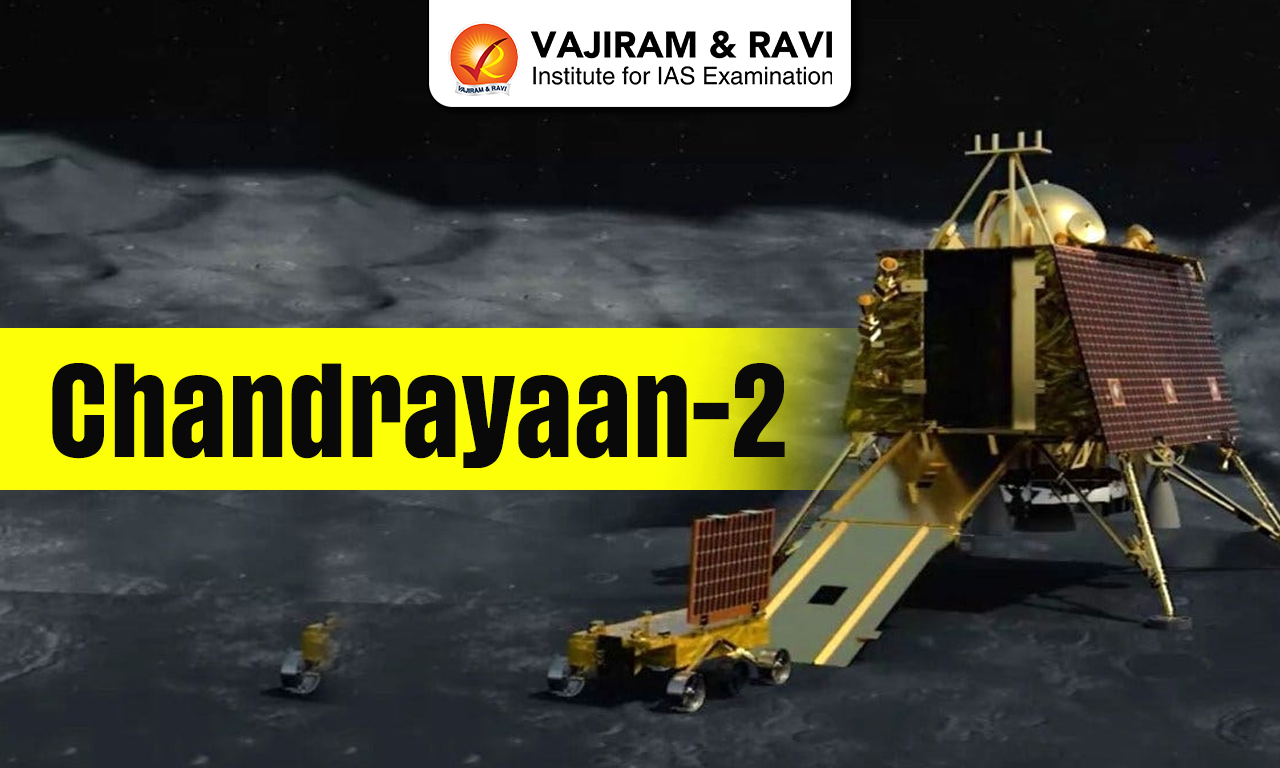
Chandrayaan-2 stands as one of India’s most ambitious and complex space missions, undertaken by the Indian Space Research Organisation (ISRO). The mission was launched in July 2019, it marked India’s second mission to the Moon and its first attempt to achieve a soft landing using entirely indigenous technology.
Chandrayaan-2 Objectives
Chandrayaan-2 aimed to advance India’s lunar exploration by conducting a detailed scientific study of the Moon’s surface, composition, and evolution.
- High-Resolution Mapping of the Moon: To create detailed topographical maps of the lunar surface for better understanding of its structure and terrain.
- Study of Lunar Mineralogy and Composition: To identify and analyze minerals and elements such as magnesium, calcium, iron, and titanium using onboard instruments.
- Detection and Distribution of Water: To investigate the presence of water molecules and map water-ice deposits, especially in permanently shadowed regions of the south pole.
- Exploration of Lunar South Polar Region: To study a largely unexplored region that may contain ancient, preserved materials and crucial scientific clues.
- Understanding Lunar Exosphere: To analyze the Moon’s thin atmosphere (exosphere) and its variations.
- Study of Lunar Surface Processes: To examine thermal properties, plasma environment, and surface interactions.
- Demonstration of Soft Landing Technology: To successfully land the Vikram Lander on the Moon using indigenous technology.
- Rover Mobility and In-situ Experiments: To deploy the Pragyan Rover for on-site chemical and elemental analysis.
- Advancement of Deep Space Technology: To develop and test technologies required for future interplanetary missions.
Mission Architecture Orbiter, Lander, Rover
Chandrayaan-2 was designed with three key components: Orbiter, Lander, and Rover to enable a combination of orbital study and direct surface exploration of the Moon, making it a technologically advanced and integrated mission.
1. Orbiter
The Orbiter is the primary component of Chandrayaan-2, placed in a ~100 km polar orbit around the Moon, designed to carry out long-term remote sensing and scientific observations.
- It carries eight advanced payloads to study lunar surface composition, mineralogy, water presence, exosphere, and ionosphere.
- It provides high-resolution imaging and mapping, helping in understanding lunar geology and evolution.
- It plays a crucial role as a communication relay system between Earth and the surface modules (lander and rover).
- It has an extended mission life and continues to send valuable scientific data even years after launch.
- It has significantly improved knowledge about the lunar south polar region, especially water-ice distribution.
2. Vikram Lander
The Vikram Lander was designed to achieve a soft landing on the Moon’s surface, particularly in the challenging south polar region, and to conduct in-situ scientific experiments.
- It was intended to land near 70° south latitude between Manzinus C and Simpelius N craters.
- It carried instruments to study surface temperature, plasma density, and thermal properties of the Moon.
- It was designed to operate for one lunar day (about 14 Earth days).
- It acted as a platform to deploy the Pragyan Rover for surface exploration.
- During the final descent phase, it lost communication and crash-landed, preventing surface experiments.
- The failure provided critical technical insights for improving future landing missions.
3. Pragyan Rover
The Pragyan Rover was a robotic vehicle designed for on-site (in-situ) exploration of the lunar surface near the landing site.
- It was a 6-wheeled, solar-powered rover designed for mobility on the lunar surface.
- It was capable of traveling up to 500 meters from the landing point.
- It carried instruments to analyze the elemental and chemical composition of lunar soil and rocks.
- It was designed to operate for one lunar day (14 Earth days).
- It was dependent on the lander for communication with Earth.
- It could not be deployed due to the failure of the Vikram Lander, but its design contributed to future mission improvements.


Chandrayaan-2 Payloads
Chandrayaan-2 orbiter carried eight sophisticated scientific payloads designed to study the Moon’s surface, subsurface, mineral composition, and exosphere in an integrated manner.
These payloads significantly improved upon the capabilities of Chandrayaan-1 by offering higher spatial resolution, deeper penetration, and better spectral accuracy.
1. Chandrayaan-2 Large Area Soft X-ray Spectrometer (CLASS)
- CLASS is a non-imaging X-ray spectrometer that studies the Moon’s surface through X-ray Fluorescence (XRF).
- It detects major rock-forming elements such as Magnesium, Aluminium, Silicon, Calcium, Titanium, Iron, and Sodium.
- The working principle involves measuring characteristic X-rays emitted by elements when excited by solar X-rays.
- It helps in understanding:
- The chemical composition of the lunar crust
- The processes involved in the Moon’s formation and differentiation
- Equipped with gold-coated copper collimators for accurate detection.
- Includes an aluminium protective door to shield detectors from radiation during transit.
- Contains a radioactive calibration source (Titanium foil) for maintaining measurement accuracy.
2. Solar X-ray Monitor (XSM)
- XSM measures solar X-ray emissions, which are essential for interpreting lunar XRF data obtained by CLASS.
- Operates in the energy range of 1–15 keV.
- Provides:
- Full solar spectrum every second
- High time-resolution light curves every 100 milliseconds
- Capable of observing a wide range of solar activity, from quiet Sun conditions to intense X-class flares.
- Ensures accurate calibration and correction of surface composition data from CLASS.
- Currently serves as a unique source of continuous solar X-ray spectral data.
Also Read: Chandrayaan 3
3. CHACE-2 (Chandra’s Atmospheric Compositional Explorer-2)
- CHACE-2 is a Quadrupole Mass Spectrometer designed for in-situ analysis of the lunar exosphere.
- Its primary objectives include:
- Determining the composition of the lunar exosphere
- Studying spatial and temporal variations in atmospheric constituents
- Key components:
- Electron impact ionizer for ionizing neutral particles
- Bayard-Alpert gauge for pressure measurement
- Quadrupole rods for mass filtering
- Detectors including Faraday Cup and Channel Electron Multiplier
- Helps in understanding:
- Surface-exosphere interactions
- Effects of solar radiation and micrometeorite impacts
4. Dual Frequency Synthetic Aperture Radar (DFSAR)
- DFSAR is a microwave imaging radar operating in both L-band and S-band frequencies.
- It is the first fully polarimetric SAR instrument used in lunar exploration, enabling detailed analysis of surface properties.
- Key objectives:
- Quantitative estimation of water-ice in polar regions
- Mapping of regolith thickness and subsurface structure
- Study of surface roughness and dielectric properties
- Can analyze:
- Permanently shadowed regions (PSRs)
- Impact craters, volcanic features, and ejecta deposits
- Equipped with:
- High-efficiency transmitter
- Low-noise receiver
- Onboard range compression technology
5. Imaging Infrared Spectrometer (IIRS)
- IIRS is a hyper-spectral imaging instrument used for mineralogical and chemical mapping of the Moon.
- Operates in the spectral range of 0.8–5.0 micrometers with about 250 contiguous spectral bands.
- Key objectives:
- Detection and characterization of water (H₂O) and hydroxyl (OH)
- Global mapping of lunar minerals and volatiles
- Special emphasis on the 3 micrometer absorption band, which indicates the presence of water molecules.
- Enables identification of:
- Major and minor mineral phases
- Variations in surface composition across regions
- Helps in studying:
- Hydration processes on the Moon
- Interaction between solar radiation and lunar surface
6. Terrain Mapping Camera-2 (TMC-2)
- TMC-2 is an advanced imaging system designed for high-resolution topographic mapping.
- Provides images with 5-meter spatial resolution and a 20 km swath width.
- Key functions:
- Creation of three-dimensional maps of the lunar surface
- Generation of Digital Elevation Models (DEM)
- Helps in:
- Understanding surface morphology and geological evolution
- Identifying features such as craters, valleys, ridges, and tectonic structures
- Data is useful for:
- Scientific analysis
- Selection of future landing sites
7. Orbiter High Resolution Camera (OHRC)
- OHRC captures ultra-high resolution images (~0.32 meters) of the lunar surface.
- Primarily used for landing site characterization and hazard detection.
- Capable of identifying:
- Small craters
- Boulders
- Surface irregularities
- Provides stereo imaging from different angles to generate high-precision Digital Elevation Models.
- Uses Time Delay Integration (TDI) sensors to enhance image clarity and sensitivity.
- Also supports post-landing scientific studies through detailed surface imaging.
8. Dual Frequency Radio Science (DFRS) Experiment
- DFRS is designed to study the lunar ionosphere and its electron density variations over time.
- Uses two coherent radio frequencies:
- X-band (8496 MHz)
- S-band (2240 MHz)
- Signals are transmitted from the orbiter and received at ground stations for analysis.
- Helps in:
- Understanding temporal changes in the lunar ionosphere
- Studying interaction of solar radiation with the Moon’s environment
- Utilizes existing telemetry and communication signals, making it resource-efficient.
- Provides insights into the electromagnetic and plasma environment around the Moon.
Chandrayaan-2 Significance
Chandrayaan-2 marked a major milestone in India’s space journey by advancing lunar science and demonstrating complex space technologies.
- Enhanced scientific understanding of the Moon’s surface, composition, and evolution, especially in the unexplored south polar region.
- Contributed to the search for water-ice and hydroxyl molecules, crucial for future human missions and resource utilization.
- Provided insights into the early Solar System, as polar craters preserve ancient geological records.
- Demonstrated India’s capability in deep space missions, orbital operations, and high-precision navigation.
- Acted as a technology testbed for future missions, including landing, rover mobility, and communication systems.
- Strengthened the development and reliability of GSLV Mk III for advanced missions.
- Laid the foundation for future missions such as Chandrayaan-3 and interplanetary exploration programs.
- Boosted India’s “Make in India” initiative by showcasing indigenous space technology and manufacturing capabilities.
- Enhanced opportunities for commercial satellite launches, contributing to economic growth and foreign exchange earnings.
About GSLV MK III
The GSLV Mk III, now officially known as LVM3 (Launch Vehicle Mark-3), is India’s most powerful and heaviest launch vehicle developed by the Indian Space Research Organisation. It is designed to launch heavy communication satellites and deep space missions, and plays a crucial role in India’s human spaceflight and planetary exploration programs.
- It is a three-stage rocket consisting of two solid strap-on boosters (S200), a liquid core stage (L110), and a cryogenic upper stage (C25).
- The cryogenic stage uses liquid hydrogen and liquid oxygen, making it highly efficient and marking India’s achievement in indigenous cryogenic engine technology.
- It has a payload capacity of about 4 tonnes to Geosynchronous Transfer Orbit (GTO) and 8–10 tonnes to Low Earth Orbit (LEO).
- The rocket has been used to launch major missions such as Chandrayaan-2 and Chandrayaan-3, along with commercial satellite launches.
- It is the designated launch vehicle for the Gaganyaan Mission and has been human-rated with enhanced safety and reliability systems.
- GSLV Mk III strengthens India’s capability in heavy-lift launches, cost-effective space missions, and global space market competitiveness, reducing dependence on foreign launch services.

 Last updated on Oct, 2026
→ UPSC 2027 Notification will be released on 13 January 2027 at upsconline.nic.in.
→ Check Nobel Prize 2026 Winners List here.
→ Download PIB PRiSM Monthly Magazine 2026 here.
→ Check UPSC Monthly Current Affairs Magazine The Recitals here.
→ Check out the latest UPSC Syllabus here.
→ Download UPSC Model Answers for Mains 2026
→ UPSC Mains Question Paper 2026 is out now for Essay & GS Paper 1, 2, 3 & 4.
→ UPSC Calendar 2027 has been released.
→ Enroll in Vajiram & Ravi’s UPSC Mains Test Series 2027 for structured answer writing practice, expert evaluation, and exam-oriented feedback.
→ Join Vajiram & Ravi’s UPSC Mentorship Program 2027 for personalized guidance, strategy planning, and one-to-one support from experienced mentors.
→ Go through the UPSC Mains Previous Year Papers to enhance your preparation.
→ UPSC has released UPSC Toppers List 2025 with the Civil Services final result on its official website.
→ Also check Best UPSC Coaching in India
Chandrayaan-2 FAQs
Q1. What is Chandrayaan-2?+
Q2. When was Chandrayaan-2 launched?+
Q3. What were the main objectives of Chandrayaan-2?+
Q4. What are the main components of Chandrayaan-2?+
Q5. Was Chandrayaan-2 successful?+
Tags: chandrayaan-2 science and technology