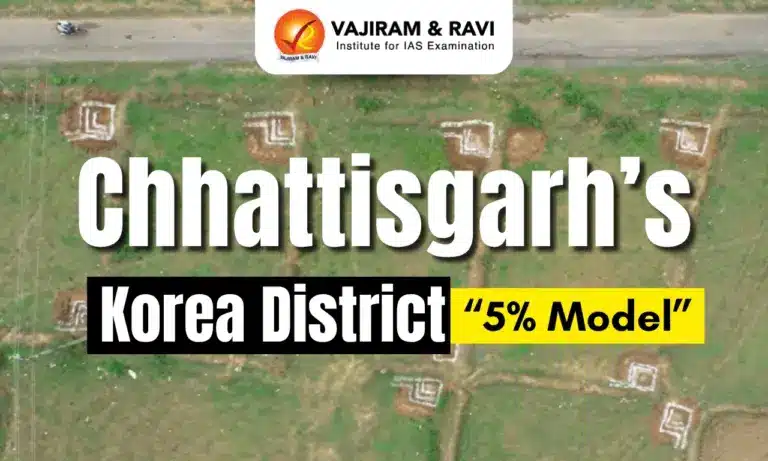
Why in the news?: Recently, Korea district of Chhattisgarh gained national recognition for its “5% Model”, a community-led water conservation initiative that has significantly improved groundwater levels through widespread public participation. The model was highlighted by the Prime Minister in Mann Ki Baat, while the Union Jal Shakti Minister suggested its adoption as a model for water conservation across the country.
About Chhattisgarh’s Korea District “5% Model”
Chattisgarh’s Korea District 5% Model is a community-based groundwater recharge initiative launched by the Korea district administration to address declining groundwater levels and recurring water scarcity through simple rainwater harvesting measures.
- Launched By: Korea District Administration, Chhattisgarh.
- Objective: To improve groundwater recharge and ensure long-term water security through community participation.
- Core Principle: Farmers voluntarily dedicate 5% of their agricultural land for constructing soak pits.
- Working Mechanism: Rainwater collected in soak pits gradually percolates into the ground, replenishing underground aquifers.
- Community-Centric Approach: The initiative relies on public awareness, voluntary participation, and local ownership.
- Campaign Name: Implemented under “Aawa Paani Jhonki”, meaning “Let’s Catch the Rain” in the Sargujia dialect.
- Implementation Support: Most activities are carried out under MGNREGS, combining water conservation with rural employment generation.
Chattisgarh’s Korea District 5% Model Key Features
Chattisgarh’s Korea District 5% Model transforms water conservation from a government programme into a community-driven movement through simple, low-cost, and scalable interventions.
- 5% Land Contribution: Farmers voluntarily allocate 5% of their farmland for constructing groundwater recharge structures.
- Large-Scale Soak Pit Construction: Soak pits are dug to capture rainwater and enhance groundwater recharge.
- Community Participation: Villagers actively participate in planning, construction, and maintenance of water conservation structures.
- Awareness and Capacity Building: The administration conducts awareness campaigns and training programmes to encourage adoption.
- Farm-Level Water Conservation: A large number of soak pits are constructed on agricultural fields to improve water availability and soil moisture.
- Household-Level Adoption: Soak pits are also created in backyards, kitchen gardens, and other household spaces.
- Borewell Recharge: Recharge structures are developed near borewells to reduce the risk of wells drying up during summer.
- Improved Soil Moisture: Increased water infiltration helps retain soil moisture and supports agricultural productivity.
- Low-Cost and Sustainable Solution: The model uses simple techniques that require limited investment and can be easily maintained by communities.
- Scalable and Replicable Model: The approach can be adopted in other groundwater-stressed regions across India.


Associated Water Conservation Measures
In addition to the 5% Model, the Korea district administration has undertaken several complementary interventions under the “Aawa Paani Jhonki” (Let’s Catch the Rain) campaign to strengthen water conservation and groundwater recharge.
- 30-40 Model: Trenches measuring 30 feet × 40 feet are dug on barren land to capture and store rainwater runoff, thereby reducing water loss and increasing groundwater recharge.
- Contour Trenches: Contour trenches are constructed in villages to slow the flow of rainwater, increase water infiltration into the soil, and reduce soil erosion.
- Pond Deepening and Desilting: Existing village ponds are being deepened and desilted to increase their water storage capacity and improve water availability during summer months.
- Borewell Recharge Structures: Soak pits are constructed near borewells to facilitate groundwater recharge and reduce the incidence of borewells drying up during periods of water scarcity.
- Model Water Conservation Villages: Two villages were identified as model centres where intensive water conservation activities were undertaken to demonstrate the effectiveness of community-led water management practices.
Chattisgarh’s Korea District 5% Model Achievements and Outcomes
The Korea district’s 5% Model has delivered measurable improvements in groundwater recharge and community participation within a short period.
- Massive Increase in Public Participation: The number of soak pits increased from nearly 2,000 in 2024 to around 30,000 in 2025, reflecting a 15-fold rise in community involvement.
- Improved Groundwater Levels: According to Central Ground Water Board (CGWB) data, the district’s post-monsoon groundwater level improved from 6.6 metres below ground level (BGL) in 2024 to 3.89 metres BGL in 2025.
- Enhanced Groundwater Recharge: Large-scale construction of soak pits and trenches has increased rainwater infiltration and replenishment of underground aquifers.
- Reduction in Drying of Borewells: Villagers have reported a decline in complaints related to borewells drying up during summer months.
- Better Soil Moisture Retention: Increased water infiltration has improved soil moisture, supporting agricultural productivity and crop growth.
- National Recognition: The initiative was highlighted by the Prime Minister in Mann Ki Baat, while the Union Jal Shakti Minister recommended its wider adoption across the country.
- Creation of Demonstration Villages: Selected model villages have emerged as learning centres showcasing effective community-led water conservation practices.
- Strengthened Water Security: The combined interventions have improved the district’s resilience to recurring summer water scarcity and groundwater depletion.
Chattisgarh’s Korea District 5% Model Significance
- Promotes sustainable groundwater management through decentralized rainwater harvesting.
- Enhances water security in regions facing recurring summer water shortages.
- Supports agricultural productivity by improving soil moisture retention.
- Encourages behavioural change and community ownership of natural resources.
- Creates durable water assets while generating rural employment under MGNREGS.
- Strengthens climate resilience against droughts and erratic rainfall patterns.
- Demonstrates how simple local solutions can produce measurable environmental outcomes.
- Provides a cost-effective and replicable model for water conservation across India.

 Last updated on Oct, 2026
→ UPSC 2027 Notification will be released on 13 January 2027 at upsconline.nic.in.
→ Check Nobel Prize 2026 Winners List here.
→ Download PIB PRiSM Monthly Magazine 2026 here.
→ Check UPSC Monthly Current Affairs Magazine The Recitals here.
→ Check out the latest UPSC Syllabus here.
→ Download UPSC Model Answers for Mains 2026
→ UPSC Mains Question Paper 2026 is out now for Essay & GS Paper 1, 2, 3 & 4.
→ UPSC Calendar 2027 has been released.
→ Enroll in Vajiram & Ravi’s UPSC Mains Test Series 2027 for structured answer writing practice, expert evaluation, and exam-oriented feedback.
→ Join Vajiram & Ravi’s UPSC Mentorship Program 2027 for personalized guidance, strategy planning, and one-to-one support from experienced mentors.
→ Go through the UPSC Mains Previous Year Papers to enhance your preparation.
→ UPSC has released UPSC Toppers List 2025 with the Civil Services final result on its official website.
→ Also check Best UPSC Coaching in India
Chhattisgarh’s Korea District “5% Model FAQs
Q1. What is the 5% Model of Korea district?+
Q2. What is the main objective of the 5% Model?+
Q3. What role do soak pits play in the 5% Model?+
Q4. What is the 30–40 Model associated with the initiative?+
Q5. Why is the Korea district 5% Model significant?+