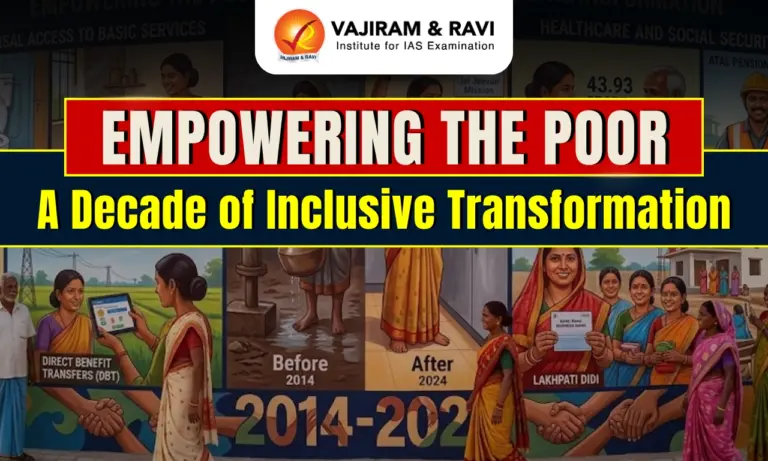
Why in the news?: Recent government data indicates that nearly 25 crore people moved out of multidimensional poverty between 2013-14 and 2022-23, highlighting the impact of sustained welfare interventions, social protection measures, infrastructure expansion, and technology-enabled governance over the last decade.
From Antyodaya to Sarvodaya: Towards Inclusive and Sustainable Development
Over the past decade, India’s poverty alleviation strategy has evolved from welfare-based support to empowerment-oriented development. Through targeted interventions in water, sanitation, housing, healthcare, education, livelihoods, financial inclusion, and digital governance, the State has sought to improve both the quality of life and economic opportunities for vulnerable households. This comprehensive approach has contributed to a sharp decline in multidimensional poverty from 29.17% in 2013-14 to 11.28% in 2022-23, enabling nearly 25 crore people to escape poverty.
Water, Sanitation and Basic Service Delivery
Access to clean drinking water, sanitation facilities, and hygiene services has emerged as a key pillar of India’s strategy to improve living standards and public health.
Jal Jeevan Mission (JJM)
Launched in 2019, the Jal Jeevan Mission aims to provide safe and adequate drinking water through Functional Household Tap Connections to every rural household.
-
- Rural tap water coverage increased from 3.23 crore households in August 2019 to 15.84 crore households by May 2026.
- Today, around 81.87% of rural households have access to tap water connections.
- More than 2.77 lakh villages have achieved 100% tap water coverage under the Har Ghar Jal initiative.
- The mission has significantly reduced the burden on rural women who traditionally spent several hours each day collecting water.
- Special attention has been given to Aspirational Districts and Aspirational Blocks, helping bridge regional development gaps.
- The programme has also expanded tap water access to schools, Anganwadi Centres, Gram Panchayats, and Community Health Centres, thereby improving health and educational outcomes.
Swachh Bharat Mission (Grameen and Urban)
The Swachh Bharat Mission was launched to eliminate open defecation, improve sanitation infrastructure, and promote scientific waste management.
- More than 12.11 crore household toilets have been constructed in rural India.
- Rural sanitation coverage increased from 39% in 2014 to 100%, leading to the declaration of India as Open Defecation Free (ODF) in 2019.
- As of March 2026, over 5 lakh villages had achieved ODF Plus status through effective solid and liquid waste management.
- More than 5.31 lakh villages have operational solid waste management systems, while 5.50 lakh villages have liquid waste management systems.
- In urban areas, door-to-door waste collection increased from 43% in 2014 to 98% in 2026, while waste processing rose from 16% to 82%.
- Improved sanitation has contributed to better public health, reduced disease burden, and enhanced dignity, particularly for women and children.


Energy Access
Access to clean cooking fuel and reliable electricity has improved living conditions, reduced health risks, and enhanced economic opportunities.
Pradhan Mantri Ujjwala Yojana (PMUY)
Launched in 2016, Pradhan Mantri Ujjwala Yojana (PMUY) provides free LPG connections to women from economically weaker households.
- More than 10.57 crore LPG connections have been provided under the scheme.
- Total LPG connections in the country increased from 14.52 crore in 2014 to 33.39 crore in 2026.
- The scheme has reduced dependence on traditional fuels such as firewood and dung cakes.
- Reduced indoor air pollution has improved the health of women and children.
- Women have benefited from reduced drudgery and greater convenience in household work.
PM Surya Ghar: Muft Bijli Yojana
Launched in 2024, the PM Surya Ghar Scheme promotes rooftop solar adoption among households.
- It provides subsidies for rooftop solar installations and offers up to 300 units of free electricity per month.
- By April 2026, around 36.8 lakh households had benefited from the programme.
- The scheme reduces electricity expenses while encouraging clean and renewable energy adoption.
Universal Electrification
The government has pursued universal electrification through SAUBHAGYA and rural power infrastructure schemes.
- All willing households were electrified under SAUBHAGYA by 2019.
- Rural electricity supply increased from 12.5 hours per day in FY 2014 to 22.6 hours in FY 2025.
- Reliable electricity has improved agricultural productivity, education, healthcare delivery, and livelihood opportunities.
Healthcare and Nutrition Security
Improving access to affordable healthcare and food security has been critical to reducing vulnerability among poor households.
Ayushman Bharat
Ayushman Bharat seeks to provide financial protection against catastrophic health expenditure. The scheme provides annual health insurance coverage of ₹5 lakh per family to economically vulnerable households.
- More than 43.93 crore Ayushman Cards have been issued.
- Hospital admissions increased from 29.96 lakh in 2019 to 12.03 crore by May 2026.
- Treatments worth more than ₹1.80 lakh crore have been provided under the scheme.
- More than 1.85 lakh Ayushman Arogya Mandirs have delivered primary healthcare services, facilitating over 540 crore patient visits.
- The Ayushman Bharat Digital Mission has created 88.33 crore ABHA accounts, promoting paperless and integrated healthcare delivery.
Maternal and Child Health Interventions
A series of initiatives have strengthened maternal and child healthcare services across the country.
- Under the Pradhan Mantri Surakshit Matritva Abhiyan, over 7 crore antenatal check-ups have been conducted.
- Mission Indradhanush has immunized 5.46 crore children and 1.32 crore pregnant women.
- Maternal Mortality Ratio declined from 130 to 88 per 100,000 live births.
- Increased institutional deliveries and antenatal care coverage have improved maternal and neonatal health outcomes.
Food Security through PM Garib Kalyan Anna Yojana (PMGKAY)
Food security remains a crucial pillar of social protection.
- PMGKAY provides free foodgrains to more than 81 crore beneficiaries.
- Over 99.8% of Fair Price Shops have been automated for Aadhaar-based distribution.
- Ration cards have been fully digitized across all States and Union Territories.
- The One Nation One Ration Card (ONORC) system has enabled more than 2.07 billion transactions, benefiting migrant workers and mobile populations.
- Improved food security has contributed to reductions in stunting, wasting, and underweight prevalence among children.
Education and Human Capital Development
Education serves as a key instrument for breaking the cycle of poverty and promoting social mobility.
Samagra Shiksha
Samagra Shiksha aims to improve access, equity, and quality across the school education system.
- More than 1.49 lakh digital and ICT initiatives, including smart classrooms, have been implemented.
- Around 25,000 schools have been covered under skill education programmes.
- More than 97% of schools now have functional girls’ toilets.
- Female primary school dropout rates declined sharply from 4.6% in 2013-14 to 0.3% in 2024-25.
- Improved infrastructure and digital learning facilities have strengthened educational participation.
Beti Bachao Beti Padhao
The programme promotes the survival, protection, and education of the girl child.
- The sex ratio improved from 943 females per 1,000 males in 2011 to 1,020 in 2021.
- Girls’ secondary school enrolment increased from 75.51% to 80.2% between 2014-15 and 2024-25.
- The initiative has contributed to greater gender equality and educational participation.
Kasturba Gandhi Balika Vidyalayas and Digital Learning
Special interventions have improved educational access for girls and disadvantaged groups.
- Student enrolment in KGBVs increased from 3.52 lakh to 7.11 lakh between 2014-15 and 2024.
- PM eVidya, SWAYAM, and DIKSHA have expanded access to digital education and quality learning resources across the country.
Housing and Basic Infrastructure
Affordable housing and improved civic infrastructure play an important role in enhancing social security and quality of life.
Pradhan Mantri Awas Yojana (PMAY)
Pradhan Mantri Awas Yojana (PMAY) seeks to ensure housing for all through urban and rural housing programmes.
- More than 98.10 lakh houses have been completed under PMAY-Urban.
- Around 3.03 crore houses have been completed under PMAY-Gramin.
- Nearly 96% of urban houses and 75% of rural houses are registered in the name of women, promoting women’s empowerment and asset ownership.
- Access to pucca housing has improved living standards and social security for poor households.
AMRUT
The Atal Mission for Rejuvenation and Urban Transformation focuses on strengthening urban infrastructure.
- The mission has facilitated more than 2.53 crore tap water connections.
- Nearly 7,943 urban infrastructure projects have been completed.
- Investments in urban services have improved water supply, drainage, and overall urban living conditions.
Connectivity and Digital Inclusion
Improved connectivity enables access to markets, services, information, and opportunities.
Pradhan Mantri Gram Sadak Yojana (PMGSY)
PMGSY has transformed rural connectivity across the country.
- Nearly 99.6% of eligible habitations have been connected through all-weather roads.
- More than 6.96 lakh facilities, including schools, health centres, and markets, have been connected.
- Better road connectivity has improved access to healthcare, education, and economic opportunities.
BharatNet and Digital Governance
Digital infrastructure has become an important tool for inclusive development.
- BharatNet has connected more than 2.19 lakh Gram Panchayats through broadband infrastructure.
- eGramSwaraj has strengthened transparency and accountability in Panchayati Raj Institutions.
- Digital governance has improved service delivery and citizen participation at the grassroots level.
Expansion of Digital Payments
India’s digital payments ecosystem has significantly expanded financial inclusion.
- UPI transactions have grown from a nascent platform to over 2,100 crore monthly transactions.
- Digital payments have reduced transaction costs and enhanced access to financial services.
- Technology-driven systems have improved the efficiency of welfare delivery and financial transactions.
Livelihood Promotion and Employment Generation
The focus has gradually shifted from welfare support alone to creating sustainable livelihood opportunities and economic empowerment.
Deendayal Antyodaya Yojana – National Rural Livelihoods Mission (DAY-NRLM)
DAY-NRLM promotes self-employment and livelihood diversification through women-led Self-Help Groups (SHGs).
- Women associated with SHGs increased from 2.37 crore to 10 crore.
- The number of SHGs expanded from 21.31 lakh to 91.75 lakh.
- Access to institutional credit and livelihood opportunities has significantly improved.
- Initiatives such as Lakhpati Didi are helping rural women become successful entrepreneurs.
Skill Development Initiatives
Skill development programmes aim to improve employability and support economic self-reliance.
- Under DDU-GKY, trained candidates increased from 43,038 in 2014-15 to 17.71 lakh in 2025-26.
- More than 1.64 crore youth have received training under Pradhan Mantri Kaushal Vikas Yojana.
- Training programmes increasingly focus on emerging technologies, future skills, and industry requirements.
Employment Guarantee and Labour Security
Employment guarantee programmes continue to provide livelihood support to rural households.
- Person-days generated under the Viksit Bharat–Guarantee for Rozgar and Ajeevika Mission increased significantly over the last decade.
- Women’s participation increased from 48% to over 58%, reflecting stronger economic inclusion.
- The eShram portal has registered over 31.64 crore unorganized workers, strengthening social protection coverage.
Financial Inclusion and Entrepreneurship Development
Access to banking, credit, and enterprise support has strengthened economic resilience among vulnerable groups.
Pradhan Mantri Jan Dhan Yojana (PMJDY)
PMJDY has laid the foundation for financial inclusion and direct benefit transfers.
- Beneficiaries increased from 17.9 crore in 2015 to 58.16 crore in 2026.
- Total deposits in Jan Dhan accounts exceeded ₹3 lakh crore.
- The scheme has enabled efficient delivery of subsidies and welfare benefits.
Pradhan Mantri MUDRA Yojana
The scheme supports micro and small enterprises through collateral-free loans.
- More than 57 crore loans have been sanctioned since inception.
- Around 66% of loans have been provided to women entrepreneurs.
- The scheme has promoted self-employment and grassroots entrepreneurship.
PM SVANidhi, PM Vishwakarma and Stand-Up India
These initiatives support vulnerable entrepreneurs and traditional workers.
- PM SVANidhi provides working capital support to street vendors.
- PM Vishwakarma offers training, toolkit assistance, and credit support to artisans and craftspeople.
- Stand-Up India promotes entrepreneurship among women and SC/ST communities through institutional credit support.
Inclusive Development of Tribal Communities
Recognising the persistent socio-economic challenges faced by tribal communities, the government has adopted a targeted and integrated approach to improve infrastructure, education, healthcare, connectivity, and livelihood opportunities in tribal regions.
Pradhan Mantri Janjati Adivasi Nyaya Maha Abhiyan (PM-JANMAN)
- Launched in 2023 to accelerate the development of 75 Particularly Vulnerable Tribal Groups (PVTGs) through a convergent and saturation-based approach.
- Focuses on providing housing, drinking water, healthcare, education, road connectivity, electrification, and livelihood opportunities in remote tribal areas.
- As of February 2026, the mission has completed 2.66 lakh houses, 1,949 km of roads, and deployed 750 Mobile Medical Units.
- It has expanded piped drinking water access to 8,473 villages, electrified 1.36 lakh households, and operationalised 2,390 Anganwadi Centres.
Pradhan Mantri Janjatiya Unnat Gram Abhiyan (PM-JUGA)
- Launched in 2024, also known as the Dharti Aaba Janjatiya Gram Utkarsh Abhiyan, to promote holistic development of tribal villages through convergence of multiple schemes.
- Emphasises housing, roads, electrification, telecom connectivity, drinking water, and improved service delivery in tribal areas.
- By April 2026, 12.89 lakh houses and 2,411 km of roads had been sanctioned under the programme.
- More than 2.87 lakh households were electrified, 6,305 villages received tap water coverage, and telecom connectivity was sanctioned for 5,252 villages.
Pradhan Mantri Janjatiya Vikas Mission (PM-JVM)
- Launched in 2021 to strengthen tribal livelihoods through value addition, entrepreneurship, and sustainable utilisation of forest resources.
- Implemented through TRIFED, the mission promotes tribal products, traditional crafts, and forest-based economic activities.
- Between 2022 and 2025, TRIFED organised 79 artisan melas and 50 exhibitions, enhancing market access for tribal producers.
- A total of 1,146 Van Dhan Vikas Kendras have been sanctioned to support value addition and income generation from minor forest produce.
Eklavya Model Residential Schools (EMRS)
- Established to provide quality residential education to Scheduled Tribe students in remote and educationally backward areas.
- The number of operational schools increased from 129 in 2014-15 to 499 by May 2026.
- These schools currently serve more than 1.54 lakh tribal students, improving access to quality education and reducing educational disparities.

 Last updated on Oct, 2026
→ UPSC 2027 Notification will be released on 13 January 2027 at upsconline.nic.in.
→ Asian Games 2026 are being held in Aichi-Nagoya, Japan, from 19 September to 4 October.
→ Check Nobel Prize 2026 Winners List here.
→ Download PIB PRiSM Monthly Magazine 2026 here.
→ Check UPSC Monthly Current Affairs Magazine The Recitals here.
→ Check out the latest UPSC Syllabus here.
→ Download UPSC Model Answers for Mains 2026
→ UPSC Mains Question Paper 2026 is out now for Essay & GS Paper 1, 2, 3 & 4.
→ UPSC Calendar 2027 has been released.
→ Enroll in Vajiram & Ravi’s UPSC Mains Test Series 2027 for structured answer writing practice, expert evaluation, and exam-oriented feedback.
→ Join Vajiram & Ravi’s UPSC Mentorship Program 2027 for personalized guidance, strategy planning, and one-to-one support from experienced mentors.
→ Go through the UPSC Mains Previous Year Papers to enhance your preparation.
→ UPSC has released UPSC Toppers List 2025 with the Civil Services final result on its official website.
→ Also check Best UPSC Coaching in India
Empowering the Poor, A Decade of Inclusive Transformation FAQs
Q1. What is meant by multidimensional poverty?+
Q2. How many people moved out of multidimensional poverty in India between 2013-14 and 2022-23?+
Q3. How has India reduced multidimensional poverty over the last decade?+
Q4. What is meant by inclusive development?+
Q5. How do targeted interventions for women and tribal communities contribute to inclusive growth?+