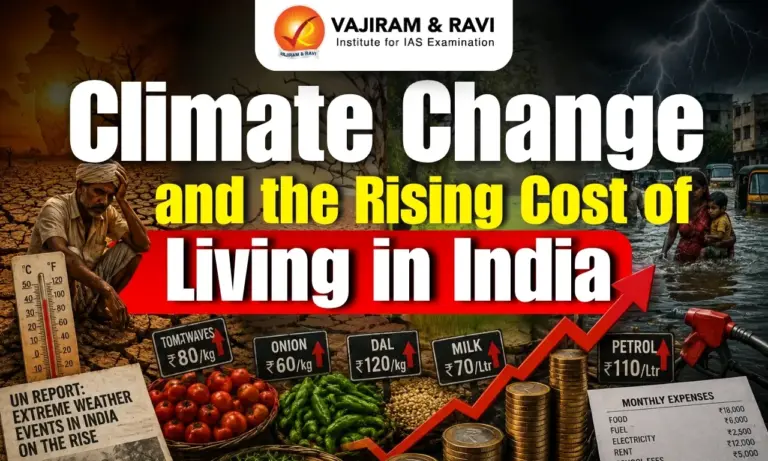
Climate change is often discussed as a long-term challenge linked to net-zero targets and future generations. However, for millions of Indians, climate change has already become an immediate economic reality. From food and electricity to water and healthcare, a warming climate is steadily increasing the cost of daily living, turning environmental stress into a household budget crisis.
About Climate Change
Climate change refers to long-term changes in temperature, rainfall patterns, and weather systems caused mainly by greenhouse gas emissions. In India, it is increasingly visible through heatwaves, irregular monsoons, floods, droughts, and extreme weather events.
Climate Change and Inflation
One of the earliest economic impacts of climate change is visible through rising inflation.
- Food and beverages account for nearly 45.86% of India’s Consumer Price Index (CPI), making household budgets highly sensitive to climate shocks.
- Economists have warned that the combination of intense heatwaves and weaker monsoons could push inflation above 5%, largely through food and energy costs.
- Rising prices of essential commodities reduce purchasing power, particularly among low-income households.


Agrarian Distress and Livelihood Insecurity
Climate change is increasingly undermining agricultural livelihoods and rural economic stability.
- Rising temperatures, erratic rainfall, droughts, and floods are reducing farm productivity and increasing uncertainty for farmers.
- Climate-vulnerable states such as Rajasthan, Madhya Pradesh, Uttar Pradesh, Maharashtra, and Chhattisgarh are expected to witness severe livelihood stress.
- These regions already face structural challenges such as low farm incomes, indebtedness, and recurring farmer suicides.
- Climate change therefore not only increases costs but also weakens the income base of rural households.
Food Insecurity and Food Inflation
Agricultural distress directly affects food availability and affordability.
- Delayed monsoons and rainfall deficits disrupt sowing activities and reduce agricultural output.
- Even when rainfall is adequate, prolonged heat stress lowers crop productivity and affects crop quality.
- In 2023, a rainfall deficit of around 6% reduced the sown area under pulses and oilseeds. Consequently, retail prices of rice, wheat, and pulses increased by 6–15% year-on-year by October 2023.
- Repeated climate shocks create a vicious cycle of lower production, supply disruptions, hoarding, and speculation, ultimately increasing food inflation.
- Thus, climate change is transforming food security from an availability challenge into an affordability challenge.
Declining Living Standards
The combined effect of falling incomes and rising expenditure is reducing living standards across vulnerable sections.
- The World Bank estimates that changing climatic conditions could reduce India’s GDP by up to 2.8% by 2050 and depress living standards for nearly half of the population.
- Households face a double burden of declining agricultural incomes and increasing expenditure on food, energy, water, and healthcare.
- Poor and marginal households are often forced to resort to debt, distress migration, reduced food consumption, and withdrawal of children from education.
- Climate change is therefore not merely an environmental challenge but a direct threat to economic security and human well-being.
Impact on Energy Costs
Increasing temperatures are making cooling a necessity rather than a luxury.
- During the May 2026 heatwave, India’s power demand touched a record 270.8 GW as millions relied on fans, coolers, and air conditioners to cope with extreme heat.
- Meeting this demand often requires expensive coal and imported fuels. These additional costs are eventually transferred to consumers through higher tariffs and surcharges.
- For middle-class households, higher electricity bills may be inconvenient; for low-income families and informal workers, they often mean sacrificing expenditure on food, education, or healthcare.
Water Scarcity
Climate change is intensifying water stress across both rural and urban India.
- Changing rainfall patterns and groundwater depletion are making water increasingly scarce.
- Many families spend more time and resources securing drinking water as wells and local sources dry up.
- In urban areas, water scarcity has led to the emergence of a “tanker economy”, where households without reliable municipal supply depend on expensive private vendors.
Climate Change and Public Health
Climate change is also imposing a growing health burden on households.
- Heat stress, worsening air quality, and the spread of climate-sensitive diseases are increasing out-of-pocket health expenditure, which is already high in India.
- Rural women often bear a disproportionate burden. They walk longer distances for water, work in hotter conditions, and shoulder caregiving responsibilities when family members fall ill.
- Every day lost to illness translates into lost wages, while every hospital visit places additional pressure on already fragile household finances.
Climate Change as a Regressive Tax
The economic burden of climate change is not distributed equally.
- Research shows that marginalised castes and tribal communities have lower access to climate-adaptive technologies such as irrigation and resilient farming practices.
- Those with larger landholdings, greater capital, and stronger social networks can better absorb climate shocks.
- In contrast, poorer households often resort to debt, distress migration, reduced food consumption, and withdrawal of children from education.
In this sense, climate change acts like a regressive tax, taking the most from those who contributed the least to the problem.
Government Approach and Its Limitations
Policy responses have largely focused on short-term crisis management rather than long-term resilience.
Measures such as export restrictions during food inflation, relief packages after floods or droughts, and temporary power subsidies during heatwaves provide immediate relief but do not address the structural drivers of rising living costs.
While think tanks and policy institutions increasingly estimate long-term GDP losses from climate change, the everyday burden of rising household expenses remains insufficiently reflected in public policy debates.
The Way Forward
Addressing climate change requires treating it as both an environmental and a cost-of-living issue.
- Promote climate-resilient agriculture: Scaling up initiatives such as Andhra Pradesh Community Natural Farming (APCNF) can reduce vulnerability to weather shocks.
- Strengthen urban climate resilience: Heat-action plans, cool-roof programmes, and climate-sensitive urban planning must become mainstream.
- Invest in universal basic services: Affordable access to water, healthcare, public transport, and energy can protect vulnerable households from climate-induced costs.
- Improve adaptive capacity: Greater access to irrigation, insurance, weather information, and climate-resilient technologies is essential.
- Ensure climate justice: Policies should focus on protecting small farmers, informal workers, women, and marginalised communities who bear the greatest burden.

 Last updated on Oct, 2026
→ UPSC 2027 Notification will be released on 13 January 2027 at upsconline.nic.in.
→ Check Nobel Prize 2026 Winners List here.
→ Download PIB PRiSM Monthly Magazine 2026 here.
→ Check UPSC Monthly Current Affairs Magazine The Recitals here.
→ Check out the latest UPSC Syllabus here.
→ Download UPSC Model Answers for Mains 2026
→ UPSC Mains Question Paper 2026 is out now for Essay & GS Paper 1, 2, 3 & 4.
→ UPSC Calendar 2027 has been released.
→ Enroll in Vajiram & Ravi’s UPSC Mains Test Series 2027 for structured answer writing practice, expert evaluation, and exam-oriented feedback.
→ Join Vajiram & Ravi’s UPSC Mentorship Program 2027 for personalized guidance, strategy planning, and one-to-one support from experienced mentors.
→ Go through the UPSC Mains Previous Year Papers to enhance your preparation.
→ UPSC has released UPSC Toppers List 2025 with the Civil Services final result on its official website.
→ Also check Best UPSC Coaching in India
Climate Change and the Rising Cost of Living in India FAQs
Q1. How does climate change increase the cost of living in India?+
Q2. Why is India’s food inflation highly vulnerable to climate change?+
Q3. How does climate change worsen agrarian distress?+
Q4. Why is climate change considered regressive in its economic impact?+
Q5. Why is climate change also a governance and development challenge?+